


After a car accident in Miami, prioritize safety by moving to a safe location and checking for injuries. Call the police, 911 if it is an emergency situation. Exchange information with all parties, document the scene with photos, and notify your insurance company. Seek medical attention within 14 days to preserve your Florida PIP insurance benefits.
Contact the experienced Miami personal injury attorneys at Jimenez Mazzitelli Mordes at (305) 960-5155 for a free consultation to protect your rights and maximize your compensation.
Being involved in a car accident in Miami can be overwhelming and disorienting. Between navigating South Florida’s busy highways like I-95 and the Palmetto Expressway, dealing with afternoon thunderstorms, and the challenges of tourist traffic, Miami drivers face unique risks on our roadways. According to recent statistics, Miami-Dade County consistently ranks among the highest in Florida for traffic accidents.
Whether you’ve been in a fender bender on Biscayne Boulevard or a serious collision on the Dolphin Expressway, knowing exactly what steps to take immediately after an accident can protect your health, preserve your legal rights, and maximize your potential compensation. This comprehensive guide provides Miami-specific information, local contacts, and actionable steps to take after any car accident in Miami-Dade County.
Immediate Safety Steps at the Accident Scene
Your priority after any collision is ensuring everyone’s safety. Here’s what to do in those critical first moments:
Stop Your Vehicle Immediately
Florida law requires you to stop your vehicle at the scene of an accident. Leaving the scene, even for a minor accident, can result in serious criminal charges, including hit-and-run violations. Pull over to the shoulder or move to a safe location if possible, but do not leave the immediate area.
Turn on Your Hazard Lights
Activate your vehicle’s hazard lights immediately to alert other drivers and prevent additional collisions, especially on Miami’s high-speed expressways and busy arterial roads like Flagler Street or Coral Way.
Check for Injuries
Assess yourself, your passengers, and occupants of other vehicles for injuries. Look for signs of trauma, bleeding, loss of consciousness, difficulty breathing, or complaints of pain. Even if injuries seem minor, many serious conditions like internal bleeding or concussions may not be immediately apparent.
Move to Safety if Possible
If the vehicles are drivable and no one is seriously injured, Florida law allows you to move vehicles out of traffic lanes to prevent additional accidents. However, try to take quick photos of the vehicle positions before moving them if it’s safe to do so. In Miami’s heavy traffic, leaving vehicles in the roadway can be extremely dangerous.
Turn Off Engines
Switch off all vehicle engines to reduce the risk of fire, especially if you smell gasoline or see fluid leaking from the vehicles.
Set Up Warning Devices
If you have flares, reflective triangles, or cones in your vehicle, place them behind your car to warn approaching traffic. This is particularly crucial on highways or during Miami’s frequent afternoon rain showers when visibility is reduced.
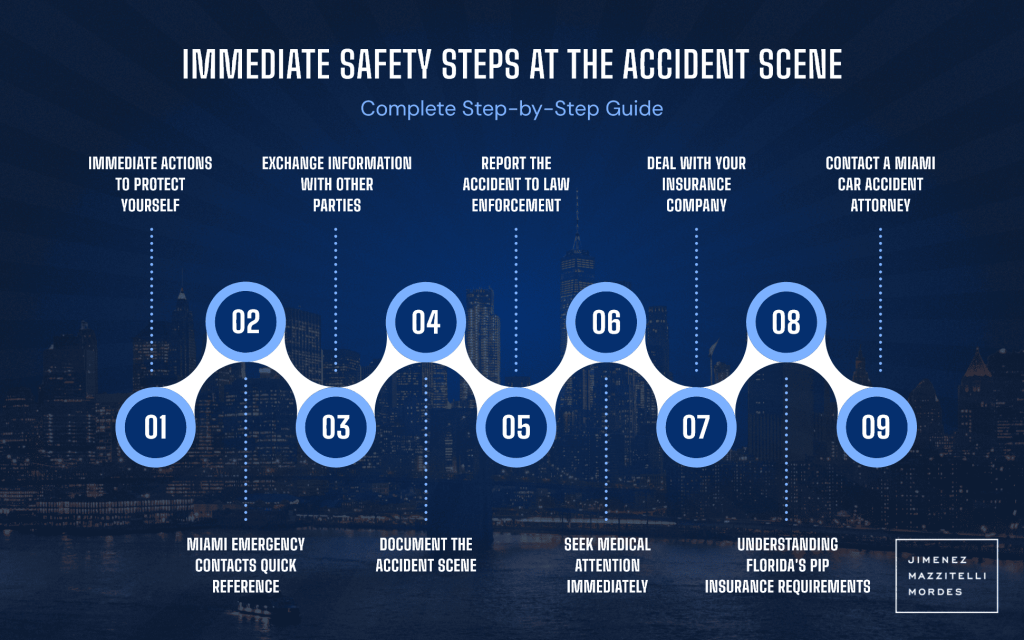
When to Call 911 in Miami
Understanding when to call 911 is crucial. In Miami-Dade County, you should immediately call 911 if the accident involves:
- Any injuries or complaints of pain – Even if someone just says they feel “a little sore,” call 911
- Death or suspected serious injury
- An unconscious person
- A hit-and-run driver – Someone left the scene without providing information
- A driver under the influence – You suspect alcohol or drug impairment
- Blocked roadways – Your accident is obstructing traffic on major roads
- Hazardous conditions – Leaking fuel, fire, or downed power lines
- A disabled vehicle – Your car cannot be safely moved from the roadway
Important Miami Emergency Contacts:
- Emergency (Police, Fire, Ambulance): 911
- Miami Police Non-Emergency: (305) 579-6111
- Miami-Dade Police Non-Emergency: (305) 476-5423
- Florida Highway Patrol: FHP (347) from your mobile phone
- Miami Beach Police Non-Emergency: (305) 673-7900
- Coral Gables Police Non-Emergency: (305) 442-1600
When calling 911, be prepared to provide:
- Your exact location (cross streets, mile markers, or landmarks)
- The number of vehicles involved
- Whether anyone is injured
- If vehicles are blocking traffic
- Any immediate hazards (fire, leaking fuel, etc.)
Exchange Information with Other Parties
While waiting for police or emergency services, exchange information with all other drivers involved. Under Florida law, you must provide and collect certain information:
Information to Exchange:
- Full legal name
- Current address and phone number
- Driver’s license number and state
- Vehicle license plate number
- Vehicle insurance company name
- Insurance policy number
- Vehicle identification number (VIN)
- Vehicle make, model, year, and color
Also Collect:
- Names and contact information of all passengers in every vehicle
- Names, addresses, and phone numbers of witnesses
- Names and badge numbers of responding police officers
- The police report number (if one is filed)
Professional Tip from Jimenez Mazzitelli Mordes: Be polite but cautious when speaking with other drivers. Exchange only factual information – do not discuss fault, apologize, or make statements about the cause of the accident. Anything you say can potentially be used against you later. Simply exchange the required information and let the evidence speak for itself.
Document the Accident Scene Thoroughly
In Florida’s no-fault insurance system, documentation is critical. Your smartphone is your most valuable tool for preserving evidence. Here’s what to document:
Photographs to Take:
- All vehicles from multiple angles showing damage
- Vehicle license plates (close-up and readable)
- The overall accident scene from various perspectives
- Skid marks, debris, or fluid on the roadway
- Traffic signs, signals, and road markings
- Weather and road conditions
- Your injuries (bruises, cuts, swelling)
- Interior damage (deployed airbags, broken glass)
- The exact location with recognizable landmarks
Video Documentation:
- Walk around the entire scene, narrating what you see
- Record statements from witnesses (with their permission)
- Capture the surrounding area and traffic conditions
Written Notes to Make:
- Date and exact time of the accident
- Weather conditions (sunny, rainy, foggy – common in Miami)
- Road conditions (wet, dry, construction zones)
- Traffic patterns and estimated speed of vehicles
- Position of vehicles before and after impact
- Traffic control devices (signals, signs, yield signs)
- Your immediate physical sensations and any pain
- Exactly what happened from your perspective
Why This Matters: Insurance companies and courts rely heavily on physical evidence. Memories fade, but photographs and videos provide irrefutable documentation of the scene as it was immediately after the accident. This evidence can be crucial in establishing fault and supporting your claim.
Report the Accident to Law Enforcement
Florida law requires specific accident reporting procedures, and compliance is mandatory to avoid penalties.
Florida’s Accident Reporting Requirements:
You must call law enforcement immediately if the accident involves:
- Death or personal injury
- Any complaints of pain or discomfort
- A suspected drunk or impaired driver
- A hit-and-run situation
- Property damage of $500 or more
- A vehicle that requires towing due to damage
Miami-Area Police Departments:
City of Miami:
- Location: 400 NW 2nd Avenue, Miami, FL 33128
- Non-Emergency: (305) 579-6111
- Emergency: 911
Miami-Dade Police Department:
- Online Reporting: www.miamidade.gov/police/police-report.html
- Non-Emergency: (305) 476-5423
- For unincorporated Miami-Dade County, Town of Cutler Bay, Village of Palmetto Bay, or Town of Miami Lakes
Miami Beach Police Department:
- Location: 1100 Washington Avenue, Miami Beach, FL
- Non-Emergency: (305) 673-7900
- Accident Investigation Office: (305) 673-7888
Coral Gables Police Department:
- Non-Emergency: (305) 442-1600
Hialeah Police Department:
- Non-Emergency: (305) 687-2525
Written Crash Reports: If law enforcement does not respond to the scene (typically for minor accidents with no injuries and less than $500 damage), you still have a legal obligation. Under Florida Statute § 316.066, the driver must submit a written crash report to the Florida Department of Highway Safety and Motor Vehicles (FLHSMV) within 10 days.
How to File a Written Report:
- Visit the Florida Crash Portal at www.flhsmv.gov
- Complete the self-reporting form online
- Include all driver and vehicle information
- Document property damage estimates
- Keep a copy of your submitted report
Penalties for Failing to Report: Failing to report an accident that meets the legal criteria is a noncriminal traffic infraction treated as a nonmoving violation. You can be fined $30, and more importantly, you may face complications with your insurance claim and potential liability issues.
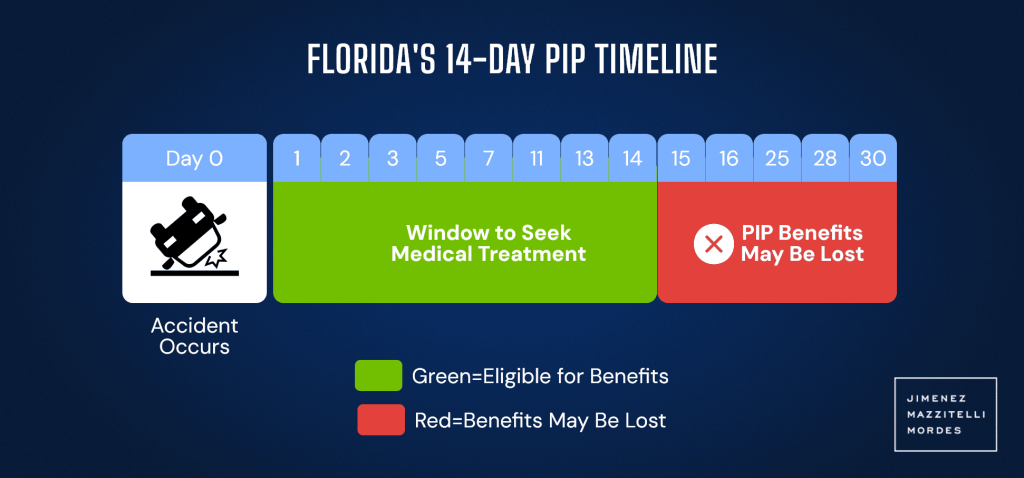
Seek Medical Attention Immediately, but no Later than 14 Days
This is one of the most critical steps for protecting both your health and your legal rights under Florida law.
The 14-Day Rule in Florida: Florida’s PIP (Personal Injury Protection) insurance law requires accident victims to seek medical treatment within 14 days of the accident to be eligible for insurance benefits. If you wait longer than 14 days, you may forfeit your right to PIP coverage for your injuries, even if those injuries are serious and clearly related to the accident.
Immediate Medical Care in Miami:
If you have any pain, discomfort, or visible injuries, go to an emergency room immediately:
Major Miami Trauma Centers:
Ryder Trauma Center at Jackson Memorial Hospital
- Address: 1800 NW 10th Avenue, Miami, FL 33136
- Phone: (305) 585-1152
- Level I Trauma Center – Handles the most serious injuries
- The premier trauma facility in Miami-Dade County
HCA Florida Kendall Hospital
- Address: 11750 Bird Road, Miami, FL 33175
- Phone: (305) 223-3000
- Level I Trauma Center for adults and pediatrics
Memorial Regional Hospital (Hollywood)
- Address: 3501 Johnson Street, Hollywood, FL 33021
- Phone: (954) 987-2000
- Level I Trauma Center serving northern Miami-Dade and Broward
University of Miami Hospital
- Address: 1400 NW 12th Avenue, Miami, FL 33136
- Phone: (305) 689-5511
Baptist Health South Florida – Multiple Locations:
- Baptist Hospital: 8900 N Kendall Drive, Miami, FL 33176 – (786) 596-1960
- South Miami Hospital: 6200 SW 73rd Street, South Miami, FL 33143 – (786) 662-4000
If Injuries Seem Minor: Even if you don’t think you need an emergency room, see a doctor within 14 days. Many injuries don’t show symptoms immediately:
- Whiplash symptoms can appear days after the accident
- Internal bleeding may not be immediately apparent
- Concussions and traumatic brain injuries can have delayed symptoms
- Soft tissue injuries often worsen over time
- Spinal injuries may not cause immediate pain
Where to Seek Treatment Within 14 Days:
- Your primary care physician
- An urgent care clinic
- A walk-in medical facility
- A chiropractor (must be a licensed DC)
- A doctor of osteopathic medicine (DO)
- An emergency room or hospital
Important Note: Under Florida law, your initial PIP-covered treatment cannot be provided solely by a massage therapist or acupuncturist. You must first see a physician, chiropractor, or other qualified medical provider.
Why the 14-Day Deadline Matters: Insurance companies use the timing of your medical treatment as evidence of the seriousness of your injuries. If you wait too long, they will argue that your injuries either didn’t exist or weren’t caused by the accident. Don’t give them this ammunition. Seek treatment promptly.
The attorneys at Jimenez Mazzitelli Mordes can help: If you’re uncertain about where to seek treatment or have questions about medical bills, call us at (305) 960-5155. We work with a network of trusted Miami medical providers and can guide you to appropriate care while protecting your legal rights.
Deal With Your Insurance Company
You must report the accident to your insurance company, but the timing and what you say matter significantly.
Important: while it is not required, we recommend you to refrain from giving a statement to any insurance company without first contacting an attorney. However If you find yourself in a position where you have to speak to the insurance company, follow these recommendations.
When to Report:
- Contact your insurance company as soon as reasonably possible after the accident
- Most policies require “prompt” or “timely” notification
- While there’s no specific deadline in the statute, delays of more than a few days can jeopardize your claim
- Report within 24-48 hours if possible
What to Report:
- Date, time, and location of the accident
- A basic description of what happened (stick to facts)
- Contact information for other drivers and witnesses
- Police report number (if one was filed)
- Extent of damage to your vehicle
- That you have or will seek medical attention
What NOT to Say to Insurance:
- Don’t speculate about who was at fault
- Don’t downplay your injuries (“I’m fine” can haunt you later)
- Don’t provide a recorded statement without consulting an attorney
- Don’t agree to a quick settlement before understanding your injuries
- Don’t sign any releases or waivers
- Don’t exaggerate or embellish the facts
Major Insurance Companies Serving Miami:
- State Farm: 1-800-STATE-FARM (1-800-782-8332)
- GEICO: 1-800-861-8380
- Progressive: 1-800-776-4737
- Allstate: 1-800-ALLSTATE (1-800-255-7828)
- USAA: 1-800-531-8722
- Nationwide: 1-877-669-6877
- Liberty Mutual: 1-800-290-8711
Critical Warning: Insurance adjusters, even from your own company, are trained to minimize payouts. They may seem friendly and helpful, but their goal is to settle your claim for as little as possible. Before providing a recorded statement or accepting any settlement offer, consult with the Miami personal injury attorneys at Jimenez Mazzitelli Mordes.
Understanding Florida’s PIP Insurance Requirements
Florida is a “no-fault” insurance state, which makes it unique from most other states. Understanding how Florida’s Personal Injury Protection (PIP) system works is essential.
What is PIP Insurance? Personal Injury Protection (PIP) is mandatory insurance coverage that all Florida drivers must carry. It provides benefits regardless of who caused the accident – hence “no-fault” insurance.
Florida’s Minimum Requirements:
- $10,000 in Personal Injury Protection (PIP)
- $10,000 in Property Damage Liability (PDL)
What PIP Covers:
- 80% of all reasonable medical expenses up to your policy limit
- 60% of lost wages if you cannot work due to your injuries
- 100% of replacement services (housekeeping, childcare, etc.)
- Up to $5,000 in death benefits to beneficiaries
Who is Covered Under Your PIP:
- You (the policyholder)
- Household family members (if they don’t have their own policy)
- Passengers in your vehicle at the time of the accident
- You, as a pedestrian or bicyclist, are struck by a vehicle (if you own a car)
The 14-Day Treatment Deadline: As mentioned earlier, you must seek medical treatment within 14 days to be eligible for PIP benefits. This is a hard deadline that cannot be extended except in cases of severe injury or incapacitation.
PIP Benefits Based on Injury Severity:
- Emergency Medical Condition: Full $10,000 available for medical expenses
- Non-Emergency Medical Condition: Only $2,500 available for medical expenses
This is why getting a proper medical diagnosis is crucial. An emergency room physician or doctor must document the nature and extent of your injuries to unlock the full PIP benefits.
When You Can Go Beyond PIP: Florida’s no-fault system prevents most injury lawsuits, but you can file a claim against the at-fault driver’s insurance (or sue them directly) if:
- Your medical bills exceed $10,000
- You suffered a permanent injury
- You experienced permanent scarring or disfigurement
- You lost a significant bodily function
- You suffered a permanent disability
The experienced attorneys at Jimenez Mazzitelli Mordes can evaluate whether your case meets the “serious injury threshold” to pursue additional compensation beyond PIP benefits.
Contact a Miami Car Accident Attorney
While not every fender bender requires an attorney, you should strongly consider legal representation if:
- Anyone was injured in the accident
- Medical bills exceed $2,500
- You have permanent injuries or scarring
- You cannot work due to your injuries
- The insurance company denies your claim
- You’re being blamed for an accident you didn’t cause
- You were hit by an uninsured driver
- The other driver was a commercial vehicle (truck, Uber, Lyft, bus)
- Multiple vehicles were involved
- Liability is disputed
Why Choose Jimenez Mazzitelli Mordes?
The Miami personal injury attorneys at Jimenez Mazzitelli Mordes have extensive experience handling car accident cases throughout Miami-Dade County. We understand Florida’s complex no-fault insurance laws and know how to navigate Miami’s local courts and insurance companies.
We Provide:
- Free initial consultations – No cost to discuss your case
- No fees unless we win – We work on contingency
- Aggressive representation – We fight for maximum compensation
- Local knowledge – We know Miami’s courts, judges, and insurance companies
- Bilingual services – Spanish-speaking attorneys available
- Personalized attention – You’re not just a case number
Contact Us Today: Jimenez Mazzitelli Mordes
Phone: (305) 960-5155
Website: myfloridalitigators.com
Free Consultation Available
Don’t wait to protect your rights. Florida’s statute of limitations gives you only four years from the date of the accident to file a personal injury lawsuit, but evidence disappears, and memories fade quickly. The sooner you contact us, the better we can preserve evidence and build your case.
What NOT to Do After an Accident
Knowing what to avoid is just as important as knowing what to do:
Never:
- Leave the scene of an accident (it’s a crime)
- Apologize or admit fault (even saying “I’m sorry” can be used against you)
- Sign anything from the other driver or their insurance company without reading it carefully
- Post about the accident on social media (insurance companies monitor Facebook, Instagram, and Twitter)
- Accept the first settlement offer without consulting an attorney
- Provide a recorded statement to the other driver’s insurance without legal advice
- Agree to handle things “without insurance” to save the other driver money
- Ignore pain or delay medical treatment
- Repair or dispose of your vehicle before it’s been inspected
- Talk extensively about the accident with anyone except your attorney
- Exaggerate or lie about your injuries
- Miss medical appointments or fail to follow treatment plans
Social Media Warning: Insurance companies routinely search social media for evidence to devalue your claim. A picture of you smiling at a family gathering can be twisted to argue you’re not really injured. The safest policy: don’t post anything about your accident or activities until your case is resolved.
Conclusion
Car accidents are traumatic events that can have lasting physical, financial, and emotional impacts. Whether you’ve been in a minor fender bender in Coconut Grove or a serious collision on the Dolphin Expressway, taking the right steps immediately after the accident can make all the difference in your recovery and your ability to obtain fair compensation.
Remember these critical takeaways:
- Prioritize safety – Check for injuries and move to a safe location
- Call 911 when required by law
- Document everything with photos, videos, and written notes
- Exchange information, but don’t admit fault
- Seek medical treatment within 14 days to preserve your PIP benefits
- Report to your insurance, but be careful with your statements
- Contact an experienced Miami car accident attorney before accepting any settlement
The Miami personal injury lawyers at Jimenez Mazzitelli Mordes have been fighting for accident victims throughout Miami-Dade County for years. We understand Florida’s complex no-fault insurance system, we know how to deal with insurance companies that try to minimize payouts, and we’re committed to obtaining maximum compensation for our clients.
Don’t face the insurance companies alone. Call Jimenez Mazzitelli Mordes today at (305) 960-5155 for your free, no-obligation consultation. We’re here to help you navigate the legal process and fight for the compensation you deserve.Visit us at myfloridalitigators.com to learn more about how we can help you recover from your car accident injuries and get your life back on track.
Frequently Asked Questions
Do I need to call the police for a minor accident in Miami?
Florida law requires calling police if there are injuries, suspected impairment, a hit-and-run, or property damage over $500. For minor accidents with no injuries and minimal damage, drivers may exchange information and file a written report with FLHSMV within 10 days. Still, calling the police can create an official record and help protect you if issues arise later.
How long do I have to file a claim after a car accident in Florida?
You should notify your insurance company within days of the accident. Florida law allows four years from the accident date to file personal injury or property damage lawsuits. Even so, it’s best to act quickly, as evidence and witness memories can fade.
What if the other driver doesn’t have insurance in Miami?
If the at-fault driver is uninsured, you may use your Uninsured Motorist (UM) coverage if you have it. You can also pursue a claim against the driver personally, though recovery may be difficult. Your PIP coverage will still cover medical expenses up to your policy limits.
Can I choose my own doctor after a car accident in Florida?
Yes, you can choose your own doctor. However, your PIP insurer may offer better coverage if you use providers within their network. Going out-of-network may result in higher out-of-pocket costs or reimbursement challenges.
What if my injuries don’t show up until days after the accident?
Delayed symptoms are common with injuries like whiplash or concussions. Florida’s 14-day rule requires you to see a doctor within 14 days to preserve PIP benefits, even if symptoms appear later. Don’t delay medical care.
How much is my Miami car accident case worth?
Case value depends on factors such as injury severity, medical bills, lost wages, long-term effects, available insurance, and fault. The attorneys at Jimenez Mazzitelli Mordes offer free case evaluations to discuss your specific situation.
What if I was partially at fault for the accident?
Florida uses a pure comparative negligence system. You can still recover damages, but your compensation is reduced by your percentage of fault. An attorney can help limit how much fault is assigned to you.
Should I accept the insurance company’s first settlement offer?
Usually not. First offers are often much lower than the true value of your claim. Once you accept and sign a release, you cannot seek additional compensation later, even if your injuries worsen.
How long will my car accident case take to resolve?
Simple cases may settle within a few months, while more complex cases can take a year or longer. Your attorney at Jimenez Mazzitelli Mordes will aim to resolve your case efficiently while pursuing fair compensation.
What if the accident happened on a Miami highway or interstate?
Accidents on major highways like I-95, I-395, SR 826, SR 836, or the Florida Turnpike are handled by Florida Highway Patrol. Call 911 or *FHP (*347). The same reporting rules apply, but FHP will investigate and prepare the crash report.