
Florida injured workers navigate two distinct legal systems when seeking compensation for workplace accidents. Workers’ compensation acts as a no-fault safety net providing immediate medical care and partial wage replacement, while personal injury claims require proving another party’s negligence to recover broader damages like pain and suffering. Understanding the difference between these two claims ensures injured Floridians maximize their financial recovery without jeopardizing their legal rights.
Key Takeaways
- Florida workers’ compensation operates as a no-fault system. Injured workers receive medical and wage benefits regardless of who caused the accident, but they generally cannot sue their direct employers for pain and suffering.
- Personal injury claims require proving negligence. Injured individuals must demonstrate that a third party breached a duty of care, which directly caused the injury and resulting financial damages.
- Third-party claims allow for broader financial recovery. If a party other than the employer (like a subcontractor or equipment manufacturer) causes the accident, the injured worker can file a personal injury lawsuit to claim pain and suffering alongside their workers’ comp benefits.
- Florida enforces a 50% modified comparative negligence rule. Injured parties barred from recovering personal injury damages if they hold more than 50% of the fault for the accident.
- Proper claim coordination prevents financial penalties. Workers’ compensation insurance carriers place liens on third-party personal injury settlements, requiring precise legal calculation using the Manfredo formula to protect the injured worker’s net payout.
Quick Answer: Why Workers’ Comp And Personal Injury Claims Differ
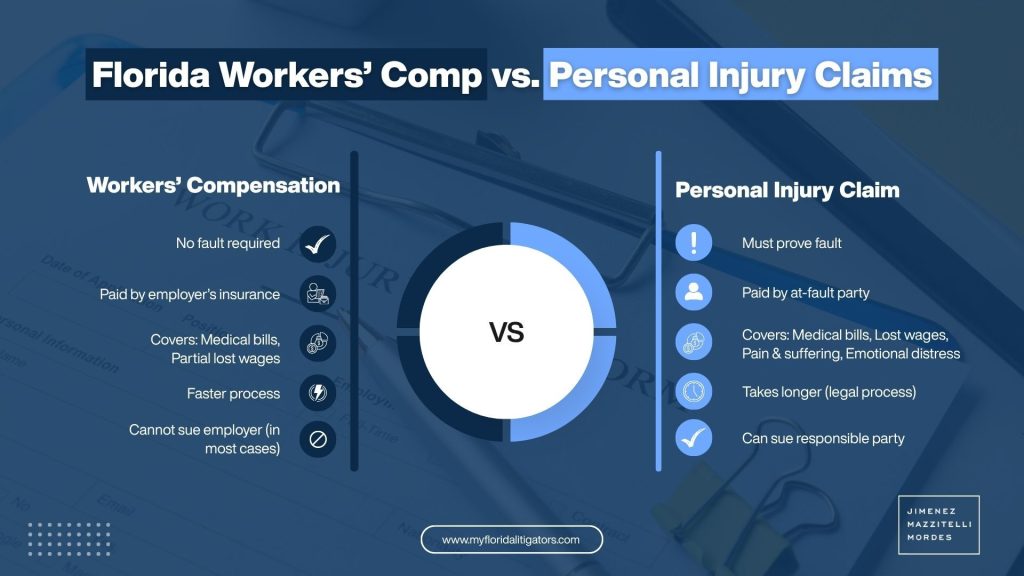
Workers’ compensation and personal injury claims serve different legal purposes in Florida. Workers’ compensation provides guaranteed benefits to injured employees without the need for a lawsuit, while personal injury claims exist to hold negligent parties accountable for the full extent of a victim’s losses.
Workers’ Comp Usually Covers Job-Related Injuries Regardless Of Fault
Florida Chapter 440 governs the state’s workers’ compensation system. This system functions as a no-fault insurance program. If an employee suffers an injury while performing work duties, the employer’s insurance carrier pays for authorized medical treatment and a portion of lost wages.
The injured employee does not need to prove the employer acted carelessly. Even if the employee caused the accident through a simple mistake, the workers’ compensation system still provides benefits. The Florida Division of Workers’ Compensation (DWC) reported processing over 3.7 million medical bill records during the 2023–2024 fiscal year, demonstrating the high volume of these no-fault medical transactions.
Personal Injury Claims Usually Require Proving Fault
Personal injury claims operate under tort law. These claims require the injured person to prove that another entity acted negligently. Negligence means a person or company failed to use reasonable care, resulting in harm to someone else.
To win a personal injury lawsuit in Florida, the plaintiff must prove four specific elements. First, the defendant owed a duty of care. Second, the defendant breached that duty. Third, the breach directly caused the accident. Fourth, the accident resulted in actual damages. Unlike workers’ compensation, personal injury courts do not award automatic benefits. The plaintiff bears the burden of proof.
In Some Florida Workplace Accidents, You May Have Both Claims
Many Florida workers mistakenly assume workers’ compensation serves as their only option after an accident. However, certain workplace accidents trigger both a workers’ compensation claim and a third-party personal injury lawsuit.
This dual-claim scenario happens frequently in construction, delivery, and industrial sectors. If a delivery driver sustains injuries when a drunk driver rear-ends their company vehicle, the driver receives workers’ compensation through their employer. Simultaneously, the driver files a personal injury lawsuit against the drunk driver’s liability insurance. A 2024 study by Florida State University noted over 89,000 unique workers’ compensation court dockets between 2021 and 2023, many of which involved overlapping third-party liability issues.
What Is A Florida Workers’ Compensation Claim
A Florida workers’ compensation claim is a formal request for statutory benefits following a workplace injury or occupational illness. Employers with four or more employees (or one or more in the construction industry) must carry this insurance under Florida law.
Workers’ Comp Covers Injuries That Happen In The Course And Scope Of Employment
Florida law dictates that an injury must arise out of and in the course of employment to qualify for compensation. This means the employee must sustain the injury while performing assigned job duties or engaging in activities that benefit the employer.
Commuting to and from work generally falls outside this scope, known as the “going and coming rule.” However, exceptions exist. Traveling salespeople, employees running special errands for their bosses, and workers injured while traveling between multiple job sites often qualify for benefits.
You Usually Do Not Need To Prove Your Employer Was Negligent
The Florida workers’ compensation system represents a legislative compromise. Employees gain quick access to medical care and wage replacement without enduring lengthy court battles. In exchange, employers receive immunity from most civil lawsuits related to workplace injuries.
Because the system ignores fault, an employee who trips over their own shoelaces receives the exact same medical benefits as an employee injured by a falling heavy box. The injured worker avoids the burden of hiring accident reconstruction experts or gathering witness statements to prove liability.
Common Florida Workers’ Comp Benefits
Florida workers’ compensation provides specific, limited benefit categories. The law strictly caps these benefits based on the worker’s average weekly wage (AWW).
- Authorized Medical Care: The insurance company pays 100% of medical bills, but the insurer selects the treating physician.
- Temporary Total Disability (TTD): Employees unable to work receive 66 2/3% of their regular wages. For 2025, the State of Florida caps the maximum weekly compensation rate at $1,295.
- Temporary Partial Disability (TPD): Employees returning to light-duty work at a lower wage receive a percentage of the difference between their pre-injury and post-injury earnings.
- Impairment Benefits: Doctors assign a permanent impairment rating once the worker reaches Maximum Medical Improvement (MMI). This rating dictates a specific payout schedule.
What Is A Personal Injury Claim
A personal injury claim is a civil action filed by an injured individual against the person or business responsible for their harm. These claims process through the Florida civil court system rather than the administrative workers’ compensation system.
A Personal Injury Claim Is Based On Negligence Or Wrongful Conduct
Personal injury law holds careless individuals financially accountable. To secure a settlement or jury verdict, the injured party’s legal team must demonstrate negligence.
Florida adheres to a modified comparative negligence standard. Under House Bill 837 passed in 2023, an injured party recovers compensation as long as their fault does not exceed 50%. The court reduces the total financial award by the plaintiff’s percentage of fault. If a jury finds the plaintiff 51% responsible, the plaintiff recovers zero dollars.
Personal Injury Claims May Include Damages Workers’ Comp Does Not Cover
Personal injury claims allow victims to pursue “non-economic” damages. Workers’ compensation strictly prohibits these payouts.
Non-economic damages compensate the victim for subjective losses. These include pain and suffering, emotional distress, mental anguish, scarring, disfigurement, and loss of enjoyment of life. Additionally, personal injury claims compensate for 100% of future lost earning capacity, whereas workers’ compensation only pays a strict percentage subject to a weekly cap.
Personal Injury Claims Are Usually Filed Against Third Parties Not Your Employer
Because of employer immunity laws, employees rarely file personal injury lawsuits against their own bosses. Instead, attorneys target “third parties.”
A third party includes any separate legal entity that contributed to the accident. Examples include negligent property owners, reckless drivers, equipment manufacturers, and independent contractors working on the same job site.
The Biggest Difference Between Fault And No-Fault Systems
The fundamental dividing line between these two legal avenues centers on liability. This distinction dictates how quickly the injured party receives money and how much total compensation they ultimately secure.
Workers’ Comp Does Not Usually Require Proving Fault
The no-fault nature of workers’ compensation accelerates the medical treatment timeline. When a warehouse worker pulls a muscle lifting a heavy box, the employer’s insurance carrier authorizes physical therapy almost immediately.
The insurance adjuster does not waste time investigating whether the worker used proper lifting techniques. The adjuster simply verifies the injury occurred on the clock and authorizes the designated clinic to begin treatment.
Personal Injury Claims Require Proving Someone Else Caused The Accident
Conversely, personal injury claims involve rigorous factual investigation. If a shopper slips on a wet floor in a Miami grocery store, the store’s liability insurer will not automatically pay for the shopper’s surgery.
The injured shopper’s attorney must prove the store knew, or should have known, about the hazardous wet floor and failed to clean it or post warning signs. This requires securing surveillance footage, interviewing witnesses, and reviewing the store’s sweeping logs.
Why This Difference Affects Compensation
The difference in the burden of proof directly impacts the payout amount. Workers’ compensation guarantees a smaller, capped payout because the risk to the insurance company remains low and predictable.
Personal injury claims carry a higher burden of proof. The plaintiff assumes the risk of losing the case entirely. Because of this risk, civil law allows plaintiffs to pursue maximum compensation, often resulting in multi-million-dollar settlements or verdicts for severe injuries.
Florida Exclusive Remedy Rule: Why You Cannot Usually Sue Your Employer
The Florida legislature designed the workers’ compensation system to prevent employees from bankrupting businesses through personal injury lawsuits. This concept forms the foundation of Florida workplace injury law.
Workers’ Comp Is Usually The Exclusive Remedy Against Your Employer
Florida Statute §440.11 establishes workers’ compensation as the “exclusive remedy” for workplace injuries. When an employer purchases the required workers’ compensation insurance policy, the employer buys legal immunity from civil lawsuits filed by employees.
This means an injured worker cannot sue their boss for pain and suffering, even if the boss acted carelessly. If a manager forgets to repair a broken handrail and an employee falls, the employee’s only legal recourse remains the workers’ compensation system.
What Exclusive Remedy Means In Simple Terms
Exclusive remedy creates a legal boundary. It restricts the injured worker’s path to financial recovery. The worker receives guaranteed medical care and partial wages, but surrenders the right to take the employer to a civil jury trial. The employer pays insurance premiums to avoid unpredictable civil liability.
Exceptions May Exist But They Are Limited
Florida law provides exceptionally narrow exemptions to the exclusive remedy rule. Courts rarely grant these exceptions, but they do exist.
The “intentional tort” exception applies if the employer commits an intentional act that causes injury or death. To succeed, the employee must prove the employer deliberately intended to injure the employee, or the employer engaged in conduct that the employer knew was virtually certain to result in injury or death, and deliberately concealed that danger. Additionally, if an employer fails to carry legally required workers’ compensation insurance, the employee regains the right to file a standard civil lawsuit.
When Can A Florida Workplace Injury Lead To A Personal Injury Claim
Workplace accidents often involve outside entities. When an independent third party causes the harm, the exclusive remedy rule does not protect them.
Third-Party Negligence Claims After Workplace Accidents
A third-party negligence claim arises when an entity separate from the employer breaches a duty of care. The injured worker files a workers’ compensation claim with their employer and a concurrent personal injury lawsuit against the third party.
Examples Of Third-Party Claims
Third-party liability manifests in several common Florida workplace scenarios:
- Motor Vehicle Accidents: A sales representative gets T-boned by a distracted driver while driving to a client meeting. The distracted driver acts as the third party.
- Construction Site Hazards: An electrician suffers a severe head injury when a separate roofing subcontractor drops tools from a scaffold. The roofing company acts as the third party.
- Defective Machinery: A factory worker loses a limb due to a malfunctioning safety guard on a pressing machine. The machine’s manufacturer acts as the third party under product liability law.
- Premises Liability: A home healthcare nurse trips on a broken, unmarked stair on the patient’s property. The homeowner acts as the third party.
Why Third-Party Claims Can Increase Total Recovery
Third-party lawsuits dramatically alter the financial outcome for an injured worker. Because civil lawsuits allow for non-economic damages and full wage replacement, the personal injury settlement often dwarfs the total value of the workers’ compensation benefits. Identifying a third party provides the only legal path to recovering compensation for physical pain and emotional trauma.
Workers’ Comp vs Personal Injury Claims: Side-By-Side Comparison
Comparing these two systems directly highlights the strategic differences attorneys use to evaluate cases.
Who Pays The Claim
In a workers’ compensation case, the employer’s workers’ compensation insurance carrier pays the benefits. In a personal injury case, the at-fault third party’s liability insurance provider (such as an auto insurer or commercial general liability insurer) pays the settlement or jury award.
Do You Need To Prove Fault
Workers’ compensation requires no proof of fault. The employee only proves the injury happened at work. Personal injury requires the plaintiff to prove the defendant’s negligence directly caused the accident.
What Damages Are Available
Workers’ compensation damages strictly cover authorized medical expenses, percentage-based temporary wage replacement, and statutory impairment payouts. Personal injury damages cover past and future medical bills, 100% of lost earning capacity, pain and suffering, emotional distress, and sometimes punitive damages.
Can You Sue Your Employer
Florida’s exclusive remedy rule prevents employees from suing their employer in 99% of cases. Plaintiffs direct personal injury lawsuits at negligent third parties.
Can Both Claims Happen At The Same Time
Yes. When a third party causes a workplace injury, the employee simultaneously pursues workers’ compensation benefits for immediate relief and a personal injury lawsuit for long-term maximum compensation.
Common Scenarios Which Type Of Claim Might Apply
Evaluating the physical location and circumstances of the accident determines the appropriate legal strategy.
You Slipped And Fell At Your Workplace
If an office worker slips on a spilled coffee cup in the company breakroom, the worker files a workers’ compensation claim. The employer maintains control of the premises, triggering the exclusive remedy rule.
However, if that same office worker slips in the lobby of a multi-tenant commercial building managed by a separate property management company, the worker files a workers’ comp claim and a premises liability personal injury claim against the property management company.
You Were Injured In A Car Accident While Working
Florida requires all drivers to carry Personal Injury Protection (PIP), covering up to $10,000 in medical expenses. However, workers’ compensation acts as the primary payer for on-the-clock auto accidents. The injured employee receives workers’ compensation medical care. If the employee sustains a serious injury, they also file a third-party personal injury lawsuit against the at-fault driver’s bodily injury liability insurance.
You Were Hurt On A Construction Site
Construction sites feature multiple independent companies working simultaneously. If a plumber falls into an unmarked trench dug by a separate excavation contractor, the plumber receives workers’ comp from the plumbing company and files a personal injury lawsuit against the excavation contractor.
You Were Injured By Defective Work Equipment
When equipment fails due to design flaws or manufacturing defects, the worker receives workers’ compensation benefits. Simultaneously, the worker’s legal team initiates a product liability lawsuit against the manufacturer or distributor of the defective machinery.
Your Employer Failed To Carry Required Workers’ Comp Insurance
If a Florida business illegally operates without workers’ compensation coverage, the employer forfeits their exclusive remedy immunity. The injured worker gains the right to sue the employer directly in civil court for full personal injury damages.
Compensation Differences: What Can You Recover
The financial payouts differ significantly between the administrative system and the civil court system.
Medical Treatment Under Workers’ Compensation
Workers’ compensation covers all necessary and authorized medical care. This includes hospital stays, surgeries, physical therapy, and prescription medications. However, the insurance carrier controls the medical care. The adjuster selects the treating physician, and the injured worker cannot simply visit their primary care doctor.
Wage Replacement Under Workers’ Compensation
Florida caps wage replacement. Workers receive 66 2/3% of their average weekly wage. For high-earning professionals, this creates a severe financial hardship because the state enforces a hard weekly maximum ($1,295 in 2025). Workers never recover their full salary through this system.
Pain And Suffering In Personal Injury Claims
Civil juries assign a monetary value to a victim’s physical pain and emotional distress. Severe injuries, such as traumatic brain injuries or spinal cord damage, often result in non-economic damage awards that exceed millions of dollars. Workers’ comp provides absolutely zero compensation for pain and suffering.
Future Lost Income And Reduced Earning Capacity
Personal injury claims utilize vocational experts and economists to project a victim’s total lifetime earning loss. If a 30-year-old worker loses a limb and can no longer work in their chosen profession, a personal injury lawsuit demands compensation for the next 35 years of lost salary potential. Workers’ compensation relies on a rigid impairment rating schedule that pays out a fraction of this actual loss.
Can You Receive Workers’ Comp And File A Personal Injury Lawsuit
Florida law actively permits injured workers to pursue both avenues of compensation simultaneously when a third party shares liability.
Yes But Usually Against A Third Party
The dual-claim strategy always targets a separate entity. The employee relies on the employer’s workers’ comp policy for immediate medical stabilization while building the negligence case against the third party.
Workers’ Comp Liens And Reimbursement Issues May Apply
Florida Statute §440.39 gives the workers’ compensation insurance carrier a statutory lien against any third-party personal injury settlement. Because the workers’ comp carrier paid for medical bills and wage replacement upfront, they possess a legal right to recoup that money if the injured worker secures a settlement from the at-fault third party.
Why Coordinating Both Claims Matters
Attorneys must strategically negotiate this workers’ comp lien. Florida courts use the “Manfredo Formula” to calculate the exact reimbursement amount. The formula ensures the workers’ comp carrier reduces their lien based on the plaintiff’s attorney fees, costs, and the percentage of the full case value the plaintiff actually recovered. Mishandling this calculation forces the injured worker to surrender too much of their personal injury settlement to the workers’ comp carrier.
Mistakes To Avoid After A Florida Workplace Injury
Navigating dual legal systems requires precise execution. Simple errors destroy case value.
Assuming Workers’ Comp Is Your Only Option
Workers routinely accept their workers’ compensation benefits and never investigate third-party liability. This mistake leaves hundreds of thousands of dollars on the table. A thorough legal investigation identifies all potentially liable subcontractors, manufacturers, and property owners.
Giving Recorded Statements Without Legal Guidance
Insurance adjusters frequently request recorded statements within days of the accident. These adjusters train to elicit statements that minimize the victim’s injuries or shift blame onto the victim. Injured workers should decline recorded statements until consulting a litigation attorney.
Waiting Too Long To Report The Injury Or Seek Treatment
Florida workers must report their injury to their employer within 30 days. Furthermore, the statute of limitations for filing a formal workers’ compensation petition is two years. Concurrently, Florida reduced the personal injury statute of limitations to two years in March 2023. Delaying medical treatment or legal action routinely results in claim denials.
Treating With Unauthorized Doctors Without Understanding The Impact
Seeking treatment outside the workers’ compensation authorized provider network jeopardizes the claim. The workers’ comp carrier refuses to pay unauthorized medical bills. If a worker visits their own doctor without legal guidance, they face massive out-of-pocket medical debt.
Settling One Claim Without Understanding How It Affects The Other
Signing a workers’ compensation settlement document (a “washout”) without coordinating the third-party personal injury claim causes catastrophic financial consequences. A poorly drafted release inadvertently waives the right to pursue the third party, or it fails to protect the plaintiff against aggressive lien recovery tactics.
How A Lawyer Evaluates Whether You Have Workers’ Comp, Personal Injury, Or Both
Attorneys utilize a specific diagnostic framework to map the legal strategy for a workplace accident.
Where And How The Accident Happened
The physical location dictates liability. An accident occurring on a public roadway immediately suggests a third-party auto negligence claim. An accident occurring inside the employer’s private warehouse heavily points toward an exclusive workers’ compensation remedy.
Who Controlled The Dangerous Condition
Attorneys analyze control. If the employer owned the defective ladder, exclusive remedy applies. If an independent equipment rental company provided the defective ladder to the job site, a third-party personal injury claim becomes viable.
Whether A Third Party Contributed To The Injury
The most crucial question remains: Did anyone other than the direct employer or a direct co-worker contribute to this accident? Identifying a vendor, contractor, or manufacturer creates the pathway to a personal injury lawsuit.
What Damages Are Available Under Each Claim
Lawyers calculate the projected payouts under both systems. If the injury involves severe, permanent disfigurement, the legal team aggressively pursues third-party liability to secure the non-economic pain and suffering damages unavailable in workers’ comp.
Florida Workers’ Comp vs Personal Injury: Claims Which One Is Better
Neither system is inherently “better.” They serve entirely different functions during the recovery timeline.
Workers’ Comp May Provide Faster Access To Medical Care
Workers’ compensation excels at rapid response. The no-fault system immediately authorizes emergency room visits, specialist consultations, and initial wage replacement. The injured worker avoids financial ruin during the first few months of recovery while the personal injury case develops.
Personal Injury Claims May Provide Broader Compensation
Personal injury claims excel at full financial restoration. These lawsuits hold negligent parties accountable for the victim’s total loss of quality of life, covering pain, suffering, and the entirety of future earning deficits.
The Best Path Depends On Whether A Third Party Caused Your Injury
The optimal strategy utilizes both systems concurrently. The injured worker leverages workers’ compensation for immediate medical stabilization while the litigation team builds a powerful third-party personal injury case to maximize the ultimate financial settlement.
Talk To A Florida Work Injury Lawyer About Your Options
Navigating overlapping legal jurisdictions requires aggressive, sophisticated advocacy.
You May Have More Than One Claim
Do not assume workers’ compensation provides your only path to financial recovery. A severe workplace injury alters your life forever, and accepting limited statutory benefits leaves your family financially vulnerable. We conduct exhaustive investigations to uncover every layer of liability.
A Legal Review Can Identify All Possible Sources Of Compensation
At Jimenez Mazzitelli Mordes, we deploy our multidisciplinary litigation expertise to analyze construction sites, auto accidents, and complex premises liability scenarios. Our Miami personal injury attorneys identify negligent subcontractors, reckless drivers, and careless property owners who hide behind complex corporate structures. We operate on a contingency fee basis—meaning we charge no fees unless we win your case. With a proven track record of securing multi-million-dollar verdicts and settlements, our award-winning legal team possesses the courtroom experience that insurance companies respect.
Schedule Your Free Case Consultation
Injured at work in Florida? Do not leave your financial future to chance. Contact our team to find out whether you have a workers’ comp claim, a personal injury claim, or both. We will evaluate your accident, explain your legal rights, and fight to maximize your recovery.
Frequently Asked Questions
Can I sue my employer for a workplace injury in Florida?
Usually no. Florida law establishes workers’ compensation as the exclusive remedy against your employer. You generally cannot sue your boss for pain and suffering unless they committed an intentional tort or failed to carry required workers’ comp insurance.
Can I file a personal injury claim if I already receive workers’ comp?
Yes. If a negligent third party (like a subcontractor, delivery driver, or equipment manufacturer) contributed to your workplace accident, you can file a personal injury lawsuit against them while continuing to receive workers’ comp benefits from your employer.
Does workers’ comp pay for pain and suffering in Florida?
No. Workers’ compensation specifically excludes payments for physical pain, emotional distress, and loss of enjoyment of life. Pain and suffering damages remain exclusive to personal injury lawsuits.
What if I was injured in a car accident while working?
You may qualify for both claims. Your employer’s workers’ compensation insurance acts as the primary payer for your medical care. Concurrently, you can file a third-party personal injury lawsuit against the at-fault driver’s auto insurance to recover broader damages.
What if my employer says I am an independent contractor?
Employers frequently misclassify employees as independent contractors to avoid paying workers’ comp insurance premiums. A legal review examines your actual job duties and control over your work; classification labels do not always decide your legal rights.
What if my workers’ comp claim is denied?
You hold the right to challenge a denied workers’ compensation claim through a formal Petition for Benefits with the Office of the Judges of Compensation Claims (OJCC). Simultaneously, you should evaluate whether a third party caused the injury, allowing for a separate civil lawsuit.
How do I know whether I have both types of claims?
You look at whether anyone besides your employer or direct co-workers caused or contributed to the injury. If a separate business entity, property owner, or product manufacturer played a role in the accident, you likely hold a third-party personal injury claim.
How much does a personal injury lawyer cost in Miami?
At Jimenez Mazzitelli Mordes, all personal injury cases are handled on a contingency fee basis. You pay absolutely nothing upfront and owe no attorney fees unless the firm successfully recovers compensation for you.
How long do I have to file my claims in Florida?
As of March 2023, Florida enforces a two-year statute of limitations for filing most negligence-based personal injury claims. Workers’ compensation claims also generally follow a two-year filing deadline, though injured workers must report the accident to their employer within 30 days.
Will my workers’ comp insurance take my personal injury settlement?
Under Florida law, workers’ compensation carriers hold a statutory lien on third-party settlements to recover the medical and wage benefits they paid. However, attorneys use the Manfredo formula to negotiate and reduce this lien, protecting the injured worker’s net recovery.
