
When you walk into a hospital or doctor’s office in Miami, you’re trusting someone with your life. That’s not an exaggeration. You’re handing over control of your body and expecting competent, careful treatment in return. Most of the time, that trust is well-placed. But when it’s not, when a surgeon operates on the wrong site, when a doctor misreads a scan, when a nurse administers the wrong medication, the consequences can be devastating. And that’s where understanding Miami medical malpractice law and your patient rights in Florida becomes more than just a legal exercise. It becomes a lifeline.
Florida has some of the most detailed medical malpractice statutes in the country. They’re housed primarily in Chapter 766 of the Florida Statutes, and they lay out specific rules about how patients can hold healthcare providers accountable. If you or someone you love has been harmed by medical negligence in Miami or anywhere across South Florida, knowing these rules can make the difference between getting the justice you deserve and missing your window entirely.
Let’s walk through what Florida law actually says, what rights you hold as a patient, and what you should know before making any legal moves. You can also consult a Miami medical malpractice attorney to better understand your options and protect your rights from the start.
What Counts as Medical Malpractice in Florida?
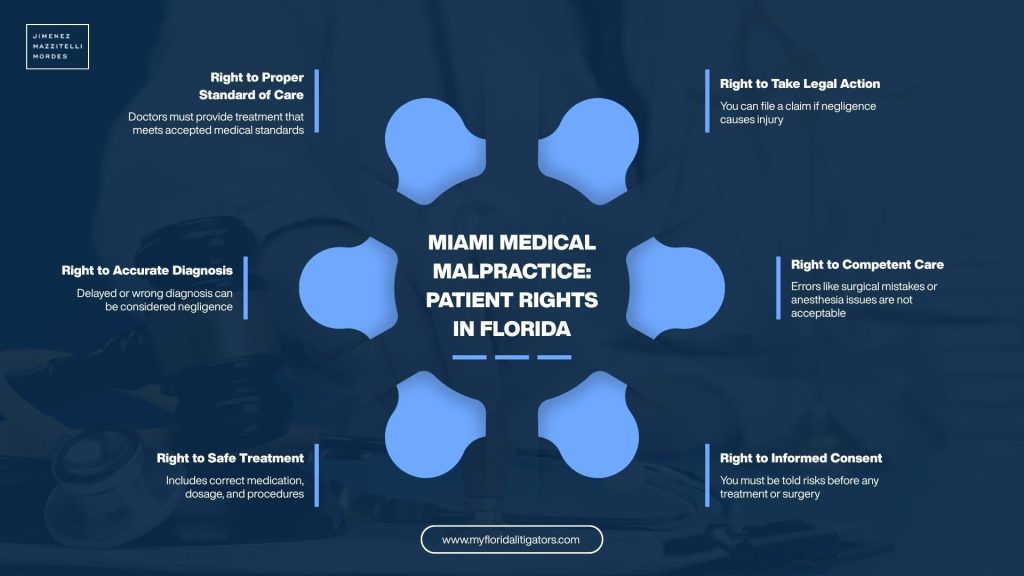
Medical malpractice isn’t just about a bad outcome. Surgeries go wrong. Treatments don’t always work. That’s the reality of medicine. But malpractice is different. Under Florida law, it happens when a healthcare provider fails to meet the “prevailing professional standard of care,” and that failure causes injury.
So what does “prevailing professional standard of care” actually mean? It refers to the level of care, skill, and treatment that a reasonably competent healthcare provider, in the same medical specialty, would have provided under similar circumstances. If a cardiologist in Miami makes a decision that no other reasonable cardiologist would have made given the same patient information, that could cross the line into malpractice.
Here are some common examples of medical malpractice cases filed in Florida:
- Misdiagnosis or delayed diagnosis of a condition like cancer, stroke, or heart disease
- Surgical errors, including wrong-site surgery or leaving instruments inside the body
- Medication errors, such as prescribing the wrong drug or incorrect dosage
- Birth injuries caused by negligent prenatal care or delivery room mistakes
- Failure to order appropriate diagnostic tests
- Anesthesia errors during surgery
- Hospital-acquired infections due to unsanitary conditions
Each of these situations involves a healthcare provider falling below the accepted standard of care. And in each case, the patient has the right to seek compensation for the harm caused.
Your Right to Informed Consent
One of the most overlooked patient rights in Florida is the right to informed consent. Before any medical procedure, your doctor is legally required to explain the risks, benefits, and alternatives. You should know what could go wrong, what the expected recovery looks like, and whether there are other treatment paths worth considering.
If a doctor performs a procedure without getting your informed consent or fails to tell you about a material risk that later causes harm, that can form the basis of a malpractice claim. It doesn’t matter if the procedure itself was performed correctly. The point is that you were never given the full picture before agreeing to it.
This comes up a lot in surgical cases. A patient goes in for a routine procedure, wakes up with unexpected complications, and later finds out the doctor never mentioned that particular risk. In Florida, the question courts ask is whether a reasonable patient, given full information, would have chosen not to go through with the procedure. If the answer is yes, the doctor may be liable.
Your Right to Access Medical Records
Under Florida Statute 456.057, patients have a clear right to their own medical records. You can request copies of your records from any healthcare provider, and they’re required to hand them over within a reasonable time. Providers can charge a reasonable fee for copying, but they can’t refuse your request or drag their feet indefinitely.
Why does this matter for malpractice cases? Because your medical records are the foundation of any claim. They tell the story of what was done, when it was done, and who did it. Without them, proving malpractice is nearly impossible.
If you suspect something went wrong during your treatment, request your records right away. Don’t wait. Don’t rely on your memory of conversations with doctors. Get the documentation in hand, because it may contain the evidence that proves your case, or at least gives your attorney enough to begin investigating.
Florida also protects your records during the pre-suit investigation process. Under Section 766.204, medical records must be made available to all parties during this phase, which we’ll get into shortly.
The Presuit Investigation: Florida’s Mandatory Waiting Period
Here’s something that catches a lot of people off guard. In Florida, you can’t just file a medical malpractice lawsuit the moment you suspect something went wrong. The state requires a mandatory pre-suit investigation period before any case goes to court.
Under Florida Statute 766.106, a patient (the claimant) must send written notice of their intent to file a medical malpractice claim to each prospective defendant. Once that notice is delivered, there’s a 90-day waiting period during which both sides conduct their own investigations.
During this 90-day presuit period, several things happen:
- The patient’s attorney obtains a verified written medical expert opinion confirming that there are reasonable grounds to believe malpractice occurred.
- The prospective defendant (the doctor, hospital, or healthcare facility) reviews the claim and conducts its own investigation.
- Both sides exchange medical records and relevant documentation.
- The defendant may request that the patient submit to a physical or mental examination by a healthcare provider.
This presuit process serves a couple of purposes. It filters out claims that don’t have medical support, and it gives the defendant a chance to evaluate the situation and potentially settle before litigation begins. At the end of the 90 days, the defendant must respond in one of three ways: reject the claim, make a settlement offer, or offer to participate in voluntary binding arbitration.
The presuit period also pauses the statute of limitations clock, which is a major detail we’ll cover next.
Filing Deadlines: The Statute of Limitations
Time limits matter. A lot. In Florida, medical malpractice claims are governed by a strict statute of limitations under Florida Statute 95.11(4)(b).
You generally have two years from the date you discovered (or should have discovered) that malpractice may have occurred. That’s the standard window. But there’s also a hard outer boundary: no matter when you discover the injury, you cannot file a claim more than four years after the date the malpractice actually happened. This is sometimes called the “statute of repose.”
There are a few exceptions. If a healthcare provider committed fraud, concealed evidence, or intentionally misled the patient, the time limits may be extended. And for minors, the rules are different as well. But in most adult cases, those two deadlines, two years from discovery and four years from the event, are firm.
Missing these deadlines means your case is gone. The court won’t hear it. So if you believe you’ve been harmed by medical negligence in Miami or anywhere in Florida, talk to a medical malpractice attorney quickly. The clock is always ticking.
What Kind of Damages Can You Recover?
If your malpractice claim is successful, Florida law allows you to recover several types of damages. These fall into two main categories.
Economic damages cover the measurable financial losses you’ve suffered. These include medical bills (past and future), lost wages, lost earning capacity, rehabilitation costs, and any other out-of-pocket expenses tied to the injury. There’s no cap on economic damages in Florida. You can recover the full amount of your financial losses.
Non-economic damages are harder to calculate. These cover things like pain and suffering, emotional distress, loss of enjoyment of life, and loss of companionship. These are the damages that reflect how the injury has changed your daily experience, your relationships, and your mental health.
Here’s where it gets tricky. Florida recently reinstated caps on non-economic damages in medical malpractice cases under Florida Statute 766.118. As of 2025, the cap is $750,000 per claimant for most cases. For practitioners in emergencies, the cap is even lower. Economic damages remain uncapped, but the non-economic cap means that even in severe cases involving extreme suffering, there’s a ceiling on what a jury can award for those less tangible losses.
This is a point of real debate in Florida. Critics argue these caps put an unfair price on human suffering, especially in cases involving catastrophic injuries. Supporters say the caps are necessary to keep malpractice insurance premiums from skyrocketing and driving doctors out of the state. Whatever your view, it’s a reality of the current legal system that every patient needs to understand.
The Expert Witness Requirement
Florida doesn’t just let anyone claim malpractice without backing it up. The state requires that any medical malpractice lawsuit be supported by testimony from a qualified medical expert.
Under Florida Statute 766.102, the standard of care in a malpractice case must be established through expert testimony. The expert must be a healthcare provider who is trained and experienced in the same specialty as the defendant. They need to be actively practicing or teaching in that field. Their role is to explain what the correct standard of care was, how the defendant failed to meet it, and how that failure caused harm to the patient.
Without a qualified expert, your case can be dismissed. This is why working with an experienced medical malpractice attorney matters so much. They’ll have connections with credible medical experts who can review your records and testify on your behalf. Trying to navigate this requirement on your own is like performing surgery without training. It’s just not going to end well.
Florida’s “Free Kill” Law and Wrongful Death Limitations
One of the most controversial aspects of Florida medical malpractice law is what critics call the “Free Kill” law. Under Florida Statute 768.21, only a legal spouse or a child under 25 can sue for pain and suffering damages when an adult over 25 dies due to medical malpractice.
Think about what that means. If an unmarried, childless adult dies because of a doctor’s negligence, their parents, their siblings, their partner of 20 years, none of them can file a wrongful death claim for pain and suffering. They can pursue compensation for funeral costs and medical bills, but the larger pain and suffering damages are off the table.
In 2025, the Florida Legislature passed HB 6017 with overwhelming bipartisan support to change this. The bill would have allowed parents to file wrongful death suits on behalf of their adult children, and vice versa. But Governor Ron DeSantis vetoed the bill in May 2025, citing concerns about increased liability and its potential effect on malpractice insurance rates.
This law remains one of the biggest gaps in patient protections in Florida. It’s something that affects real families in Miami, Fort Lauderdale, West Palm Beach, and across the state every single year. If you’re concerned about how it might affect your family, it’s worth talking to an attorney about what rights you do have under the current statute.
Comparative Fault: What If You Share Some Blame?
Florida follows a modified comparative fault system. This means that if you, the patient, were partially at fault for your own injury, your compensation may be reduced by your percentage of fault. And if you’re found to be more than 50% responsible, you may not be able to recover anything at all.
In malpractice cases, this can come up when a patient fails to follow medical advice, doesn’t take prescribed medications, or delays seeking treatment. For example, if a doctor misdiagnoses a condition but the patient also ignored symptoms for months before seeing the doctor, the jury might assign a portion of the blame to the patient.
This is another reason why documenting everything is so important. Keep records of your appointments, follow your doctor’s instructions, and don’t skip prescribed tests or follow-up visits. Those records can protect you if the defense tries to argue that you contributed to your own harm.
How Miami’s Medical Landscape Affects Malpractice Cases
Miami is home to some of the nation’s top hospitals and research institutions. Jackson Memorial Hospital, Baptist Health, Mount Sinai Medical Center, and the University of Miami Health System all serve the region. With such a large and diverse patient population, the volume of medical treatment is enormous, and so is the volume of potential malpractice incidents.
Miami-Dade County also has some of the highest malpractice insurance premiums in the country. According to data reviewed by the Florida Office of Insurance Regulation, doctors in Miami-Dade paid the highest premiums in the nation for specialties like internal medicine, general surgery, and OB/GYN as of 2022.
This means two things. First, the local legal system is experienced in handling malpractice cases, so you’ll want an attorney who knows the Miami courts well. Second, the high-premium environment sometimes pushes healthcare providers to practice defensively, ordering extra tests and procedures not because they’re needed, but to protect against potential lawsuits. That defensive approach can sometimes create its own set of problems for patients.
Whether you received care at a hospital in downtown Miami, a clinic in Coral Gables, or an urgent care facility in Hialeah, your rights under Florida law are the same. What changes is the local procedural landscape and the importance of working with legal representation that understands the Miami-Dade court system.
Arbitration as an Alternative to Court
Florida law gives both patients and healthcare providers the option to resolve malpractice disputes through voluntary binding arbitration instead of going to trial. Under Sections 766.207 through 766.209, either side can propose arbitration during the pre-suit period.
In arbitration, a neutral third party hears the evidence and makes a decision. It’s generally faster and less expensive than a full trial, but the trade-off is that you give up your right to a jury. The arbitrator’s decision is typically final and binding.
There are situations where arbitration makes sense, especially when the liability is fairly clear, and both sides want to avoid the uncertainty and cost of a trial. But it’s not always the best option for the patient. If your case involves large damages or complex facts, a jury trial might give you a better chance at full compensation. This is a strategic decision that should be made with your attorney after weighing all the factors.
What to Do If You Suspect Medical Malpractice in Miami
If you believe you or a loved one has been harmed by a healthcare provider’s negligence, here’s a practical roadmap:
- Request your medical records immediately. Don’t wait. Florida Statute 456.057 gives you the right to access them, and they are the backbone of any claim.
- Document everything you can remember. Write down dates, names of providers, what was said, and what symptoms you experienced. Your memory will fade over time, so capture the details now.
- Don’t discuss your case on social media. Anything you post publicly can be used against you. Keep your situation private until you’ve spoken with an attorney.
- Consult with a medical malpractice attorney. These cases are complex. The presuit requirements, expert witness rules, and filing deadlines all require legal guidance. Most malpractice attorneys in Florida offer free initial consultations and work on a contingency fee basis, meaning you don’t pay unless they win your case.
- Act quickly. The two-year statute of limitations starts ticking from the moment you discover the injury. And the mandatory pre-suit investigation adds another 90 days to the timeline before a lawsuit can even be filed.
Protecting Your Rights Moving Forward
Medical malpractice can shake your faith in the healthcare system. It can leave you with physical pain, financial hardship, and a deep sense of betrayal. But the law gives you tools to fight back. Florida’s patient protections, while not perfect, are designed to hold negligent providers accountable and to help injured patients recover what they’ve lost.
The system is complicated, no question about that. Between the presuit investigation requirements, the expert witness standards, the damage caps, and the filing deadlines, pursuing a malpractice claim in Florida demands patience, preparation, and the right legal support.
At Jimenez Mazzitelli Mordes, we handle medical malpractice and personal injury cases across Miami and throughout Florida. Our team works with clients who’ve been wrongfully injured, and we fight to make sure they receive fair compensation for what they’ve been through. If you have questions about a potential malpractice case, we encourage you to reach out for a free consultation.
Your health matters. And so do your rights. Don’t let confusion about the legal process keep you from holding the right people accountable. The law is on your side, but only if you use it.
Frequently Asked Questions
How long do I have to file a medical malpractice claim in Florida?
You generally have two years from the date you discovered (or reasonably should have discovered) the injury. There’s also a hard four-year deadline from the date the malpractice occurred, regardless of when you found out about it. Exceptions exist for fraud, concealment, and cases involving minors.
Do I need an expert witness for a medical malpractice case in Florida?
Yes. Florida law requires a qualified medical expert to provide testimony supporting your claim. The expert must practice or teach in the same specialty as the healthcare provider you’re suing.
What is the presuit investigation in Florida medical malpractice cases?
Before you can file a lawsuit, Florida requires a 90-day presuit investigation period. During this time, you must notify the defendant, exchange medical records, and obtain a verified medical expert opinion supporting your claim. The defendant then has the opportunity to settle, reject, or offer arbitration.
Is there a cap on damages in Florida medical malpractice cases?
Economic damages (medical bills, lost wages) are not capped. Non-economic damages (pain and suffering) are currently capped at $750,000 per claimant under Florida Statute 766.118, with lower caps applying in some emergency care situations.
What is Florida’s “Free Kill” law?
Florida Statute 768.21 limits who can file wrongful death claims in medical malpractice cases. Only a legal spouse or child under 25 can sue for pain and suffering when an adult over 25 dies due to malpractice. Efforts to reform this law were vetoed by the governor in 2025.
