
Can I walk into a USCIS office without an appointment?
Generally no. Almost all services require an appointment scheduled through the USCIS Contact Center or received by mail.Anyone who has ever needed to visit a USCIS office in Miami knows the drill. You show up an hour early. You circle the parking lot twice. You wait in line outside before the door opens. You get to the window, and the officer tells you one small thing is missing from your packet. Come back in three months.
For Miami-Dade County residents, the United States Citizenship and Immigration Services system is a regular feature of life. Nearly half a million legal permanent residents in the county are eligible to naturalize. Thousands more are working through green card petitions, marriage-based green card interviews, work permit renewals, asylum cases, and family reunification paperwork every month. The USCIS offices in Miami-Dade that serve this population are always busy, the appointment windows are narrow, and the consequences of getting something wrong are big.
This guide covers what you need to know before walking into a USCIS office in Miami-Dade. It includes office locations, what to expect inside, current processing trends, preparation checklists, and when speaking with a Miami immigration lawyer may help, along with warnings about the fraud that targets people going through the same process.
The Main USCIS Offices in Miami-Dade
Miami-Dade County is served by two main USCIS field offices, plus a nearby asylum office. Each handles different kinds of cases, and showing up at the wrong one wastes a day you cannot get back.
Miami Field Office
Located at 8801 NW 7th Avenue in Miami, the Miami Field Office is the primary USCIS office handling naturalization interviews, green card interviews, biometrics appointments for certain cases, and other in-person business for residents in the central and northern parts of the county. Public transit access is limited, so most people drive. Parking is available on site, but it fills up quickly on peak interview mornings.
Kendall Field Office
Serving the southern and western parts of Miami-Dade, the Kendall Field Office handles many of the same functions as the Miami Field Office for residents closer to Kendall, Pinecrest, Cutler Bay, and Homestead. Appointments are scheduled by USCIS based on your address, not your choice, so you cannot pick between the two.
Miami Asylum Office
The Miami Asylum Office serving South Florida handles affirmative asylum interviews for cases filed by people already inside the United States. Its location has shifted in recent years, so always check the appointment notice for the exact address before you go. This office does not handle naturalization, green card renewals, or standard visa-related matters.
Application Support Centers (biometrics)
Application Support Centers for biometrics — fingerprinting, photographs, and signature — are separate locations throughout South Florida. Your biometrics appointment notice will list the specific ASC address assigned to you.
USCIS Marriage-Based Green Card Interviews in Miami
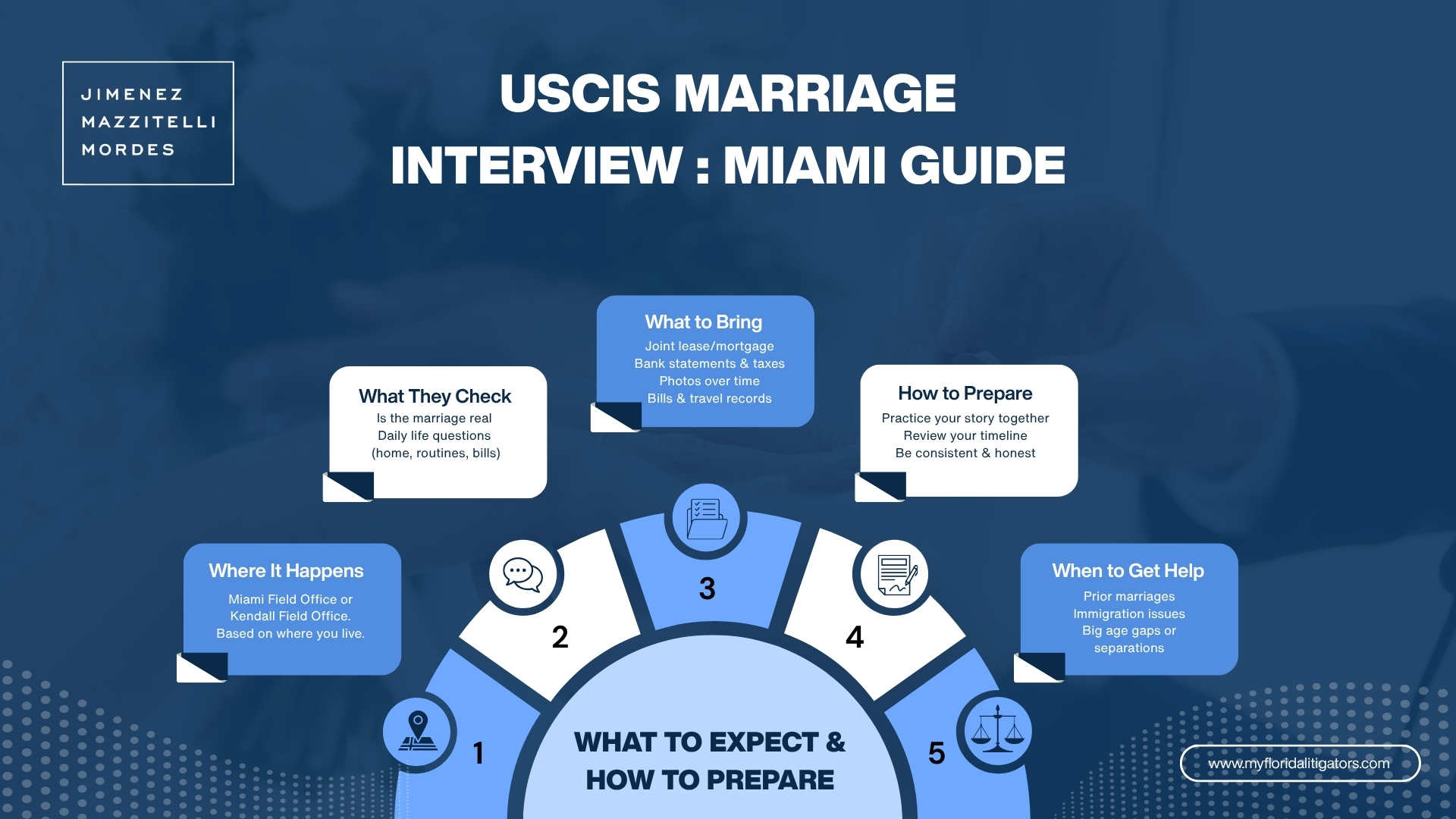
Miami marriage interviews are one of the single most-searched USCIS topics in the county. A marriage-based green card in Miami typically runs through either the Miami Field Office or the Kendall Field Office, depending on where the petitioning couple lives.
The interview itself focuses on whether the marriage is real, not whether it is perfect. Officers ask about daily life: who cooks, where you sleep, which side of the bed, how you handle bills, and where you went for your anniversary. Bring joint documentation that shows a shared life: a lease or mortgage with both names, joint bank account statements, tax returns filed together, photos across multiple years, utility bills, and travel records. Originals of every document you filed, copies of. Translated versions of anything not in English.
The Miami office is known for thorough questioning. Couples who prepare together, sit down the week before the interview, and walk through their actual history out loud tend to do better than couples who show up hoping the officer will keep it simple. If anything about your case is complicated — prior marriages, immigration violations, large age gaps, separations during the relationship — this is one of those moments where a Miami immigration attorney pays for themselves.
The Miami Asylum Office: What to Expect
Miami asylum cases are heard at the Miami Asylum Office by an asylum officer, not a judge. The interview is non-adversarial in form but high-stakes in substance. You will be asked to narrate, in detail, the persecution you experienced or fear, and officers look for consistency between your written declaration and your spoken testimony.
Asylum documentation in South Florida is the other half of the equation. Country conditions reports, medical records if torture or physical harm is claimed, affidavits from family members, news articles, and any official documentation of threats — these are the evidentiary backbone of a strong asylum case. If you are in the Homestead, Plantation, or broader South Florida area and are unsure whether your documentation is sufficient, an asylum attorney in Homestead or elsewhere in South Florida can review your file before the interview. Mistakes made before the hearing are almost impossible to fix after.
Family-Based Green Card Cases Across Miami-Dade Neighborhoods
Family-based immigration is the single largest category of cases moving through Miami USCIS offices. Family-based green card cases from Hialeah, Homestead, Doral, and Plantation all funnel through the same two field offices depending on address, but the local attorneys who work those neighborhoods know the small differences — which documents the local officers prefer to see, which translation services hold up at interview, and how long the current queue actually runs in practice.
Whether you are petitioning for a spouse, a parent, a child, or a sibling, the paperwork is thick and the evidence standard is specific. Family-based immigration in Hialeah often includes Cuban and Venezuelan families with complex documentation histories. Family-based green card cases in Homestead more often involve agricultural-community petitions where prior work history and address records matter. Every neighborhood has its own rhythm.
How to Actually Get an Appointment
USCIS moved almost entirely to an appointment-only system a few years ago, and walk-in service is essentially gone. Here is how scheduling usually works, depending on your case type.
Scheduled interview notices
For naturalization (N-400) and green card (I-485) interviews, USCIS mails an appointment notice with a specific date, time, and office. If you cannot make it, you can request a reschedule, but doing so often pushes your case back several months.
InfoPass appointments
These used to be easy to book online. Now they are limited and usually require calling the USCIS Contact Center first. If the officer on the phone cannot resolve your issue, they may escalate it and schedule an in-person appointment for you.
Emergency appointments
If you have an urgent travel need, a pending military service matter, or a compelling humanitarian situation, emergency appointments exist but require supporting documentation.
Biometrics
You receive a separate notice for biometrics. Rescheduling is possible online, but each reschedule adds weeks to your processing time. For most people in Miami-Dade, the phone system is the entry point. Budget at least 30 to 60 minutes on hold, and have your receipt numbers and A-number ready before you dial.
Current Processing Trends at Miami USCIS Offices
Processing times move constantly. Anyone who quotes you a hard number is either guessing or reading yesterday’s information. What we can say based on what Miami residents are seeing in practice this year:
- N-400 naturalization cases at the Miami Field Office have generally tracked between 8 and 14 months from filing to oath ceremony, depending on case complexity and background check results.
- I-485 adjustment of status cases (including marriage-based green card cases in Miami) vary widely based on visa category, but family-based petitions from Miami are running in the 12 to 24-month range for most applicants.
- I-765 work permit cases are processing faster than they were a year ago, but still often take longer than the 30-day standard many people remember from pre-pandemic years.
- I-130 family petitions continue to move slowly when the beneficiary is outside the United States and must go through consular processing.
Always check the official USCIS processing time tool for your specific form and field office before making any assumptions. Miami’s times often differ from the national averages by a noticeable margin.
What to Bring to Your USCIS Appointment in Miami
Showing up missing a document can cost you months. The packet varies by case type, but a safe baseline for any USCIS appointment in Miami-Dade includes:
- The original appointment notice (printed, not just on your phone)
- Valid government-issued photo identification, ideally a passport and green card if you have one
- Your full immigration file copy, including every form you have ever submitted
- Original versions of every document you filed copies of with your application
- Updated marriage, divorce, birth, and death certificates for yourself and dependents, including certified translations for anything not in English
- Tax returns for the most recent three to five years
- Evidence updates if your case has changed since filing (new address, new job, new child, new criminal issue)
- Medical records, if relevant to the case type
- Any court documents for past arrests or convictions, even if dismissed
For a naturalization interview, add the study materials for the civics test, a list of all trips outside the United States since becoming a resident, and a current Selective Service registration if applicable.
Parking, Transit, and Timing
The Miami Field Office on NW 7th Avenue is accessible by car with on-site parking, but the lot fills by mid-morning on busy days. Metrobus routes serve the area, though the walk from the nearest stop is not short. Give yourself 45 minutes of buffer beyond your planned arrival.
The Kendall Field Office has better parking availability in general. Public transit to Kendall is more limited than in Miami proper, so plan for a car or rideshare.
Arriving early sounds smart, but USCIS security usually does not allow entry more than 15 to 30 minutes before your scheduled time. Bring a book. The waiting room has no amenities to speak of.
Cell phones are allowed, but large bags, food, and recording devices often are not. Check your appointment notice for the specific rules, which have changed.
Watch Out for Notario Fraud
Miami has one of the worst notario fraud problems in the country. In many Latin American countries, a notario publico is a licensed attorney. In the United States, a notary public has no legal authority whatsoever beyond witnessing signatures. Unscrupulous operators exploit this language gap to charge thousands of dollars for immigration services they are not qualified to provide. Signs to watch for:
- Anyone advertising as a notario who is not a licensed attorney or a USCIS-accredited representative
- Promises of guaranteed results, expedited processing, or hidden green card programs
- Pressure to sign blank forms
- Refusal to give you copies of everything submitted in your name
- Requests for payment in cash with no receipt
The Florida Bar, the Attorney General’s office, and community legal aid organizations all publish resources in English, Spanish, and Creole warning about this. If you are unsure whether someone is authorized to help, you can verify attorneys through The Florida Bar’s member directory and accredited representatives through the Department of Justice’s list.
Aviso en español: un notario público en los Estados Unidos no es un abogado. Si usted está buscando abogados de inmigración en Homestead, Hialeah, Doral o cualquier parte del condado de Miami-Dade, verifique siempre las credenciales antes de entregar documentos o dinero.
Practical Tips That Save Time
A few habits make USCIS interactions go more smoothly in Miami.
Keep a dedicated folder, physical or digital, for every piece of immigration paperwork you have ever touched. Organized applicants finish their cases faster than disorganized ones, even when the underlying facts are identical.
Respond to every Request for Evidence immediately. USCIS sets strict response windows, and missed deadlines often result in denial without appeal rights in some case types.
Update your address with USCIS within 10 days of any move using form AR-11 online. Missed mail because of an old address is one of the top reasons Miami cases fall apart.
If English is not your strongest language, bring a qualified interpreter to any interview that allows one. USCIS has specific rules about who can interpret, and not every family member qualifies.
When It Makes Sense to Work With an Immigration Attorney
Not every case needs a lawyer. Straightforward naturalization applications, simple marriage-based green card cases with no prior issues, and basic work permit renewals often move through fine without legal help.
Cases involving any of the following generally benefit from professional guidance: past criminal records, prior removal or deportation orders, complicated family histories, asylum claims, business-based petitions, prior denials, and anything involving minors in complex situations.
The cost of getting it right the first time is almost always lower than the cost of fixing it later. At JIMENEZ MAZZITELLI MORDES, we walk clients through the full arc of their immigration process, from first consultation to oath ceremony, with the kind of local knowledge that only comes from practicing immigration law in Miami-Dade County for years. If you are preparing for a USCIS appointment and something about your case feels uncertain, reach out before you walk into that office.
