
The insurance adjuster often calls quickly after a crash. Sometimes it happens within 24 hours. Sometimes it happens the very same day. The conversation usually feels polite and helpful. If you have not spoken with an attorney yet, which is the case for most people, it can seem like things are already moving in the right direction.
But they’re not moving in the right direction for you.
After a commercial trucking accident, the trucking company and its insurer usually go into action right away. Their team may send investigators to the scene, gather electronic logging data, and document evidence before anything changes. At the same time, they’re often already working to shape the story of what happened before you have had a real chance to understand your legal options.
That is not an overreaction. It is how these cases are commonly handled, and knowing that early can make a real difference in protecting yourself.
What to Know Before Talking to Anyone
Truck accident cases are not handled the same way as ordinary car accident claims. They often involve different legal issues, different insurance policies, and a more complex set of rules.
In many of these cases, responsibility may not fall on just one person or company. Depending on what happened, liability could involve the driver, the trucking company, the cargo company, a vehicle manufacturer, or even a maintenance provider.
The defense side usually begins working immediately after the crash. That is why it’s so important for injured victims to get legal guidance early, before critical evidence is lost or the facts start getting shaped by the other side.
Strong cases are not built by rushing to settle. They are built through early preparation, careful investigation, and a willingness to prepare the case for litigation from the start. That is often what creates real leverage.
Speaking with an attorney early does not cost anything, but it can make a meaningful difference in how your case is handled and how well your rights are protected.
Why Truck Accidents are Different
When people hear the term truck accident lawyer, they often assume it simply means a personal injury attorney handling a more serious crash. In reality, these cases are more specialized than that.
Commercial trucking is one of the most heavily regulated industries in the country. Federal safety rules govern how long drivers can stay on the road, how cargo must be loaded and secured, what maintenance records must be kept, and how electronic logging devices must operate. After a crash, the legal analysis does not focus only on what the driver did. It also looks at whether the trucking company and every other party involved followed the rules they were required to follow.
That is why truck accident cases become complex immediately. The important issues often begin at the scene itself, in the electronic data, in the driver logs, and in the records showing who owned the truck, maintained it, loaded it, and operated it.
For injured victims, timing matters. Some of the most important evidence may exist right now, but it may not still be there a week from now if no one acts to preserve it.
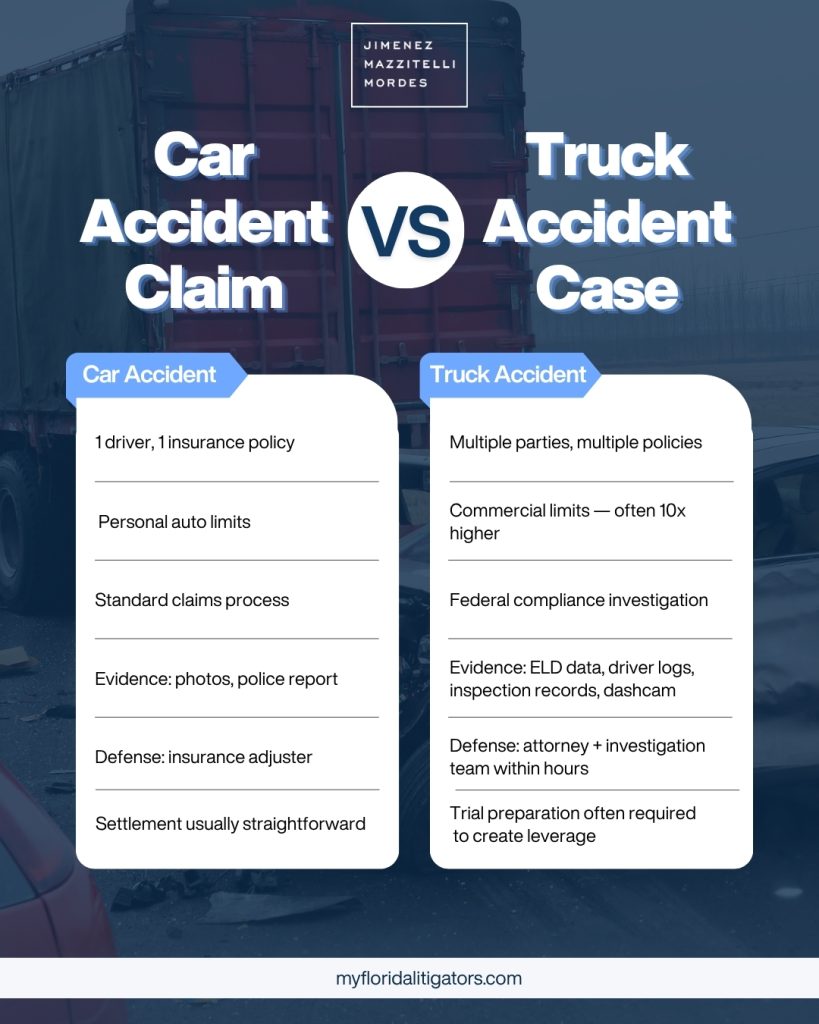
Multiple Liable Parties and Layered Commercial Insurance
In a typical car accident case, there is usually one at fault driver and one insurance policy to deal with. In a commercial truck accident case, figuring out who is legally responsible is often a much deeper investigation.
Depending on the facts, liability may extend to:
- The truck driver, for negligent driving, fatigue, distraction, or hours of service violations
- The trucking company, for poor hiring, inadequate training, lack of supervision, or safety compliance failures
- The owner of the vehicle, who may be separate from the carrier and may have independent maintenance responsibilities
- The cargo loading company, if improper loading, overloading, or poor weight distribution contributed to the crash
- The truck or parts manufacturer, if defective brakes, tires, steering components, or other equipment played a role
- Third party maintenance contractors, if inspections were missed, repairs were done improperly, or records were inaccurate
Each of these parties may carry separate commercial insurance coverage, often with policy limits far greater than those in a standard car accident claim.
The difference between identifying one responsible party and identifying all of them can be substantial. But that only happens when the investigation begins early, before records change, before internal communications disappear through routine deletion practices, and before the defense has months to shape its version of what happened.
How Defense Teams Respond to a Crash
Most injured people don’t learn this until later, and by then the delay may already have affected the case.
Trucking companies and their insurance carriers usually have a response plan in place for serious crashes. In many cases, the insurer is notified almost immediately, and the next steps are already coordinated.
An accident reconstruction expert may be sent to the scene before it’s even cleared. Electronic logging device data showing the driver’s hours, speed, location, and braking activity may be gathered and preserved early, often by the defense side. If dashcam footage exists, it may be secured quickly. The driver may also give a statement about what happened before anyone representing the injured person has had the chance to ask a single question.
None of this is unusual. For major trucking companies and their insurers, it’s often a routine part of how these cases are handled.
Once you understand that, the first 48 hours after a truck accident look very different. Every hour that passes without an attorney taking steps to preserve evidence and investigate liability is time the defense is already using to protect its own position.
Common Tactics Trucking Insurers Use
Commercial insurers handling truck accident claims do this every day. They have resources, experience, and a clear goal from the beginning, which is to protect their bottom line and pay as little as possible. The good news is that their tactics are often predictable. When an attorney understands how these claims are handled, it becomes much easier to protect your case from the start.
Common approaches include:
- Early recorded statement requests, where you’re asked to give an official version of events before you have had the chance to speak with counsel. What seems like a routine conversation can later be used against you.
- Fast settlement offers, sometimes made within days or weeks of the crash, before the full extent of your injuries is clear. These offers are often aimed at closing the claim before future treatment, lost income, and long term limitations are fully understood.
- Challenges to medical causation, where the insurer argues that your injuries were preexisting, overstated, or unrelated to the accident.
- Comparative fault arguments, where they try to shift part of the blame onto you in order to reduce their financial exposure.
- Delays in the claims process, which can put pressure on injured people who are already dealing with medical bills, missed work, and uncertainty.
- Surveillance or monitoring, used in an effort to find something they can point to as inconsistent with your injury claims.
Simply knowing these tactics exist is not enough. What makes the real difference is having an attorney who has dealt with them before and knows how to build a case with those defenses already in mind.
Preparation is not about creating conflict. It is about making sure your case is taken seriously from the very beginning.
Why Early Trial Preparation Changes Everything
Defense attorneys and insurance adjusters evaluate every case based in part on how prepared the injured person’s legal team appears to be.
When a case has missing documentation, delayed expert involvement, and no clear strategy, it sends a message. It tells the defense that the case may be easy to pressure. They may assume a low early offer could be enough, or that the plaintiff is not in a position to push the case forward.
A case prepared for litigation from the very beginning sends a very different message. The evidence is preserved and organized. Liability has been examined across every potentially responsible party. Experts are brought in early when needed. The legal issues are developed clearly and thoroughly. At that point, the defense is no longer guessing whether the case will be pursued seriously. They have to consider what it may actually cost to defend at trial, and that often changes how they respond.
Trial preparation is not something that only matters at the end of a case. In many serious injury and truck accident matters, it’s what creates leverage from the start.
Most of these cases do settle. The ones that tend to settle from a stronger position are often the ones that were prepared as though trial was a real possibility from day one.
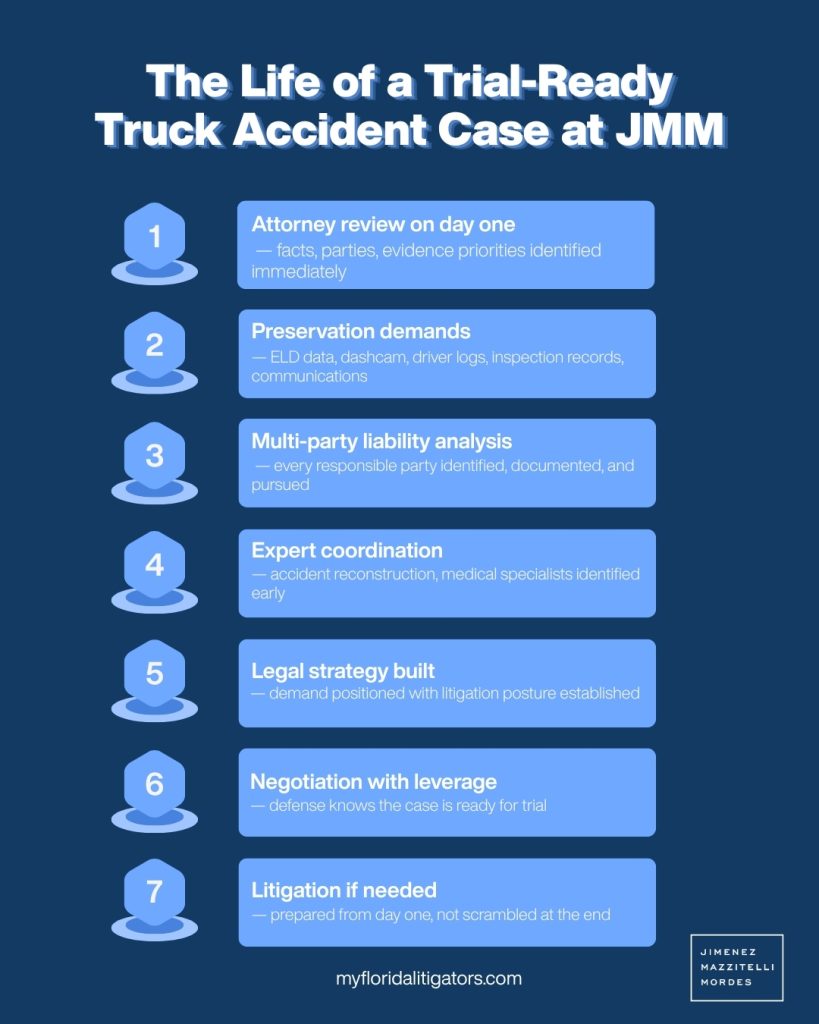
How JMM Handles These Kinds of Cases Differently
At Jimenez Mazzitelli Mordes, serious injury and truck accident cases are not treated like files moving through a system. They are built carefully from the start, and that difference begins on day one.
At many high volume firms, the early stages of a case are handled mostly by staff. The file is opened, organized, and moved through intake before an attorney takes a close look at it. Sometimes that review does not happen until weeks later. Demand letters may go out on a routine schedule, and when an offer comes in, there can be pressure to resolve the case quickly because so many other files are waiting behind it.
At JMM, an attorney reviews the facts as soon as the client hires the firm. Evidence preservation begins right away. Liability is examined across every potentially responsible party. Medical documentation is approached with the full life of the case in mind, not just the fastest possible outcome.
Clients also communicate directly with the attorneys handling their case, not only at the beginning, but throughout the process.
The firm is selective about the matters it accepts. For the cases it does take, the approach is consistent from the first conversation forward. They are handled with litigation in mind from the very beginning.
Mistakes That Cost… And How to Avoid Them
The most important decisions in a serious injury case often happen within the first 72 hours, which is usually when injured people are in the worst position to make them. They are dealing with pain, stress, uncertainty, and pressure from all sides. These are some of the most common mistakes, and none of them are the victim’s fault.
- Giving a recorded statement to the trucking company’s insurer before speaking with an attorney. What feels like a simple conversation can become part of the record, and even an innocent comment may later be used to challenge your claim.
- Accepting an early settlement offer before the full extent of the injuries is understood. It can take time to know the true cost of medical treatment, lost income, future care, and lasting physical limitations. Early offers are often made before that picture is clear.
- Waiting too long to get medical treatment. Delays in treatment can create gaps in the record, and insurance companies often use those gaps to argue that the injuries were not serious or were unrelated to the crash.
- Posting about the accident on social media. Anything shared publicly can be reviewed, saved, and used by the defense in an attempt to weaken your case.
- Believing the claims process is neutral. It is not. The people working for the trucking company and its insurer are there to protect their side. Their job is to reduce exposure and limit what gets paid.
- Waiting too long to hire an attorney. As time passes, evidence can disappear, memories fade, and the defense gains more room to shape the case before your side has had the chance to act.
What makes these mistakes so common is that most people don’t realize how quickly a truck accident case begins taking shape behind the scenes. The earlier you understand that, the better positioned you’re to protect yourself.
When to Contact an Attorney
The right time to speak with an attorney is before you do anything else. Specifically, before you:
- Give any recorded statement to an insurance company
- Respond to a settlement offer, formal or informal
- Sign any document from the trucking company or carrier
- Post anything publicly about the accident
- Assume the insurer’s adjuster is working in your interest
You should also reach out immediately if:
- Your injuries are serious, ongoing, or expected to affect your ability to work long-term
- A family member suffered catastrophic injury or wrongful death in a truck accident
- You’re unsure how many parties were involved or who bears responsibility
- The trucking company’s insurer has already contacted you
An early conversation doesn’t create an obligation. It creates a clear picture of where you stand — before the defense has had weeks to build their version of events.
Speak with an Attorney at Jimenez Mazzitelli Mordes
If you or a family member has been injured in a truck accident or serious injury case in Florida, understanding your position early matters.
Jimenez Mazzitelli Mordes is a Miami-based litigation law firm handling personal injury, truck and auto accidents, medical malpractice, commercial litigation, and select immigration matters throughout Florida. Our attorneys provide direct oversight, clear communication, and trial-ready preparation from the first conversation.
Call (305) 548-8750 to speak directly with an attorney.
Visit myfloridalitigators.com
Miami, Florida | Serving clients statewide
