
You can get your Miami crash report by identifying the responding law enforcement agency, waiting up to 10 days for processing, and purchasing the document online through the Florida Highway Safety and Motor Vehicles (FLHSMV) portal or requesting it directly from the local police department. This document provides crucial evidence for your personal injury claim, including the investigating officer’s narrative, scene diagrams, and citations issued. Understanding how to navigate Florida’s 60-day confidentiality rule ensures you can access your report quickly to build a strong legal case.
Florida traffic crash reports consolidate essential details about your accident into one official document. The FLHSMV system charges a $10 fee plus a $2 convenience fee for online downloads. Under Florida Statute § 316.066, only involved parties, their attorneys, and insurance companies can access this report during the first 60 days following the crash. Gathering this report immediately after the confidentiality period or submitting a sworn statement allows you to provide insurers with factual evidence regarding liability and property damage.
Key Takeaways
- Determine the agency: Identify whether the Miami Police Department, Miami-Dade Police Department, or Florida Highway Patrol handled your collision.
- Wait for processing: Law enforcement officers have up to 10 days to file the Florida Traffic Crash Report with the FLHSMV.
- Navigate confidentiality rules: Florida Statute § 316.066 restricts public access to crash reports for 60 days, meaning you must provide a sworn statement to get it sooner.
- Check for errors: Review the report for factual mistakes regarding vehicle locations, witness statements, and insurance details, as these influence your settlement.
- Hire legal representation: Miami personal injury attorneys use the crash report to investigate fault, handle insurance adjusters, and connect your injuries to the collision.
Why Your Crash Report Matters After A Miami Accident
Your crash report serves as the foundational document for your personal injury claim. Insurance adjusters and personal injury lawyers rely on this report to establish a baseline of facts regarding the collision. In 2023, Miami-Dade County recorded over 63,000 traffic crashes. This high volume means insurance companies process thousands of claims monthly, making the official police report vital for separating facts from disputes.
What Information Is Included in a Florida Crash Report?
A Florida crash report details the objective facts and officer observations from the scene. You will find specific data points that insurers require to process a claim.
The report includes:
- Crash date, time, and exact geographic location.
- Involved drivers, passengers, vehicle models, and insurance policy numbers.
- The responding officer’s written observations and narrative.
- A visual diagram of the crash scene and vehicle impact points.
- Traffic citations issued and contributing factors.
- Witness names and contact information, when available.
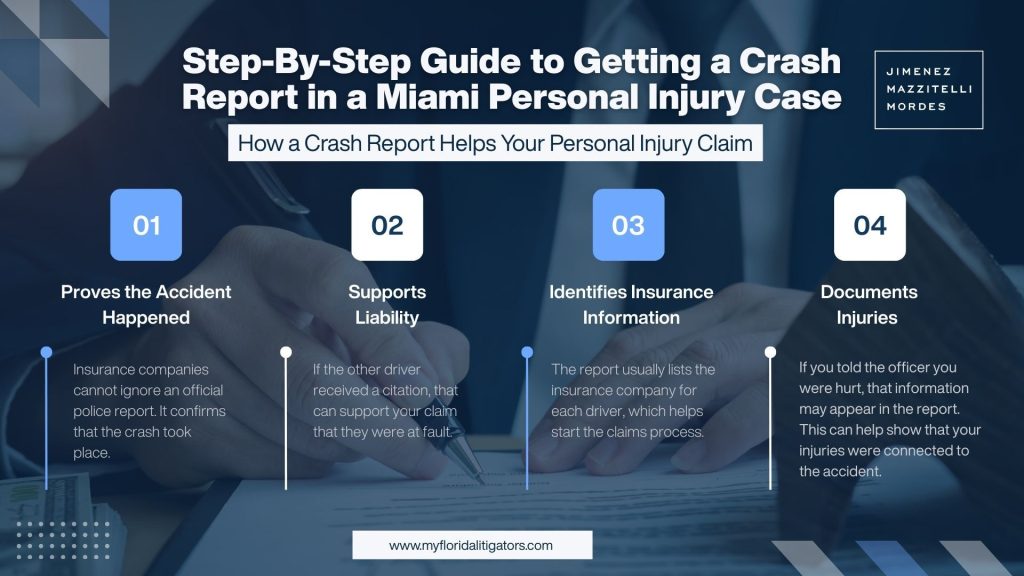
How a Crash Report Can Help Your Personal Injury Claim
The document provides objective evidence that supports your version of events. Insurance companies look for specific indicators of fault before offering a settlement.
The report supports:
- Liability investigations by detailing who violated traffic laws.
- Insurance claim filing by providing accurate policy numbers.
- Medical injury timelines by documenting complaints of pain at the scene.
- Witness follow-up by securing neutral third-party contact data.
- Settlement negotiations by presenting official law enforcement findings.
What a Crash Report Does Not Prove by Itself
A crash report provides valuable evidence, but it does not guarantee a successful case. Florida courts consider police reports as hearsay in certain trial settings. Medical records, photographs, video footage, witness statements, and expert analysis provide necessary context. An officer’s opinion on fault does not legally bind a judge or jury.
Step 1: Identify Which Agency Responded To Your Miami Crash
You must identify the specific law enforcement agency that investigated your accident to request the correct records. Multiple jurisdictions overlap within Miami-Dade County. Requesting the report from the wrong department causes unnecessary delays in your injury claim.
Miami Police Department
The Miami Police Department handles collisions that occur within the official City of Miami limits. You should contact their Records Unit if your accident happened in neighborhoods like Brickell, Downtown Miami, Little Havana, or Coconut Grove. The department processes thousands of these specific municipal reports annually.
Miami-Dade Sheriff’s Office or Local Municipal Police
The Miami-Dade Police Department covers unincorporated areas and specific contracted municipalities. You will need their records if your crash occurred in Kendall or Doral. Additionally, independent cities like Miami Beach, Coral Gables, Hialeah, and Homestead operate their own police departments and maintain their own crash records.
Florida Highway Patrol
The Florida Highway Patrol (FHP) Troop E investigates crashes on state highways and major interstates. You must request your report from FHP if your collision happened on I-95, Florida’s Turnpike, the Palmetto Expressway (SR 826), or the Dolphin Expressway (SR 836). FHP troopers handle high-speed collisions that frequently result in severe injuries.
Step 2: Gather The Information You Need Before Requesting The Report
You need specific details to locate your report in local or state databases. Having the right information ready prevents search errors and saves time. Law enforcement records departments require exact data points to pull the correct file from tens of thousands of annual crashes.
Basic Crash Details
You must provide the fundamental facts of the incident to initiate a search. Without these, clerks cannot distinguish your crash from others occurring on the same day.
Include the following details:
- Date of the accident.
- Approximate time of the collision.
- Street name or intersection location.
- Names of the involved drivers.
- Vehicle makes, models, and license plate numbers.
- The official report number or case number provided by the officer.
Personal Identification and Relationship to the Crash
You must prove your identity to access the report during the initial restricted period. Florida law protects the privacy of crash victims. Access requires proof that the requester is an involved party, an attorney representing a victim, an insurer, or another statutorily authorized person. You will need a valid government-issued ID.
Insurance and Claim Information
You should keep your insurance claim number organized alongside your crash details. While the police department does not always require your claim number to release the report, having it ensures you can immediately forward the document to the correct claims adjuster. This keeps your claim moving forward without administrative pauses.
Step 3: Wait For The Crash Report To Become Available
You cannot get a crash report the same day your accident occurs. Law enforcement officers require time to complete their investigations, write the narrative, draw the diagrams, and submit the paperwork to the state database.
How Long Does It Take to Get a Florida Crash Report?
Florida traffic crash reports take up to 10 days to become available after the investigation ends. Florida Statute § 316.066 gives officers a 10-day window to file the Long Form report with the FLHSMV. Complex crashes involving fatalities or commercial trucks may require longer investigative periods before the final report becomes public.
What to Do While You Are Waiting
You should take proactive steps to build your case while the official report processes. Waiting idly allows crucial evidence to disappear and insurance deadlines to pass.
We recommend you:
- Get immediate medical care to document your injuries.
- Save all photographs and videos from the crash scene.
- Keep your vehicle repair estimates and invoices.
- Save all written insurance communications.
- Write down your exact memory of the crash events.
- Avoid giving recorded statements to insurance adjusters without legal guidance.
Step 4: Request The Crash Report Online Through FLHSMV
You can obtain your crash report quickly through the state’s centralized digital system. The FLHSMV manages the Florida Crash Portal, which aggregates reports from all local and state law enforcement agencies.
Using the Florida Crash Portal
The FLHSMV provides online access to Florida traffic crash reports through its dedicated crash report system. You visit the portal, enter your crash details, and verify your identity. The system searches the statewide database, allowing you to bypass physical trips to local police stations.
How Much Does a Florida Crash Report Cost?
The FLHSMV charges a mandatory statutory fee for official documents. The department currently lists a $10 report fee plus a $2 convenience fee per transaction for online purchases. You must pay this $12 total using a credit or debit card through the secure online portal.
What Happens After You Purchase the Report?
The system provides a downloadable link immediately after your payment clears. You typically receive access to download the report electronically as a PDF file. You must download the file within 48 hours before the link expires. Save a digital copy to your computer and print a physical copy for your legal records.
Step 5: Request The Report Directly From The Responding Agency
You may need to bypass the state portal and request the document straight from the local police department. This method works best when the state system experiences delays or when local municipalities hold back records for internal review.
When to Contact the Police Department Directly
You should use local records departments under specific circumstances.
Use this section for cases where:
- The report does not appear online after 10 days.
- The crash happened within a specific municipality with its own portal.
- You possess the exact local police report number.
- The crash involved a local municipal agency rather than the Florida Highway Patrol.
What to Ask For When Calling or Visiting
You must use precise language when communicating with police records clerks. Vague requests lead to confusion and delays.
Include these terms and details:
- Ask for the “Florida Traffic Crash Report.”
- Provide the exact crash date.
- Provide the specific report number.
- State the responding officer’s name and badge number.
- State the exact street location of the crash.
- Clarify your specific role in the crash (e.g., driver, passenger).
Why Agency Rules May Vary
Local law enforcement agencies operate under independent administrative guidelines. The Miami Police Department handles records requests differently than the Miami Beach Police Department. Local agencies possess different records request software systems, varied processing times, specific identification requirements, and unique payment methods. Always check the specific department’s website before visiting in person.
Step 6: Understand Florida’s 60-Day Crash Report Confidentiality Rule
You cannot assume crash reports are immediately available to the general public. Florida enforces strict privacy laws to protect accident victims from predatory solicitation by tow trucks, mechanics, and unsolicited medical clinics.
Who Can Access a Crash Report During the First 60 Days?
Florida law restricts public access to crash reports for a period immediately after filing. During the first 60 days, only authorized entities can view the document. These authorized parties include the involved drivers and passengers, their legal representatives, licensed insurance agents, prosecutors, and radio or television media outlets.
Why You May Need to Submit a Sworn Statement
You must prove your legal right to bypass the 60-day restriction. Requesters must submit a sworn statement certifying they fall under an authorized exemption. Falsifying this sworn statement constitutes a third-degree felony in Florida. You must sign this document online or present it in person with a valid ID.
What Happens After the Confidentiality Period Ends?
The restricted access expires exactly 60 days after the report date. Once the confidentiality period ends, the crash report becomes a public record. Anyone can request, purchase, and view the report without providing a sworn statement, subject to standard public records rules and redaction of sensitive personal information.
Step 7: Review The Crash Report Carefully
You must audit your crash report the moment you receive it. Officers investigate multiple crashes daily and occasionally make transcription errors. An inaccurate report severely damages your ability to recover fair compensation.
Check for Accuracy
You need to verify every single data field on the document.
Review the following details:
- Spelling of all driver and passenger names.
- Accuracy of auto insurance policy numbers.
- Vehicle makes, models, and VINs.
- Exact street names and intersection details.
- Direction of travel for all involved vehicles.
- Names and phone numbers of witnesses.
- The officer’s written narrative of events.
- The visual diagram representing the impact.
- Any traffic citations issued to the at-fault driver.
Look for Evidence That Supports Liability
You want to locate the specific codes and narrative notes that assign blame to the other driver. The report contains a section for “Contributing Causes.”
Examples of liability evidence include:
- Failure to yield the right of way.
- Following too closely (rear-end collisions).
- Speeding or driving too fast for conditions.
- Distracted driving or cell phone use.
- Improper or unsafe lane changes.
- DUI suspicion or alcohol test results.
- A formal traffic citation issued at the scene.
Save a Clean Copy for Your Attorney and Insurance Claim
You must maintain the integrity of the original document. Keep the original PDF file unchanged on your hard drive. Never write on or alter your master copy. Send clean, unedited digital copies to your personal injury attorney and your insurance claims adjuster as needed.
What If The Crash Report Contains An Error
You may find mistakes in the officer’s report. Errors range from simple misspellings to entirely incorrect fault determinations. Addressing these errors requires prompt action and an understanding of police administrative procedures.
Common Errors in Miami Crash Reports
You should anticipate potential discrepancies. High-stress crash scenes often lead to minor clerical mistakes.
Common examples include:
- Incorrect vehicle resting locations on the diagram.
- Misspelled names or incorrect birth dates.
- Wrong insurance carrier names or expired policy numbers.
- Incomplete or missing witness contact information.
- Incorrect narrative details regarding traffic light colors.
- Missing notations regarding your complaints of physical pain.
Can You Correct a Florida Crash Report?
You can request a correction, but the process depends on the specific law enforcement agency and the nature of the error. Factual errors, such as a misspelled name or wrong insurance company, are relatively easy to amend. The records unit usually handles these clerical updates. Conversely, disputing an officer’s conclusion about who caused the crash proves extremely difficult. Officers rarely change their subjective liability determinations once the report is finalized.
Why You Should Speak With a Personal Injury Attorney Before Challenging the Report
You risk aggravating the situation if you challenge the police independently. A personal injury attorney determines whether the error legally matters to your case. If the officer made an incorrect liability determination, an attorney knows how to supplement the official record with stronger evidence, such as intersection surveillance video or expert accident reconstruction, rather than fighting a losing administrative battle with the police department.
Can You File A Personal Injury Claim Without The Crash Report
You do not have to wait for the crash report to initiate your insurance claim. Time limits apply to medical coverage in Florida, so delaying action harms your case.
Yes, But the Report Can Strengthen the Claim
You can open your claim using alternative evidence. A claim begins with emergency room medical records, photographs of vehicle damage, videos of the scene, witness names, and the exchange of insurance information. While the report is pending, your attorney uses this initial evidence to notify the insurance carrier and establish a claim number. The crash report later solidifies the preliminary facts.
Why Waiting Too Long Can Hurt Your Case
You compromise your legal rights if you wait weeks for the police report before acting. Florida law requires you to seek medical treatment within 14 days to utilize your Personal Injury Protection (PIP) benefits. Furthermore, nearby businesses overwrite surveillance video quickly, witness memory fades, and insurance companies use delays to argue your injuries are unrelated to the crash.
What an Attorney Can Do Before the Report Is Available
You benefit from immediate legal intervention. Lawyers execute crucial investigative tasks before the FLHSMV publishes the document.
An attorney will:
- Send preservation letters to prevent businesses from deleting video footage.
- Contact witnesses while their memories remain fresh.
- Photograph the crash scene to document skid marks and debris.
- Communicate directly with insurers to stop harassing phone calls.
- Track down report availability through agency contacts.
- Review your auto policy for underinsured motorist coverage issues.
How A Miami Personal Injury Lawyer Uses Your Crash Report
You hire an attorney to translate the raw data of a crash report into a compelling legal argument. The police report serves as the foundation for your lawyer’s strategic plan to maximize your financial compensation.
Investigating Fault and Negligence
Your attorney analyzes the report to identify liable drivers. The document highlights contributing causes and helps the legal team pinpoint possible third parties. For example, if the report notes a commercial truck experienced brake failure, your lawyer investigates the trucking company and the maintenance provider for negligence.
Dealing With Insurance Companies
Your attorney uses the report as leverage during insurance negotiations. Insurers use crash reports to evaluate liability and minimize payouts. When an adjuster tries to assign you partial blame under Florida’s modified comparative negligence law, your lawyer counters with the officer’s objective findings and citations to protect your settlement value.
Connecting the Crash to Your Injuries
Your attorney establishes causation using the officer’s notes. Insurance companies often claim your back or neck pain stems from a pre-existing condition. Attorneys compare the crash report’s documentation of impact severity and your initial complaints of pain with emergency room records, treatment notes, diagnostic imaging, and medical bills to prove the crash directly caused your current injuries.
Building a Settlement Demand or Lawsuit
Your attorney packages the crash report as one vital piece of a larger evidence portfolio. The firm drafts a comprehensive settlement demand letter that includes the police findings alongside your medical records and lost wage documentation. If the insurer refuses to offer a fair settlement, your lawyer uses the crash report data to draft the formal civil lawsuit complaint.
Mistakes To Avoid When Getting A Crash Report After A Miami Accident
You can easily jeopardize your claim by making procedural errors following a crash. Avoiding common mistakes protects your ability to recover damages.
Waiting Too Long to Request It
You delay your entire case by failing to request the report promptly. Insurers delay property damage payouts and liability decisions until they review the official document. Request the report the moment the 10-day processing window closes.
Assuming the Report Proves the Whole Case
You must remember that a crash report does not equal an automatic victory. A report stating the other driver received a citation helps, but it does not prove the severity of your injuries. You still need comprehensive medical evidence.
Ignoring Errors in the Report
You cannot let factual inaccuracies slide. If the report lists the wrong insurance company for the at-fault driver, your claim stalls. Review the document instantly and notify your attorney of any discrepancies.
Giving the Insurance Company a Recorded Statement Too Early
You must never provide a recorded statement to the at-fault driver’s insurance adjuster before reviewing the crash report and consulting a lawyer. Adjusters use recorded statements to lock you into a narrative that contradicts the official police findings, destroying your credibility.
Posting About the Accident Online
You destroy your case value by posting on social media. Defense attorneys scour Facebook and Instagram for posts that contradict your injury claims or the crash report narrative. Keep your accident details strictly offline.
Documents To Gather Along With Your Crash Report
You build an impenetrable case by supporting the crash report with a robust file of supplementary documents. The police report answers “what happened,” but your other documents prove “how much it cost.”
Medical Records and Bills
You must collect every record from the ambulance ride, emergency room visit, MRI facility, orthopedic surgeon, and physical therapist. These documents prove the financial severity of your physical trauma.
Photos and Videos From the Crash Scene
You provide visual proof of the impact. Photos of shattered glass, deployed airbags, and vehicle positioning offer context that a standard police diagram cannot fully capture.
Vehicle Repair Estimates
You establish the force of the impact using property damage invoices. A $15,000 auto body repair bill heavily supports your claim that the collision caused a severe spinal injury.
Insurance Correspondence
You need to track all communications. Save every letter, email, and digital portal message from your PIP carrier and the at-fault driver’s bodily injury liability carrier.
Witness Contact Information
You rely on witnesses when liability becomes a “he-said, she-said” battle. Keep a secure list of the names, phone numbers, and email addresses of anyone who saw the crash occur.
Lost Wage Documentation
You must prove the income you lost while recovering. Gather recent pay stubs, tax returns, and formal letters from your employer detailing the exact dates you missed work due to your injuries.
Talk To A Miami Personal Injury Lawyer About Your Crash Report
We understand that deciphering legal codes and navigating state databases feels overwhelming while you recover from painful injuries. You do not have to fight the insurance companies alone.
Get Help Obtaining and Reviewing the Report
We manage the entire administrative process for you. Our legal team secures your Florida Traffic Crash Report, handles the 60-day sworn statement requirements, and meticulously reviews the officer’s narrative for critical liability details. We take the bureaucratic burden off your shoulders.
Find Out Whether the Report Supports Your Injury Claim
We evaluate the facts to build your legal strategy. Our attorneys cross-reference the crash report against Florida’s negligence laws to determine the exact value of your case. If the report contains errors or unfair fault assessments, we deploy investigators to gather the necessary evidence to correct the record and protect your rights.
Injured in a Miami Crash?
Contact our Miami personal injury lawyer at Jimenez Mazzitelli Mordes for a free consultation. We handle complex car accidents, truck collisions, and motorcycle crashes across South Florida. We can help you obtain your crash report, review the evidence, and explain your legal options. You pay absolutely no upfront fees, and we only get paid if we win your case. Call us today at (305) 548-8750 to schedule your free case evaluation.
Frequently Asked Questions
How do I get a crash report after a car accident in Miami?
Identify the responding agency (Miami PD, Miami-Dade PD, or FHP). Wait up to 10 days, then use the FLHSMV Florida Crash Portal online or contact the local police records unit directly to purchase your document.
How long does it take for a Florida crash report to be available?
FLHSMV notes that traffic crash reports may take up to 10 days to become available. Officers use this time to finalize their investigations, complete diagrams, and upload the data to the state system.
How much does a Florida crash report cost?
FLHSMV currently lists a $10 report fee plus a $2 convenience fee per transaction for online crash report purchases. Local police departments generally charge similar statutory fees for printed copies.
Are Florida crash reports public record?
They are subject to Florida’s crash report confidentiality rules for an initial restricted period under § 316.066. During the first 60 days, only involved parties, attorneys, and insurers can access them. They become entirely public after 60 days.
Can my lawyer get the crash report for me?
Yes. A personal injury attorney submits a sworn statement of representation to bypass the 60-day restriction. Your lawyer obtains, reviews, and utilizes the report as foundational evidence for your injury claim.
What if the crash report says I was partly at fault?
You should speak with an attorney before accepting the report’s conclusions as final. Other evidence, like surveillance video or expert reconstruction, may clarify or challenge the officer’s subjective opinion regarding fault.
Do I need a crash report for a minor fender bender?
Yes. Florida law requires you to report any crash involving injuries, complaints of pain, or property damage exceeding $500. A report protects you if the other driver later invents a false narrative.
How do I read the codes on my Florida crash report?
The FLHSMV utilizes specific numeric codes to indicate vehicle damage, driver actions, and weather conditions. You can find a code overlay guide on the FLHSMV website, or your attorney can translate the codes for you.
Can the insurance company deny my claim without a crash report?
Insurance companies routinely delay processing bodily injury or property damage claims until they possess the official police report. The report confirms the date, time, and involved parties necessary to trigger coverage.
Does a crash report expire?
No. The state of Florida retains traffic crash reports indefinitely in their archives. However, you should retrieve your copy immediately, as delaying your personal injury claim violates the statute of limitations.
