
Getting a phone call that a family member has been detained by Immigration and Customs Enforcement (ICE) is one of the most stressful experiences any family can face. The fear, confusion, and urgency are overwhelming and the clock starts ticking immediately. If your loved one has been taken into ICE custody in Miami or anywhere in South Florida, knowing what steps to take in the first hours and days can make a real difference in the outcome of their case. Speaking with a Miami immigration lawyer early on can help you understand what happens after an ICE detention, how bond hearings work, what legal defenses may be available, and what you can do right now to help.
Why Does ICE Detain People?
ICE does not detain people randomly. Detentions typically result from specific triggers related to a person’s immigration status or history. Understanding why your family member was detained is the first step toward building a defense.
Common Reasons for ICE Detention
The most frequent reasons people are taken into ICE custody include overstaying a visa beyond the authorized period of stay, entering the United States without inspection (crossing the border without going through an official port of entry), having a criminal record or pending criminal charges even for relatively minor offenses, being subject to a final order of removal (a prior deportation order that was never executed), failing to appear for a scheduled immigration court hearing, and being identified during a workplace raid or other enforcement operation. It is important to understand that being detained does not automatically mean your family member will be deported. Many detained individuals have legal options and defenses that can lead to their release and allow them to remain in the United States.
What Happens Immediately After ICE Detention?
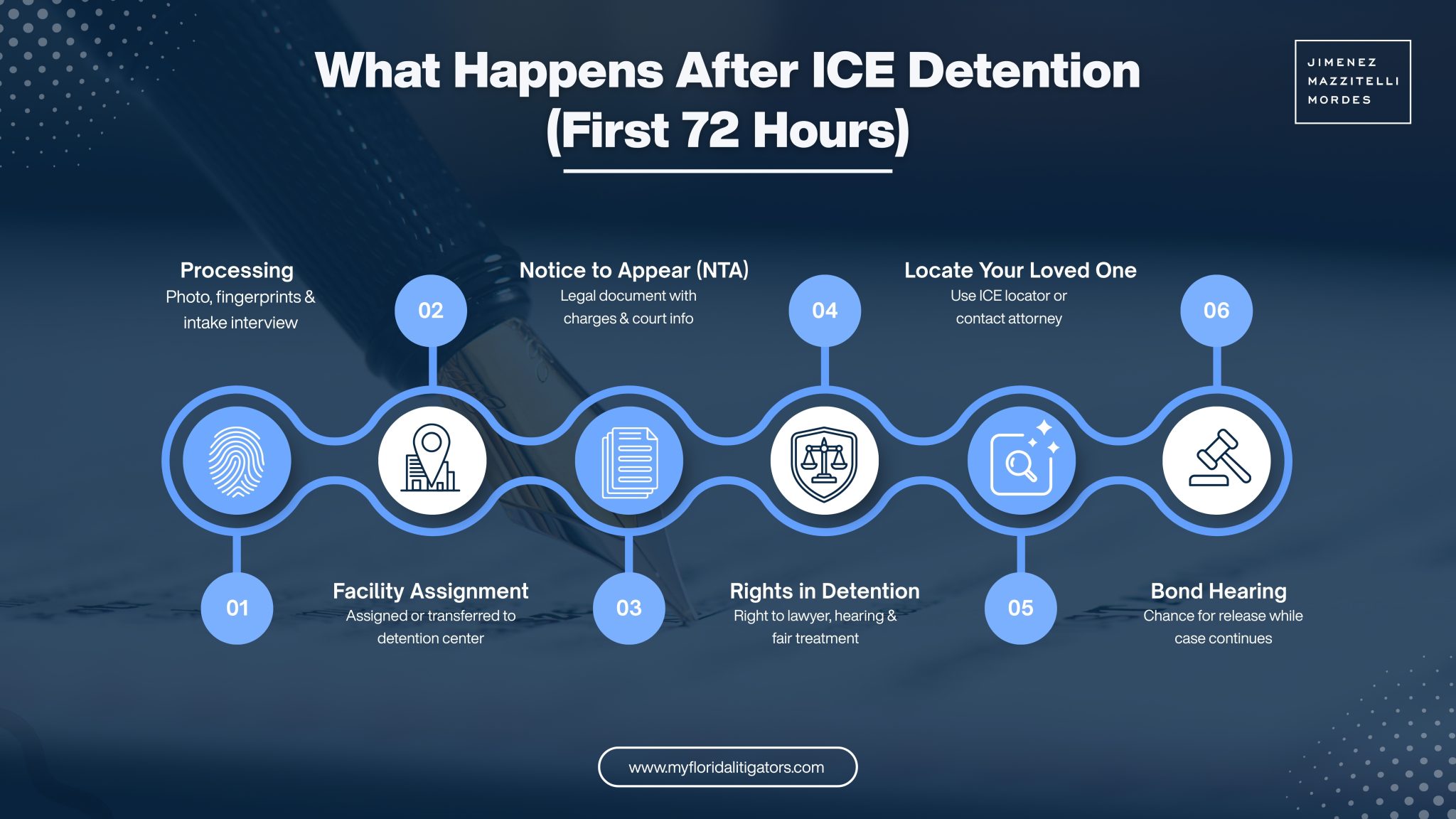
The first 24 to 72 hours after a detention are critical. Here is what typically occurs and what your family should know.
Processing and Facility Assignment
After being taken into custody, your family member will be processed at an ICE facility. During processing, they will be photographed, fingerprinted, and interviewed. ICE will determine whether to hold them at a local detention facility or transfer them to another location. In the Miami area, detained individuals may be held at the Krome North Service Processing Center in Miami-Dade County, the Broward Transitional Center in Pompano Beach, or other contract detention facilities throughout Florida. Transfers to facilities outside of South Florida are possible, which can make communication with family members more difficult.
The Notice to Appear (NTA)
If your family member is placed in removal proceedings, they will receive a Notice to Appear (NTA). This document outlines the government’s allegations about why the person is removable from the United States and provides information about their upcoming immigration court hearing. The NTA is a critical document; keep a copy if your family member is able to share it with you.
Your Loved One’s Rights in Detention
Regardless of their immigration status, your detained family member has rights. These include the right to contact family members and an attorney, the right to a hearing before an immigration judge (in most cases), the right to present evidence and call witnesses in their defense, the right to request a bond hearing, the right to appeal an immigration judge’s decision, and the right to be free from abuse or inhumane treatment while in custody. ICE is required to provide detainees with access to legal resources, including a list of free or low-cost legal service providers. However, the government is not required to provide a free attorney in immigration proceedings the way it does in criminal cases. Hiring an attorney to represent your family member is one of the most impactful steps you can take.
How to Locate a Detained Family Member
One of the first challenges families face is simply finding out where their loved one is being held. ICE does not always notify family members directly, and detainees are sometimes transferred between facilities without advance notice.
Using the ICE Online Detainee Locator System
The fastest way to locate a detained family member is through the ICE Online Detainee Locator System, available on the ICE website. To search, you will need the person’s full legal name (as it appears on their immigration documents), their date of birth, and their country of birth or A-Number (Alien Registration Number) if available. If the system does not return results, the person may not yet have been fully processed, may have been recently transferred, or may be held under a slightly different name spelling. In these situations, contacting an immigration attorney who can make direct inquiries to ICE on your behalf can be helpful.
Contacting the Local ICE Field Office
The ICE Miami Field Office handles detention cases throughout South Florida. An attorney can contact this office to locate your family member, confirm their detention status, and begin the process of requesting a bond hearing.
Understanding Immigration Bond Hearings
For many detained individuals, a bond hearing represents the first opportunity to be released from custody while their immigration case proceeds through the courts.
What Is an Immigration Bond?
An immigration bond works similarly to bail in the criminal justice system. If an immigration judge grants bond, the detained person can be released from custody after paying the bond amount. The individual must then attend all future court hearings and comply with any conditions of release. Bond amounts in immigration cases typically range from $1,500 to $25,000 or more, depending on the circumstances of the case. The minimum bond amount set by law is $1,500.
What Does the Judge Consider at a Bond Hearing?
At a bond hearing, the immigration judge evaluates two primary factors. Whether the person is a danger to the community. The judge will consider the person’s criminal history (if any), the nature and severity of any past offenses, and whether there is any evidence suggesting the person poses a threat to public safety. Whether the person is a flight risk. The judge assesses whether the person is likely to attend all future court hearings. Factors that weigh in the detainee’s favor include strong family ties in the community (especially U.S. citizen or permanent resident family members), stable employment history, length of time living in the United States, property ownership or a long-term lease, enrollment in school or community programs, and no history of failing to appear for court hearings.
How to Strengthen a Bond Hearing Case
An attorney can gather and present evidence that maximizes your family member’s chances of being granted bond. This includes letters of support from family, employers, and community members, proof of employment and tax payment history, evidence of family ties such as birth certificates of U.S. citizen children, documentation of community involvement (church membership, volunteer work, school enrollment), and records showing compliance with prior immigration reporting requirements.
Legal Defenses Available to Detained Individuals
Being in ICE detention does not mean deportation is inevitable. Depending on the facts of your family member’s case, several legal defenses may be available.
Cancellation of Removal
Cancellation of removal is available to certain non-permanent residents who have been physically present in the United States for at least 10 continuous years, can demonstrate good moral character during that period, have no disqualifying criminal convictions, and can prove that removal would result in exceptional and extremely unusual hardship to a qualifying U.S. citizen or permanent resident family member (spouse, parent, or child). If granted, cancellation of removal results in the person receiving lawful permanent resident status, a green card.
Asylum and Withholding of Removal
If your family member fears persecution in their home country based on race, religion, nationality, political opinion, or membership in a particular social group, they may be eligible for asylum or withholding of removal. These claims can be raised as a defense during removal proceedings, even if the person did not previously apply for asylum. The asylum filing deadline is generally one year from the date of arrival in the United States, but exceptions may apply for individuals who can demonstrate changed circumstances in their home country or extraordinary circumstances that prevented timely filing.
Adjustment of Status
In some cases, a detained individual may be eligible to apply for a green card while in removal proceedings. This is possible if the person qualifies through a family relationship (such as marriage to a U.S. citizen) or through an employer-sponsored petition. An immigration judge can grant an adjustment of status during proceedings, which would end the removal case and result in permanent residency.
Waivers of Inadmissibility
If your family member has certain grounds of inadmissibility, such as prior unlawful presence, previous immigration violations, or certain criminal convictions, they may be eligible for a waiver that forgives those grounds and allows them to pursue legal status. Common waivers include the I-601 waiver for fraud or criminal inadmissibility and the I-212 waiver for individuals seeking permission to reapply for admission after a prior deportation.
Voluntary Departure
In some situations, the best strategic option may be voluntary departure, leaving the United States voluntarily instead of being formally deported. While this still results in the person leaving the country, it avoids the formal removal order and the associated bars on future reentry, which can last 5, 10, or 20 years depending on the circumstances.
What Family Members Can Do to Help Right Now
While your loved one is in detention, there are concrete steps you can take to support their case and improve their chances of release.
Hire an Immigration Attorney as Soon as Possible
Legal representation is the single most important factor in immigration detention cases. Studies consistently show that individuals with attorneys are significantly more likely to win their cases than those who represent themselves. An attorney can file for bond, prepare legal defenses, represent your family member in court, and keep you informed throughout the process.
Collect and Organize Important Documents
Start gathering documents that can support your family member’s case. These include copies of their immigration documents (passport, visa, I-94 arrival record, work permits), evidence of family relationships (marriage certificates, birth certificates of children), proof of employment and tax filing history, letters of support from family, friends, employers, and community leaders, and records of community involvement and ties to the local area.
Maintain Communication
Try to maintain regular communication with your detained family member. Most detention facilities allow phone calls and, in some cases, video visits. Staying in touch provides emotional support and also helps your attorney stay informed about conditions and developments inside the facility.
Know What Not to Do
It is equally important to know what actions to avoid. Do not sign any documents on behalf of your family member without consulting an attorney. Do not provide information to ICE officers without legal guidance. Do not attempt to post bond without first confirming the amount and conditions with the court. And do not share details about your family member’s case on social media, as this information can potentially be used against them.
How JIMENEZ MAZZITELLI MORDES Helps Families with ICE Detention Cases
At JIMENEZ MAZZITELLI MORDES, we understand that when a family member is detained, you need answers and action, not delays. Our team responds quickly to ICE detention cases across Miami-Dade County, Broward County, and throughout South Florida. We help families by locating detained family members through direct communication with ICE, filing emergency bond hearing requests to seek release as quickly as possible, preparing and presenting compelling evidence at bond hearings, identifying and pursuing all available defenses against deportation, representing detained individuals in immigration court proceedings, and keeping families informed and supported at every stage of the case. We know how frightening this situation is, and we are committed to fighting for the best possible outcome for your family. If your loved one has been detained, contact JIMENEZ MAZZITELLI MORDES today for immediate legal assistance.
