
Fear spreads fast in a community. A neighbor sees an unmarked van parked on their street for an hour. A cousin in Hialeah does not show up to work on Tuesday. A friend in Homestead stops answering texts. Within a few hours, WhatsApp groups across Miami are lighting up with rumors, some true, some not, about what happened and what is coming next. For immigrant families in Miami-Dade County, 2026 has been a heavy year. Enforcement activity has increased across South Florida. Temporary Protected Status designations have shifted for several nationalities. Habeas corpus challenges at Krome Detention Center are working their way through the courts. Policy changes at the federal level arrive faster than community organizations can translate them into guidance. In the middle of all of this, one fact holds steady.
If you live in Florida, even if you are undocumented, you have legal rights. Knowing those rights, having the right phone numbers saved in your phone, and knowing which community organizations can actually help is the difference between a bad day and a permanent change in your family’s life. This guide is a resource list built for Miami-Dade residents. It covers rights during ICE encounters, legal aid organizations, emergency contacts, Miami immigration detention help, and where to turn for immigration-related support across the county’s neighborhoods. It also explains when speaking with a Miami immigration lawyer may be worth considering, particularly in cases involving detention, removal defense, bond hearings, or potential civil rights violations related to immigration enforcement.
Your Rights During an Encounter With ICE or Local Law Enforcement
These rights apply regardless of immigration status. They come from the United States Constitution, and they do not disappear because someone knocks on your door. You have the right to remain silent. You are not required to answer questions about where you were born, how you entered the country, or your immigration status. You can say, “I am using my right to remain silent,” and nothing more. You do not have to open the door. If ICE or any law enforcement agency comes to your home, they cannot enter without a judicial warrant signed by a judge. An ICE administrative warrant, often titled “Warrant of Arrest of Alien” or Form I-200, does not give them the right to enter. Ask the officer to slide the warrant under the door or hold it up to a window. A valid judicial warrant will have the name of a court and be signed by a judge.
You have the right to speak to an attorney. Tell the officer clearly, “I want to speak to a lawyer.” Do not sign anything without speaking to one first. Signing a voluntary departure form can permanently damage your case. You have the right to refuse to sign documents. Officers sometimes present forms in English to non-English speakers and encourage them to sign. You are not required to. Ask for a copy in your language and for a chance to review with a lawyer. You do not have to reveal your country of origin. This information can be used against you in removal proceedings. If you are driving, you must show a license, registration, and proof of insurance if stopped, but you still have the right to remain silent about anything beyond that. Passengers generally have the right not to answer questions at all. Write these rights down. Share them with your family, including your kids. Rehearse them the way you would rehearse a fire drill.
Emergency Numbers to Save in Your Phone Today
Every adult in the household should have these numbers stored and memorized if possible.
- Americans for Immigrant Justice hotline: 305-573-1106
- Catholic Legal Services of the Archdiocese of Miami: 305-373-1073
- Church World Service legal help line
- The Florida Immigrant Coalition hotline
- The Miami office of the American Civil Liberties Union
- The nearest consulate for your country of origin
If a family member is detained, the ICE Online Detainee Locator (locator.ice.gov) lets you search by name, date of birth, and country of origin. You will need the person’s A-number if they have one, which is an eight or nine-digit number starting with the letter A.
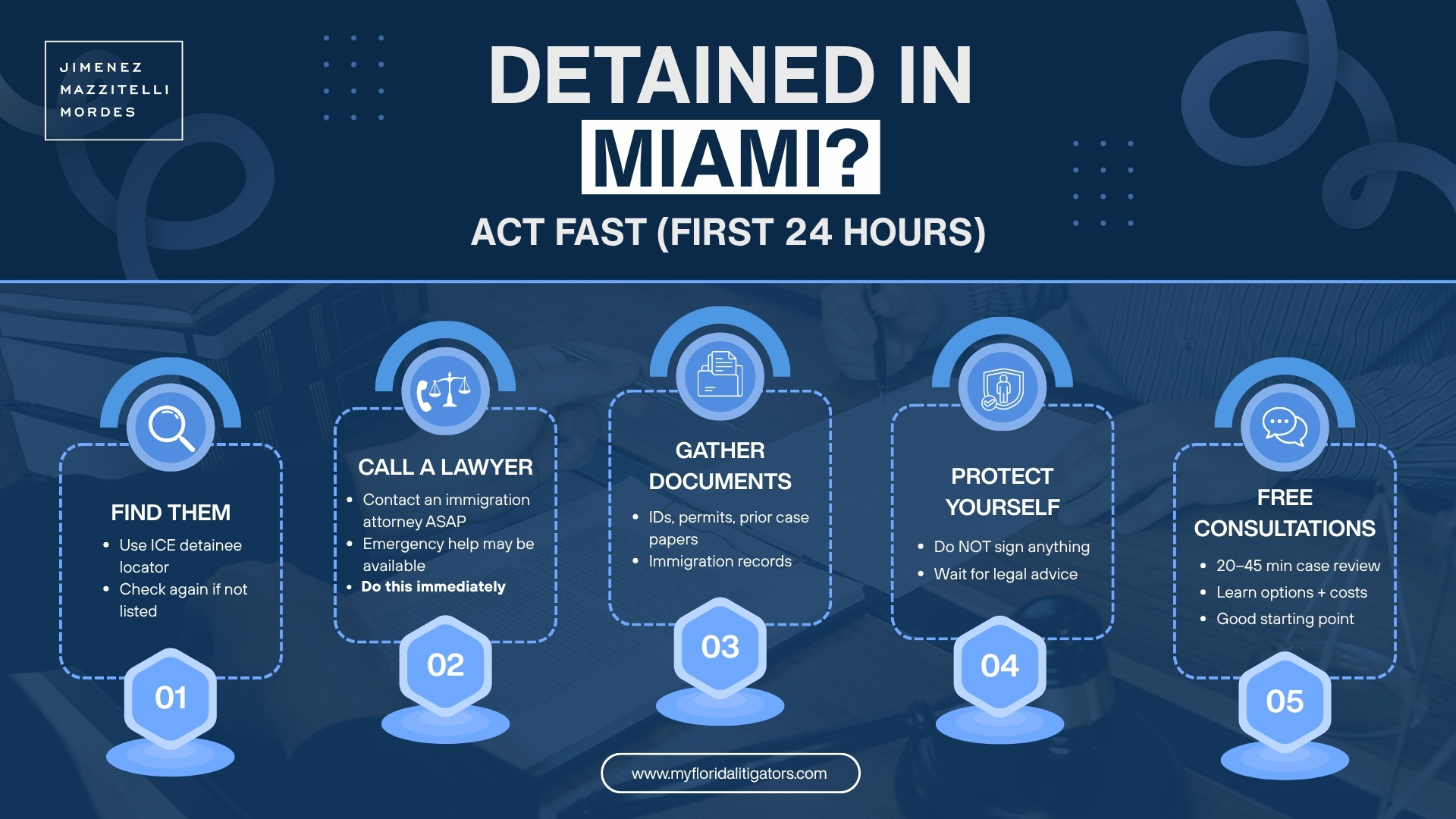
Miami Immigration Detention: What to Do in the First 24 Hours
The first hours after a detention are the ones that matter most. If a family member has been taken to Krome or another South Florida facility, here is a rough playbook. This is where a Miami immigration detention lawyer or immigration detention attorney earns their fee — the decisions made on the first day often control the trajectory of the entire case.
- Locate the person using the ICE Online Detainee Locator. If they are not listed, wait a few hours and check again. It can take time for records to appear.
- Contact an immigration attorney immediately. Many legal aid organizations in Miami-Dade have emergency response systems for detention cases, and several private Miami immigration detention lawyers take emergency intake after hours.
- Gather the person’s immigration documents, including any prior case numbers, work permits, green cards, or court paperwork.
- Identify witnesses to the arrest if it happened in public.
- Do not sign anything they ask you to sign without talking to a lawyer first.
- If you are a family member with lawful status, start gathering documents that could support a bond motion, including tax returns, proof of residence, letters of support, and evidence of community ties.
Krome Service Processing Center in southwest Miami-Dade is the primary ICE detention facility in the region. Conditions and access there have been the subject of active federal litigation, which means the landscape shifts regularly. An attorney who actually practices at Krome knows what is happening this week, not what the guidelines say on paper.
Free Immigration Consultations in Miami
One of the most common things people search for in Miami-Dade is an immigration lawyer’s free consultation. Free consultations do exist — both at nonprofit legal aid organizations and at many private immigration law firms in Hialeah, Homestead, Doral, and downtown Miami. What a free immigration consultation usually covers: a 20 to 45-minute review of your situation, a preliminary assessment of your legal options, and a clear explanation of what the attorney would charge to take your case if you move forward. It is not a full strategy session, and it is not a substitute for retained representation, but it is a real and useful starting point, especially for people who are early in the process or are not sure whether they need legal help at all. At JIMENEZ MAZZITELLI MORDES, we offer free immigration consultations for Miami-Dade families. Bring whatever paperwork you have, a list of questions, and a translator if you need one.
Free and Low-Cost Legal Aid Organizations in Miami-Dade
Miami-Dade has one of the strongest networks of immigrant legal aid organizations in the country, built up over decades in response to waves of migration from Cuba, Haiti, Nicaragua, Venezuela, Colombia, and beyond. A few are worth knowing by name. Americans for Immigrant Justice. Based in downtown Miami, AIJ has been serving low-income immigrants in South Florida since 1996. They handle asylum, children’s cases, detention representation, and deportation defense. Catholic Legal Services of the Archdiocese of Miami. One of the largest immigration legal aid providers in the state, with offices serving clients regardless of religion. They handle the full range of immigration matters, including family petitions, naturalization, and removal defense. Church World Service of Miami. Focused heavily on refugee resettlement, asylum, and community integration services. Florida Immigrant Coalition (FLIC).
A statewide coalition with deep roots in Miami-Dade, providing know-your-rights trainings, policy advocacy, and referrals to legal services. The Miami Office of New Americans. A county-level initiative offering workshops, citizenship drives, and resource connections for immigrant families across Miami-Dade. Legal Services of Greater Miami. Handles certain immigration matters alongside other civil legal aid for low-income residents. Put Families First. Focuses on keeping families together through legal representation during deportation proceedings. Eligibility varies by organization. Most have income guidelines, and some focus on specific populations like children, victims of crime, or asylum seekers. Calling ahead saves time.
Community Resources by Neighborhood: Homestead, Hialeah, Doral, Little Haiti, Little Havana
Miami-Dade’s immigrant population is not concentrated in one neighborhood. It stretches across the county, and so do the resource centers that serve it.
Homestead
Homestead serves the farmworker community and has long-standing connections to organizations like the Farmworker Association of Florida. Legal help, health services, and children’s advocacy all have a base here. Homestead immigration cases tend to involve agricultural work histories, and local Homestead immigration attorneys know which documentation patterns the field offices respond to.
Hialeah
Hialeah is the heart of the Cuban community in South Florida, with a strong consular presence and a number of community nonprofits. Hialeah also has a growing Venezuelan population, and resource centers have adjusted their services accordingly. Many families search specifically for Hialeah, Florida immigration lawyers because the neighborhood’s legal community is bilingual, deeply networked, and experienced with Cuban Adjustment Act and Venezuelan humanitarian parole cases.
Doral
Doral is the Venezuelan hub of South Florida. Consular services, mutual aid groups, and immigrant-focused nonprofits have multiplied here in recent years. A Doral immigration attorney will typically have heavy experience with Venezuelan TPS, asylum, and humanitarian parole matters.
Little Haiti and North Miami
Home to the Sant La Haitian Neighborhood Center and other organizations providing Creole-language legal and social services. The Haitian community here has been hit hard by shifts in TPS status and parole programs.
Little Havana
Home to longtime Cuban and Central American institutions. Resource centers here offer everything from citizenship classes to food pantry access. The area around Calle Ocho and SW 27th Avenue has multiple organizations within walking distance of each other.
Kendall and West Kendall
A growing immigrant corridor with a mix of nationalities. Resource access is more dispersed, but libraries and community centers host regular know-your-rights workshops. If you are not sure where to start, the Office of New Americans maintains a county-level list of partner organizations and can help direct you to the right door.
Status-Specific Updates: Venezuelan TPS, Cuban Parole, Haitian TPS
The federal environment for status-based protections changes often, and families should check current designations before making any decisions based on older guidance. Venezuelan TPS. Plantation, Doral, and Hialeah all have concentrated Venezuelan populations, and TPS re-registration windows, employment authorization renewals, and related matters are the most common questions a Venezuelan TPS attorney handles in South Florida. Deadlines for re-registration are unforgiving — missing one can end protection.
Cuban Parole and Cuban Adjustment Act. Long-standing pathways for Cuban nationals continue to operate but have seen procedural changes in recent years. An attorney familiar with Cuban immigration history is essential for complex cases. Haitian TPS. Haitian Temporary Protected Status has gone through several extensions and legal challenges. Families in Little Haiti and North Miami should verify current designations and re-registration windows whenever policy shifts. I
f your status is changing, about to expire, or has recently been affected by a federal announcement, do not wait for the rumor mill. Verify with a licensed immigration attorney or a legitimate legal aid organization.
Overstayed Visas and Visa Denials in Florida
Two other scenarios bring a steady stream of Miami-Dade residents into immigration attorney offices: overstayed visas and visa denials. Both are recoverable in many cases, but both carry compounding penalties the longer they go unaddressed. An overstayed visa lawyer in Florida will walk you through the consequences of overstay — potential three-year and ten-year bars to reentry, grounds of inadmissibility, and whether you qualify for a waiver — and chart a path forward.
A visa denial lawyer similarly reviews the denial reason, evaluates whether an appeal or refiling is the better strategy, and identifies what documentation was missing or insufficient the first time around. Neither situation fixes itself. Waiting makes both worse.
Miami Immigration Court
The Miami Immigration Court, located downtown, handles removal proceedings for detained and non-detained cases throughout South Florida. Hearings are scheduled by immigration judges, not by USCIS. Missing a court date can result in an in absentia removal order issued without you being present, which is one of the most damaging outcomes in immigration law. Key points about the court:
- Always arrive early. Security lines are long.
- Bring every document you have, even if you think the judge already has it.
- Language interpreters are provided, but the quality varies. If you have a private interpreter, bring them.
- If you cannot attend a hearing for a genuine emergency, your attorney must file a motion to continue before the hearing date.
- Change of venue motions can move a case to another immigration court if you have relocated, but these are not automatic.
Practical Preparation for Families
Every immigrant family in Miami-Dade should have a basic emergency plan. At minimum, that means:
- A list of emergency contacts, including attorneys and community organizations, is posted somewhere in the home and saved on multiple phones
- Copies of important documents — passports, birth certificates, marriage certificates, immigration paperwork — stored somewhere safe and accessible to a trusted family member
- A designated guardian for minor children in case both parents are detained
- Power of attorney documents prepared in advance, where appropriate, allowing a trusted person to handle finances, medical decisions, and school paperwork
- A plan for bills, rent, and essential expenses if a primary earner is detained
These plans are hard to build because they force families to imagine outcomes nobody wants to imagine. They are also the single most protective thing a family can do.
Final Thoughts on Knowing Your Rights
Immigration status in the United States is complex, and the rules change faster than most people can track. What does not change is this: you have rights, even when enforcement is loud, even when the news is frightening, even when your neighbors are worried. Staying connected to reliable legal aid, keeping your documents organized, and having a plan in place are not paranoia. They are preparing.
At JIMENEZ MAZZITELLI MORDES, we have spent years standing with immigrant families across Miami-Dade through every version of the federal environment, and we see firsthand how much difference knowledge and preparation make. If your family has questions about your immigration status, detention, removal defense, or any legal process you are facing in Florida, reach out to us or to any of the trusted organizations listed here. You do not have to navigate this alone, and the earlier you get informed, the stronger your position will be.
Frequently Asked Questions
Do I have to open the door if ICE knocks?
No. You only have to open the door if officers have a judicial warrant signed by a judge. An administrative ICE warrant does not grant entry.Can I get deported for refusing to answer questions?
You can use your right to remain silent. Staying silent does not create a new basis for deportation.Are there free immigration lawyers in Miami-Dade?
Yes. Several organizations, including Americans for Immigrant Justice and Catholic Legal Services, provide free or low-cost immigration help to qualifying clients. Many private immigration law firms also offer free initial consultations.Where can I get a free immigration lawyer consultation in Miami?
Free immigration consultations are available at several Miami-Dade nonprofits and at many private immigration law firms, including Jimenez Mazzitelli Mordes. Expect 20 to 45 minutes for an initial review of your situation.Do I need a Miami immigration detention lawyer right away if my family member is at Krome?
Yes. The first 24 to 72 hours after a detention are critical for bond motions, documentation gathering, and protecting the person’s case. An immigration detention attorney familiar with Krome should be contacted as soon as possible.
