
Construction work in Miami is booming. The city’s skyline keeps changing, new developments pop up regularly, and the construction industry remains one of the region’s largest employers. But for every new building that rises, there’s a real human cost. Construction sites are inherently dangerous places, and when injuries happen, it’s often unclear who bears responsibility.
If you or someone you know has been injured on a construction site in Miami, understanding liability can mean the difference between recovering damages and being left with mounting medical bills. The question of “who is liable?” isn’t always straightforward. It depends on multiple factors: the nature of the injury, the parties involved, workplace conditions, and how Florida law applies to your specific situation. Speaking with experienced Miami Construction Accident Lawyers can help clarify your rights and identify the parties responsible for your injuries.
Understanding Construction Site Liability in Miami
Construction site injuries happen more frequently than many people realize. In Florida, construction workers face risks ranging from falls and equipment accidents to electrocution and struck-by incidents. What makes these injuries unique from other workplace accidents is that liability can extend far beyond a simple workers’ compensation claim.
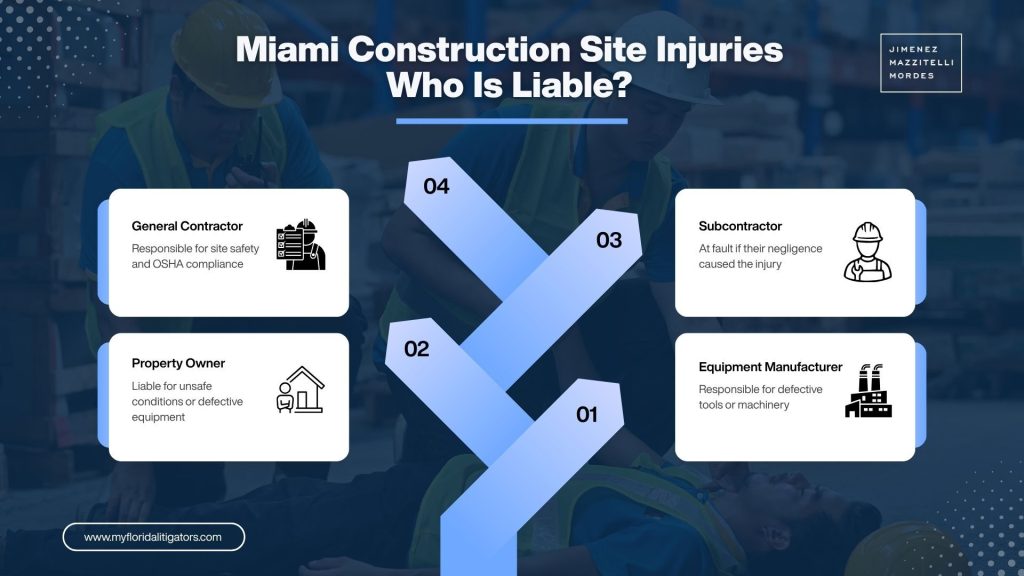
The first thing to understand is that construction site liability operates on multiple legal fronts. There’s the world of workers’ compensation, which typically covers employees injured while working. But there’s also personal injury law, premises liability, and third-party liability claims. In Miami, construction accident cases often involve several parties, each with varying degrees of responsibility.
Florida Statute 440.11 governs workers’ compensation in the state. This system provides benefits to workers injured on the job, but it also limits what workers can recover. Here’s the catch: accepting workers’ compensation often means you give up the right to sue your employer directly. However, third-party liability is different. If someone other than your employer caused your injury, you might have grounds for a much larger personal injury claim.
The Role of General Contractors and Site Safety
General contractors hold significant responsibility on construction sites. They’re the ones who organize the work, hire subcontractors, and set the safety standards. Under OSHA regulations and Florida law, general contractors must maintain a safe work environment and ensure compliance with safety regulations.
When a general contractor cuts corners on safety, ignores OSHA standards, or fails to properly supervise workers and subcontractors, they can be held liable for resulting injuries. For example, if a general contractor doesn’t provide proper fall protection on a high-rise job in downtown Miami, and a worker falls, that contractor bears liability even if a subcontractor performed the actual work.
A real scenario that’s common in Miami: A high-rise residential project in Brickell has a general contractor who doesn’t require hard hats on the job site. An accident occurs where a worker is struck by falling debris. Even if a subcontractor was responsible for the negligence, the general contractor may still be liable for failing to enforce proper safety protocols.
Florida courts have consistently held that general contractors have a non-delegable duty to maintain safe working conditions. This means they can’t simply pass responsibility to subcontractors and wash their hands clean. They remain accountable.
Premises Liability and Third-Party Claims
Premises liability is another avenue for construction injury claims. This applies when someone is injured because a property owner or manager failed to maintain safe conditions. In construction, this might involve:
- Unsafe scaffolding or equipment
- Inadequate signage or warnings
- Wet or slippery surfaces
- Unsecured hazardous materials
- Defective equipment provided by the site owner
A practical example: Suppose a construction worker in Miami Beach is injured because a ladder provided by the property owner was defective. The worker might not be limited to workers’ compensation. They could file a premises liability claim against the property owner, potentially recovering damages for pain and suffering, lost wages, and medical expenses far exceeding workers’ compensation benefits.
The key difference here is that premises liability claims allow for recovery of damages that workers’ compensation doesn’t cover. You can claim pain and suffering, emotional distress, and punitive damages in cases of gross negligence.
Subcontractors and Shared Liability
Miami’s construction industry relies heavily on subcontractors. General contractors hire electricians, plumbers, roofers, and dozens of other specialists. When a subcontractor’s negligence causes an injury, liability becomes complex.
If a subcontractor is independent and carries their own insurance, they typically bear responsibility for injuries their negligence causes. However, if the general contractor was involved in directing the subcontractor’s work or failed to supervise, both parties might share liability.
Florida’s comparative negligence law (Florida Statute 768.31) allows for shared liability based on each party’s percentage of fault. If you’re found 20% at fault and the defendant is 80% at fault, you can still recover 80% of your damages. This makes it crucial to have skilled legal representation to accurately assign fault.
A real-world scenario in the Miami construction industry: A roofing accident occurs at a commercial project in Coral Gables. The roofing subcontractor failed to provide fall protection, but the general contractor also failed to conduct proper safety inspections. Both parties bear responsibility, and both can be held liable.
OSHA Violations and Negligence
OSHA (Occupational Safety and Health Administration) sets strict standards for construction sites. These include requirements for:
- Fall protection at heights over 6 feet
- Proper scaffolding and ladder safety
- Equipment guarding and maintenance
- Personal protective equipment (PPE)
- Trenching and excavation safety
- Electrical safety
When a construction site in Miami violates OSHA standards, it’s not just a regulatory issue. OSHA violations can establish negligence in a personal injury lawsuit. If a contractor violated an OSHA standard and that violation caused your injury, you have strong grounds for a liability claim.
For instance, if a construction site in Miami-Dade County didn’t follow OSHA trenching standards and a worker suffered a cave-in injury, that OSHA violation demonstrates negligence. It becomes difficult for the defendant to argue they weren’t responsible when they clearly violated federal safety standards.
Workers’ Compensation vs. Third-Party Claims
Here’s where many construction workers get confused. Workers’ compensation is mandatory in Florida for most construction companies with employees. It’s a trade-off: you get automatic benefits regardless of fault, but you typically can’t sue your employer.
Third-party claims are different. These are suits against people or companies other than your direct employer. This might include:
- The general contractor (if you work for a subcontractor)
- A property owner or manager
- A manufacturer of defective equipment
- Another contractor whose negligence caused your injury
A worker employed by a subcontractor in Miami can file workers’ compensation with their employer and simultaneously pursue a third-party claim against the general contractor or property owner. This combination often results in significantly higher recovery because third-party claims aren’t capped like workers’ compensation benefits.
Real-World Miami Construction Injury Cases
Construction injury cases in Miami follow patterns established by Florida courts. While specific confidential cases can’t be discussed in detail, the types of injuries and liability scenarios are well-documented:
Falls remain the leading cause of construction deaths and serious injuries. A construction worker falling from a scaffold in a Wynwood construction project due to inadequate fall protection has a clear negligence case. The absence of proper harnesses, guardrails, or safety nets indicates failure to follow OSHA standards.
Electrical injuries occur regularly on construction sites. When a worker in Miami is electrocuted due to improper grounding, inadequate PPE, or failure to de-energize equipment, liability falls to whoever was responsible for electrical safety on the site.
Equipment-related injuries involve everything from nail guns to heavy machinery. A construction worker struck by a forklift on a site in Midtown Miami might have claims against the equipment owner, the operator, and the general contractor for failure to supervise or properly train operators.
How Fault is Determined
Determining fault in construction injury cases requires investigation. Attorneys examine:
- OSHA reports and safety records
- Witness statements from other workers
- Photographs and video of the accident scene
- Equipment maintenance records
- Training documentation
- Prior similar incidents
- Expert testimony about safety standards
In Miami, construction injury investigations must happen quickly. Evidence can disappear, witness memories fade, and sites change. That’s why getting legal guidance immediately after an injury matters so much.
A site accident in Doral that involved a worker being hit by equipment might involve multiple investigations: OSHA’s official investigation, the company’s internal investigation, insurance adjusters’ investigations, and your attorney’s independent investigation. Each may reach different conclusions about fault.
Damages You Can Recover
Construction injury damages depend on the type of claim. Workers’ compensation covers medical expenses and partial lost wages, but not pain and suffering. Third-party claims can cover:
- All medical expenses (past and future)
- Lost wages and lost earning capacity
- Pain and suffering
- Emotional distress
- Permanent disability
- Disfigurement
- Punitive damages (in cases of gross negligence)
A serious construction injury in Miami can result in damages ranging from $50,000 to several hundred thousand dollars, depending on injury severity, age, earning capacity, and liability strength.
Comparative Negligence and Your Recovery
Florida’s comparative negligence doctrine affects your recovery. If you were partially at fault for your injury, it reduces your damages proportionally. However, you can still recover as long as you’re less than 50% at fault.
Example: You’re injured in a construction accident where you weren’t wearing required PPE (20% your fault) and the contractor failed to provide proper fall protection (80% their fault). You can still recover 80% of your damages.
What To Do After a Construction Injury
The steps you take immediately after a construction injury significantly impact your claim:
- Seek medical attention. Your health is priority one, and medical records establish injury severity.
- Report the injury to your employer. This triggers workers’ compensation and creates documentation.
- Document everything. Take photos, get witness names and contact information, and write down what happened.
- Don’t sign anything. Insurance adjusters may ask you to sign statements. Consult an attorney first.
- Contact an attorney. Time limits apply to construction injury claims, and early representation helps preserve evidence.
- Keep records. Save all medical bills, pay stubs, and communications about your injury.
Florida’s Statute of Limitations
You have four years from the date of your construction injury to file a personal injury lawsuit in Florida (Florida Statute 95.11). However, don’t wait. Evidence deteriorates, memories fade, and witnesses move away. The sooner you pursue your claim, the stronger it typically becomes.
For workers’ compensation claims, there are different time limits, often more restrictive. Acting quickly protects your rights.
Prevention: Construction Safety in Miami
While this article focuses on liability after injury, prevention is always better. Construction sites in Miami should maintain strict safety protocols:
- Regular OSHA compliance training
- Proper fall protection systems
- Daily safety inspections
- Hazard identification and control
- Emergency response procedures
- Personal protective equipment for all workers
- Equipment maintenance and inspection
- Clear communication and supervision
Companies that prioritize safety reduce injuries, reduce liability, and create better workplaces.
Navigating the Legal System
Construction injury cases are complex. They require an understanding of workers’ compensation law, personal injury law, OSHA regulations, and Florida-specific statutes. They also require investigation skills and access to expert witnesses who can testify about industry standards.
When you’re injured and recovering, hiring experienced legal representation allows you to focus on healing while attorneys handle the legal complexity. The difference between representing yourself and having skilled counsel often means the difference between a minimal settlement and a fair recovery.
Moving Forward After a Construction Injury
A construction injury disrupts your life. Beyond physical pain, there’s lost income, medical stress, and uncertainty about the future. Knowing who’s liable and understanding your legal options provides clarity during a difficult time.
At JIMENEZ MAZZITELLI MORDES, we’ve represented construction workers injured in Miami and throughout Florida for years. Our team understands how these injuries happen, who typically bears responsibility, and how to build strong cases that result in fair compensation. We handle the legal process so you can focus on recovery.
If you’ve been injured on a construction site in Miami, don’t navigate this alone. The parties responsible for your injury have insurance companies and legal teams protecting their interests. You deserve the same level of protection and advocacy. We can discuss your case, explain your options, and help you understand what you might recover.
Construction sites will always carry risks. But that doesn’t mean workers should accept injuries caused by negligence or corner-cutting. When construction site negligence causes injury, we’re here to hold the responsible parties accountable and get you the compensation you deserve.
Frequently Asked Questions
Can I sue my employer if I was injured on a construction site in Florida?
In most cases, no. Workers’ compensation prevents employees from suing their direct employer. However, if you were injured by a third party (general contractor, property owner, equipment manufacturer), you can sue them separately. If you work for a subcontractor and the general contractor was negligent, you likely have a claim against the general contractor.
What is an OSHA violation, and why does it matter in my injury case?
OSHA violations are breaches of federal safety standards. When a contractor violates OSHA regulations and that violation causes your injury, it establishes negligence. It’s difficult for defendants to argue they weren’t responsible when they clearly violated federal safety standards that existed specifically to prevent your type of injury.
How long do I have to file a personal injury claim after a construction injury in Miami?
You have four years from the date of injury to file a personal injury lawsuit in Florida. However, evidence and witnesses are best preserved sooner. Don’t wait to pursue your claim. Contact an attorney as soon as possible after your injury.
What damages can I recover in a construction injury case?
Third-party liability claims can include medical expenses, lost wages, lost earning capacity, pain and suffering, emotional distress, permanent disability, and punitive damages in cases of gross negligence. Workers’ compensation covers medical expenses and partial lost wages, but not pain and suffering.
What if I were partially at fault for my construction injury?
Florida’s comparative negligence law allows you to recover damages even if you’re partially at fault, as long as you’re less than 50% responsible. Your recovery is reduced by your percentage of fault.
