
The most common personal injury claims in Miami involve car accidents, truck collisions, motorcycle crashes, pedestrian incidents, boating accidents, slip and falls, and medical malpractice. Victims file these claims to recover financial compensation for medical bills, lost wages, and pain and suffering caused by another party’s negligence. Florida law gives victims exactly two years to file a negligence claim.
Miami experiences thousands of personal injury accidents every year due to dense populations, heavy tourism, and congested roadways. This guide explains the most frequent types of personal injury claims in Miami, the legal options available to victims, and the specific compensation they can recover. Readers will learn how Florida’s updated negligence laws affect their cases and why securing legal representation early makes a significant difference. Jimenez Mazzitelli Mordes provides aggressive representation to help injured individuals secure maximum compensation.
Key Takeaways
- Car accidents dominate claims: Vehicle collisions account for the highest volume of personal injury cases in Miami-Dade County.
- Florida limits filing time: House Bill 837 changed the statute of limitations for general negligence claims to two years.
- Fault affects compensation: Florida follows a modified comparative negligence rule, meaning victims receive no compensation if they hold more than 50% of the fault.
- Boating accidents present unique risks: Miami’s extensive waterways lead to complex maritime injury claims requiring specialized legal knowledge.
- Early legal intervention increases success: Contacting Jimenez Mazzitelli Mordes immediately preserves critical evidence and prevents insurance companies from minimizing payouts.
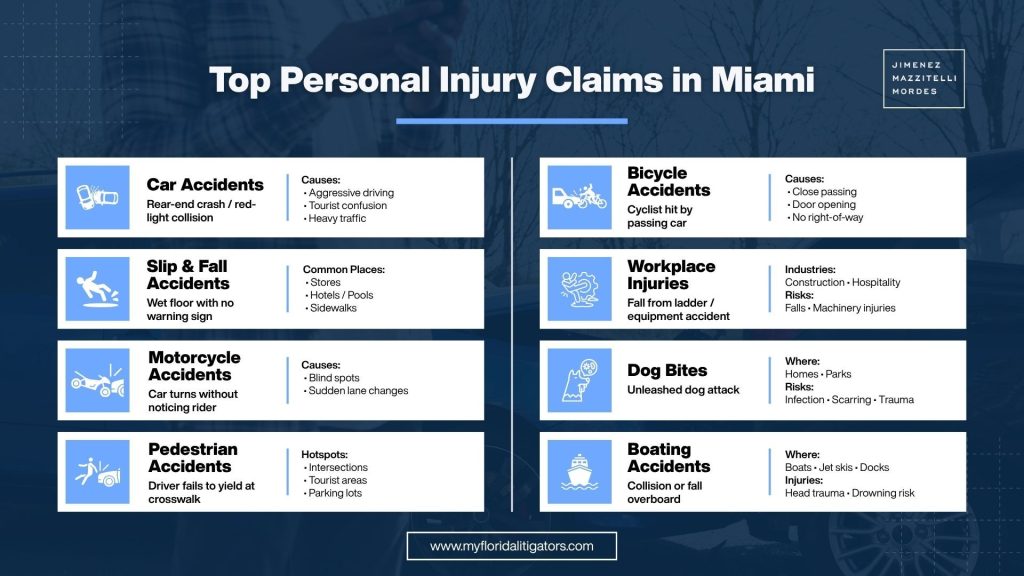
Why Personal Injury Claims Are So Common In Miami
Miami ranks among the busiest and most densely populated regions in the United States. This high concentration of residents and visitors directly increases the frequency of accidents. Negligence takes many forms, from distracted driving on the highway to poorly maintained commercial properties. Jimenez Mazzitelli Mordes routinely represents clients injured in these diverse environments.
Miami’s Heavy Traffic, Tourism, Waterways, And Dense Urban Areas
Miami-Dade County features heavy traffic congestion, extensive tourism, and bustling waterways. These elements combine to create a high-risk environment for accidents. Major highways like I-95, the Palmetto Expressway, and Biscayne Boulevard see thousands of vehicles daily. Dense urban areas like Brickell and Downtown Miami mix heavy commuter traffic with vulnerable pedestrians and cyclists.
According to the Florida Department of Highway Safety and Motor Vehicles, Miami-Dade County regularly records over 60,000 traffic crashes annually. Rideshare traffic significantly contributes to this congestion. Drivers for Uber and Lyft frequently stop in active lanes, causing unexpected hazards for other motorists.
Tourists unfamiliar with local roads add another layer of danger. Visitors often navigate unfamiliar routes using GPS devices, leading to distracted driving. Beyond the roads, Miami Beach, Biscayne Bay, Key Biscayne, and the Intracoastal Waterway host thousands of recreational boaters. This heavy maritime traffic directly leads to high rates of boating collisions and water-related injuries.
Common Places Where Accidents Happen In Miami
Accidents happen constantly across various private and public locations in Miami. Our Miami personal injury attorneys regularly investigate incidents at the following sites:
- Highways and intersections: High-speed collisions frequently occur on I-95 and at major intersections along US-1.
- Hotels and restaurants: Slip and fall accidents regularly happen in dining areas, lobbies, and pool decks.
- Apartment complexes and shopping centers: Poor maintenance leads to trips, falls, and negligent security incidents.
- Construction sites: Miami’s constant development exposes workers and bystanders to falling debris and heavy machinery accidents.
- Parking lots: Low-speed impacts and pedestrian knockdowns occur daily in crowded retail parking garages.
- Beaches, marinas, and boat ramps: Waterfront locations present high risks for slip and falls and boating-related injuries.
- Cruise terminals: Passengers frequently sustain injuries during embarkation or while navigating crowded terminal facilities.
- Waterfront entertainment areas: High alcohol consumption in these districts increases the risk of assaults and negligent security claims.
1. Car Accident Claims
Car accidents represent the highest volume of personal injury claims in Miami. The sheer number of vehicles on the road guarantees a steady rate of daily collisions. Victims file car accident claims to cover expenses that exceed their Personal Injury Protection (PIP) coverage. Jimenez Mazzitelli Mordes helps car accident victims navigate these complex insurance disputes.
Rear-End Collisions, Intersection Crashes, And Highway Accidents
Different types of collisions dominate Miami’s traffic reports. Rear-end collisions happen frequently during sudden traffic stops on the Palmetto Expressway. Drivers following too closely fail to stop in time, causing significant impact force.
Intersection crashes represent another major category. Drivers running red lights or making unsafe left turns along Biscayne Boulevard frequently cause T-bone accidents. These side-impact collisions often result in catastrophic injuries because the sides of vehicles offer less protection than the front or rear.
Highway accidents on the Dolphin Expressway and I-95 tend to involve high speeds. These crashes often involve multiple vehicles and result in severe property damage and life-threatening injuries.
Common Car Accident Injuries
Vehicle collisions cause a wide spectrum of physical trauma. The sudden deceleration and blunt force impact damage the human body in predictable ways. Common car accident injuries include:
- Whiplash: The sudden back-and-forth movement of the neck tears muscles and ligaments.
- Back injuries: The impact force commonly causes spinal sprains and muscle strains.
- Traumatic brain injuries (TBI): Striking the steering wheel or window causes concussions and severe brain damage.
- Fractures: High-impact crashes frequently break arms, legs, ribs, and collarbones.
- Soft tissue injuries: Seatbelts and airbags save lives but often cause severe bruising and deep tissue damage.
- Herniated discs: The spinal column compresses during a crash, causing discs to rupture and press against sensitive nerves.
Who May Be Liable After A Miami Car Accident
Identifying the liable party remains a critical step in any personal injury claim. Multiple parties may share responsibility for a single crash. Potentially liable parties include:
- Negligent drivers: Individuals who speed, text, or drive under the influence hold primary liability.
- Commercial drivers: Delivery drivers and service workers operate under strict regulations. Their employers may also share liability for their negligence.
- Rideshare drivers: Uber and Lyft drivers carry specific corporate insurance policies that activate depending on their app status at the time of the crash.
- Vehicle owners: Florida law holds vehicle owners liable for the negligence of anyone driving their car with permission.
- Uninsured/underinsured motorists: When the at-fault driver lacks insurance, victims may file claims against their own uninsured motorist policies.
2. Truck Accident Claims
Commercial truck accidents cause devastating injuries due to the massive size and weight of the vehicles involved. A fully loaded semi-truck weighs up to 80,000 pounds, making it incredibly dangerous when it collides with a standard passenger car. Jimenez Mazzitelli Mordes aggressively pursues trucking companies that violate safety regulations.
Why Truck Accidents Often Cause Severe Injuries
The physical disparity between trucks and cars guarantees severe outcomes in a collision. Size and weight directly correlate to the amount of force transferred during an impact. Standard passenger vehicles simply cannot withstand the crushing force of a commercial truck.
Cargo loads also complicate these accidents. Improperly secured cargo can shift during transit, causing the truck to jackknife or roll over. Overloaded trucks require significantly longer braking distances. A truck traveling at highway speeds needs the length of two football fields to stop completely.
Multi-vehicle crashes frequently happen when a truck loses control on a busy highway like I-95. Port-related commercial traffic moving in and out of PortMiami adds thousands of heavy trucks to local roads daily, increasing the risk for all commuters.
Potentially Liable Parties In A Truck Accident
Trucking accident claims involve complex liability structures. Unlike a simple two-car crash, a trucking accident often implicates multiple corporate entities. Liable parties may include:
- The truck driver: The driver holds liability for speeding, driving while fatigued, or violating hours-of-service regulations.
- The trucking company: Employers face liability for negligent hiring, inadequate training, or forcing drivers to meet unrealistic deadlines.
- The maintenance provider: Third-party mechanics hold liability if they fail to repair brakes or replace worn tires properly.
- The cargo loader: Companies that improperly load or secure freight hold liability when shifting cargo causes a crash.
- The parts manufacturer: Manufacturers face strict liability if a defective tire or steering component causes the accident.
3. Motorcycle Accident Claims
Motorcyclists face unique dangers on Miami’s crowded streets. They lack the protective metal shell, seatbelts, and airbags that shield passenger vehicle occupants. As a result, motorcycle accidents almost always result in serious injury or death. Our Miami personal injury attorneys understand the biases motorcyclists face from insurance adjusters.
Why Motorcyclists Face Higher Injury Risks In Miami
The design of a motorcycle leaves the rider completely exposed to external forces. When a crash occurs, the rider absorbs the direct impact of the collision and the subsequent impact with the asphalt.
Miami drivers frequently make sudden lane changes without checking their blind spots. Motorcyclists easily disappear into these blind spots, leading to side-swipe collisions. Distracted driving heavily contributes to these accidents. Drivers looking at their phones often fail to notice a stopped motorcycle at an intersection, resulting in catastrophic rear-end crashes.
Unsafe turns also threaten riders. Left-turning cars frequently pull directly into the path of an oncoming motorcycle. Furthermore, poor road conditions like potholes, uneven pavement, and loose gravel cause motorcycles to lose traction. Tourist traffic compounds these issues, as lost visitors make unpredictable maneuvers.
Common Motorcycle Accident Injuries
The lack of physical protection guarantees severe trauma during a crash. Even low-speed accidents cause significant damage to the human body. Common injuries include:
- Road rash: Sliding across the asphalt scrapes away layers of skin and muscle, often requiring skin grafts.
- Fractures: Riders frequently break their legs, arms, and pelvis upon impact with the road or the opposing vehicle.
- Spinal injuries: The force of the crash can sever or compress the spinal cord, leading to partial or complete paralysis.
- Head injuries: Even with a helmet, riders suffer severe traumatic brain injuries and skull fractures.
- Amputations: Crushing forces during a collision can severely damage limbs, making surgical amputation the only medical option.
4. Pedestrian Accident Claims
Miami promotes a vibrant, walkable culture, particularly in tourist-heavy areas. However, this walkability places pedestrians in close proximity to aggressive traffic. Pedestrian accidents cause some of the most catastrophic injuries because the human body cannot withstand the impact of a moving vehicle.
Where Pedestrian Accidents Often Happen
Certain areas in Miami see a higher concentration of pedestrian knockdowns. These locations blend heavy foot traffic with confusing vehicle traffic patterns. High-risk locations include:
- Crosswalks: Drivers frequently fail to stop for pedestrians legally crossing the street.
- Hotel zones: Visitors walking between hotels and beaches face constant traffic from taxis and rideshares.
- School zones: Children walking to and from school face risks from speeding commuters.
- Nightlife districts: Intoxicated drivers and pedestrians share the same space in areas like Wynwood and Miami Beach.
- Parking lots: Drivers backing out of spaces often fail to check for people walking behind them.
- Downtown Miami and Brickell: Heavy commuter traffic clashes with residents walking to local businesses.
Common Causes Of Pedestrian Injuries
Driver negligence causes the vast majority of pedestrian accidents. Drivers frequently ignore traffic laws designed to protect vulnerable road users. Common causes include:
- Speeding: High speeds reduce a driver’s reaction time and dramatically increase the severity of the pedestrian’s injuries.
- Failure to yield: Drivers turning right on red often strike pedestrians legally entering the crosswalk.
- Distracted driving: Texting drivers drift into bike lanes and crosswalks without looking up.
- Impaired driving: Alcohol and drugs severely reduce a driver’s ability to spot pedestrians at night.
- Rideshare pickup/drop-off areas: Uber and Lyft drivers make sudden, illegal stops, forcing pedestrians to walk into active traffic lanes to enter the vehicle.
5. Boating Accident Claims
Miami’s culture heavily revolves around the water. Biscayne Bay and the Atlantic Ocean attract thousands of recreational boaters every weekend. Boating accidents generate a significant percentage of personal injury claims in South Florida. Jimenez Mazzitelli Mordes possesses the specific maritime law experience required to handle these complex cases.
Why Boating Accidents Are Common In Miami
Miami features miles of navigable waterways that remain active year-round. Biscayne Bay, Miami Beach, Key Biscayne, and the Intracoastal Waterway host everything from massive yachts to small personal watercraft.
According to the Florida Fish and Wildlife Conservation Commission (FWC) 2023 Boating Accident Statistical Report, Florida recorded 659 reportable boating accidents, resulting in 59 fatalities. Miami-Dade County consistently ranks among the highest in the state for boating accidents.
The sheer volume of vessels creates dangerous conditions. Marinas, boat ramps, and sandbars become highly congested on weekends. Yacht charters, fishing charters, and jet ski rentals place inexperienced operators behind the wheel of powerful watercraft. Waterfront tourism encourages a party atmosphere, heavily mixing alcohol consumption with boat operation.
Common Causes Of Boating Accidents
Boating accidents stem from operator negligence and a lack of safety enforcement. The water presents a dynamic, constantly changing environment that requires total focus. Common causes include:
- Operator inexperience: Renters often operate high-powered boats with zero prior training.
- Boating under the influence (BUI): Alcohol severely impairs judgment, balance, and reaction time on the water.
- Speeding: Operating at high speeds in congested areas like the Intracoastal Waterway reduces the ability to avoid collisions.
- Reckless operation: Jet ski operators frequently jump wakes and weave dangerously between larger vessels.
- Distracted boating: Operators focus on passengers or phones instead of scanning the water for navigational hazards.
- Overcrowded vessels: Exceeding the maximum capacity alters the boat’s center of gravity, leading to capsizing.
- Poor weather and visibility: Sudden South Florida storms create massive waves and eliminate visibility in minutes.
- Equipment failure: Poorly maintained steering cables or engines cause operators to lose control.
- Lack of safety gear: Failing to provide accessible life jackets turns minor accidents into fatal drownings.
- Negligent rental companies: Businesses hold liability when they rent defective vessels or fail to provide legally required safety instructions.
Common Injuries In Miami Boating Accident Claims
Water-based accidents introduce the immediate threat of drowning alongside blunt force trauma. Passengers lack seatbelts, meaning collisions throw them violently around the cabin or directly into the water. Common injuries include:
- Drowning and near-drowning: Unconscious victims quickly sink, suffering severe brain damage from oxygen deprivation.
- Traumatic brain injuries: Passengers frequently strike their heads against bulkheads or the deck during sudden stops.
- Spinal cord injuries: The impact of a boat slamming into a wave at high speeds compresses the spine.
- Broken bones: Collisions easily snap arms and legs against the rigid fiberglass hull.
- Propeller injuries: Victims in the water suffer catastrophic lacerations and amputations if a boat reverses over them.
- Burns: Engine fires or fuel explosions cause severe, disfiguring burns.
- Hypothermia: Extended time in the water, even in Florida, lowers core body temperatures to dangerous levels.
- Wrongful death: Fatalities occur frequently due to drowning and massive internal trauma.
Who May Be Liable After A Boating Accident
Determining liability in a boating accident requires a thorough investigation of the vessel’s operation and ownership. Multiple parties may share financial responsibility. Liable entities include:
- Boat operators: The person driving the vessel holds the primary duty of care for their passengers and surrounding boats.
- Boat owners: Florida law holds vessel owners liable for damages caused by anyone operating their boat with permission.
- Rental and charter companies: Businesses face liability if they rent unsafe equipment or hire unqualified captains.
- Tour operators: Commercial tour boats must adhere to strict Coast Guard safety regulations.
- Jet ski rental providers: Facilities hold liability when they allow clearly intoxicated or underage individuals to rent personal watercraft.
- Marinas and maintenance companies: Negligent repairs that cause engine failure transfer liability to the mechanic.
- Equipment manufacturers: Defective steering systems or hull designs trigger product liability claims.
Why Boating Accident Claims Can Be More Complex
Boating accidents differ significantly from car accidents. They involve overlapping jurisdictions and specialized legal codes. These claims often implicate Florida boating laws alongside federal maritime law.
Investigations rely heavily on Coast Guard or local marine patrol reports, which differ from standard police traffic reports. Furthermore, rental waivers complicate the process. Rental companies force customers to sign liability waivers, but Jimenez Mazzitelli Mordes knows how to challenge these documents when gross negligence occurs. Insurance disputes happen frequently because marine insurance policies contain specific navigational limits and exclusions. Finally, alcohol-related liability and questions about exactly where the accident occurred (state waters versus international waters) drastically change the legal strategy.
6. Bicycle And Scooter Accident Claims
Bicycles and motorized scooters provide popular alternative transportation across Miami. However, the infrastructure has not fully adapted to protect these riders. Cyclists and scooter riders face the exact same exposure risks as motorcyclists, often with even less protective gear.
Why Bicycle And Scooter Accidents Are Increasing In Urban Areas
The rise of micromobility fundamentally changed how people navigate Downtown Miami and Brickell. The introduction of app-based rental scooters and e-bikes flooded the streets with new riders.
Bike lanes remain inconsistent and frequently blocked by delivery drivers. Delivery riders on e-bikes rush through congested traffic to meet app deadlines, increasing the risk of collisions. Tourists heavily utilize rental scooters to explore the city, often riding on sidewalks or ignoring traffic signals. Congested downtown streets simply do not offer enough safe space to accommodate cars, pedestrians, and scooters simultaneously.
Liability Issues In Bike And Scooter Claims
Establishing fault in bicycle and scooter accidents requires demonstrating exactly how the collision occurred. Liability issues frequently involve:
- Negligent drivers: Motorists turning right frequently cut off cyclists riding in the designated bike lane.
- Unsafe roads: Potholes and uneven pavement throw scooter riders violently to the ground.
- Defective equipment: Rental scooters often suffer from broken brakes or sticking throttles.
- Scooter rental company issues: Companies face liability if they fail to perform scheduled maintenance on their fleet.
- Failure to yield: Drivers opening their car doors into the bike lane cause devastating “dooring” accidents.
- Poor visibility: Accidents spike at night when drivers fail to notice cyclists lacking proper reflective gear.
7. Slip And Fall Claims
Slip and fall accidents fall under premises liability law. Property owners in Florida owe a legal duty to keep their premises reasonably safe for invited guests. When they fail this duty, they become liable for the resulting injuries. Jimenez Mazzitelli Mordes investigates property records to prove negligence in slip and fall claims.
Common Slip And Fall Locations In Miami
Dangerous property conditions exist in both commercial and residential spaces. High foot traffic rapidly creates hazards. Common locations include:
- Grocery stores: Spilled liquids in aisles create immediate slipping hazards.
- Hotels and restaurants: Greasy kitchen floors and freshly mopped lobby tiles cause sudden falls.
- Apartment buildings: Poorly maintained stairwells and broken elevators injure tenants.
- Malls and shopping centers: Leaking air conditioning units puddle water on slick tile floors.
- Parking garages: Oil spills and uneven concrete cause trips and slips.
- Pool decks, cruise terminals, and marinas: Standing water naturally accumulates in these waterfront properties, requiring constant monitoring.
Dangerous Conditions That Can Lead To A Claim
Property managers must identify and fix hazards before they cause an injury. Dangerous conditions that trigger claims include:
- Wet floors: Mopping without placing visible warning signs constitutes clear negligence.
- Uneven pavement: Cracked sidewalks and raised tree roots create invisible tripping hazards.
- Poor lighting: Burned-out bulbs in stairwells hide obstacles from visitors.
- Broken stairs and missing handrails: Building code violations guarantee liability when a fall occurs.
- Loose mats: Frayed or unsecured entry mats slide underfoot, causing instant trips.
- Slippery pool decks and unsafe docks: Marinas must treat walking surfaces to provide adequate traction near the water.
What Must Be Proven In A Slip And Fall Case
Winning a slip and fall case requires proving specific legal elements. The victim cannot simply state they fell; they must prove the property owner caused the fall through negligence. The required elements include:
- Duty of care: The owner possessed a legal obligation to keep the property safe.
- Notice of hazard: The owner knew, or reasonably should have known, about the dangerous condition.
- Failure to fix or warn: The owner failed to clean the spill, repair the break, or post adequate warning signs.
- Causation: The specific hazard directly caused the victim’s fall.
- Damages: The fall resulted in verifiable medical injuries and financial losses.
8. Negligent Security Claims
Negligent security claims represent a high-value subset of premises liability. These cases arise when a person suffers a violent crime on someone else’s property because the owner failed to implement adequate security measures. Property owners must protect visitors from foreseeable criminal acts.
When A Property Owner May Be Responsible For Criminal Acts
Property owners hold liability when their negligence allows criminals easy access to victims. Foreseeable crime remains the key factor. If a parking lot has a history of muggings, the owner must implement security measures. Liability triggers include:
- Inadequate lighting: Dark parking lots invite robberies and assaults.
- Broken locks: Failing to fix secure entry doors allows criminals into apartment complexes.
- Lack of security personnel: High-risk venues like nightclubs must employ trained bouncers.
- Poor access control: Hotels must ensure strangers cannot access guest hallways.
- Failure to monitor high-risk areas: Property managers must utilize and actively monitor surveillance cameras.
Common Negligent Security Locations
Criminals target locations where property owners ignore security protocols. Jimenez Mazzitelli Mordes pursues claims against owners of the following properties:
- Apartment complexes: Unsecured gates lead to home invasions and assaults in common areas.
- Hotels: Guests suffer assaults when keycard access fails.
- Parking lots and gas stations: Isolated customers face high risks of robbery late at night.
- Nightclubs and entertainment districts: Overcrowding and alcohol mix to cause violent fights when bouncers fail to intervene.
- Marinas and waterfront venues: Unsecured docks allow thieves access to vulnerable boaters.
9. Dog Bite And Animal Attack Claims
Florida enforces strict liability for dog bites. This means dog owners hold financial responsibility when their dog bites someone, regardless of whether the dog showed prior aggression. Victims do not need to prove the owner was negligent, only that the bite occurred in a public place or while legally on private property.
Common Injuries From Dog Bites
Dog attacks cause severe physical trauma and leave victims with lasting psychological damage. The crushing force of a dog’s jaw destroys tissue and bone. Common injuries include:
- Puncture wounds: Teeth drive deep into the muscle, introducing dangerous bacteria.
- Infections: Dog mouths carry pathogens that cause severe secondary infections, requiring intravenous antibiotics.
- Nerve damage: Deep bites sever nerves, leading to permanent loss of sensation or mobility.
- Scarring and facial injuries: Children frequently suffer bites to the face, requiring extensive reconstructive plastic surgery.
- Emotional trauma: Victims, especially children, often develop severe PTSD and lifelong phobias of animals.
Who Can Be Liable For A Dog Bite In Miami
Identifying the liable party usually involves tracking down homeowner’s or renter’s insurance policies. Liable parties include:
- Dog owners: The owner holds primary strict liability under Florida law.
- Property owners: Homeowners hold liability if the dog escapes from an unsecured fence.
- Landlords in limited cases: Landlords face liability if they know a tenant harbors a dangerous dog and fail to evict them.
- Commercial property operators: Businesses face liability if they allow dangerous guard dogs to attack customers.
10. Medical Malpractice Claims
Medical malpractice occurs when a healthcare professional deviates from the accepted standard of care, resulting in patient injury or death. These are not standard negligence claims. Medical malpractice cases require extensive resources, expert testimony, and a deep understanding of Florida’s complex pre-suit requirements.
Examples Of Medical Malpractice Claims
Doctors and nurses make devastating errors in clinical settings. When medical professionals act negligently, the consequences are life-altering. Examples include:
- Surgical errors: Surgeons leave sponges inside patients, operate on the wrong body part, or lacerate adjacent organs.
- Misdiagnosis and delayed diagnosis: Doctors fail to identify cancer or stroke symptoms, destroying the patient’s chance of survival.
- Medication errors: Nurses administer the wrong dosage or the wrong medication entirely.
- Birth injuries: Obstetricians apply excessive force during delivery, causing cerebral palsy or Erb’s palsy.
- Emergency room mistakes: Overworked staff discharge patients suffering from active heart attacks.
- Anesthesia errors: Anesthesiologists administer improper chemical mixtures, causing brain damage or waking the patient during surgery.
Why Medical Malpractice Cases Are Different
Medical malpractice cases follow completely different legal rules than car accidents or slip and falls. Florida law heavily regulates these claims to protect doctors from frivolous lawsuits.
These claims require a mandatory pre-suit investigation period. Before filing a lawsuit, the attorney must secure an affidavit from an independent medical expert swearing that malpractice occurred. The claims involve highly complex medical records that require specialized clinical analysis. Furthermore, the statute of limitations operates differently, often governed by a “rule of discovery” regarding when the patient actually learned of the medical error.
11. Wrongful Death Claims
Wrongful death claims represent the most tragic personal injury cases. When a victim dies due to another party’s negligence, their surviving family members step into their legal shoes to file a claim. Jimenez Mazzitelli Mordes handles these sensitive cases with total compassion while aggressively pursuing the responsible parties.
When A Personal Injury Case Becomes A Wrongful Death Claim
Any standard personal injury incident turns into a wrongful death claim if the injuries prove fatal. This transition shifts the legal focus from compensating the victim to compensating the victim’s estate and survivors. Common triggers include:
- Fatal crashes: High-speed highway collisions frequently kill drivers and passengers.
- Boating accidents: Drownings immediately trigger wrongful death statutes.
- Falls: Elderly victims often succumb to complications arising from a broken hip sustained in a slip and fall.
- Medical negligence: Surgical errors directly cause patient fatalities.
- Workplace incidents: Construction workers die in scaffolding collapses.
- Violent incidents: Negligent security cases become wrongful death claims when an assault results in murder.
Damages Families May Be Able To Seek
The Florida Wrongful Death Act strictly dictates who can recover damages and what types of compensation are available. Eligible survivors (usually spouses, children, and parents) may seek:
- Funeral and burial expenses: Covering the immediate costs of laying the loved one to rest.
- Medical expenses: Paying the hospital bills incurred between the injury and the time of death.
- Lost support and services: Replacing the financial income and household labor the deceased provided.
- Loss of companionship: Compensating spouses and children for the emotional void left by the death.
- Pain and suffering: Covering the severe mental anguish experienced by the surviving family members.
What Damages Can You Recover In A Miami Personal Injury Claim
The primary goal of a personal injury claim is financial recovery. The law attempts to “make the victim whole” by assigning a dollar value to their physical and emotional losses. Our Miami personal injury attorneys meticulously calculate these damages to ensure insurance companies do not undervalue the claim.
Economic Damages
Economic damages represent objective, out-of-pocket financial losses. These damages come with receipts and invoices. They include:
- Medical bills: Covering emergency room visits, surgeries, and hospital stays.
- Future treatment: Funding anticipated surgeries and long-term medication needs.
- Rehabilitation: Paying for physical therapy and occupational therapy.
- Lost wages: Reimbursing the paychecks missed while recovering from the injury.
- Reduced earning capacity: Compensating the victim if a permanent disability prevents them from returning to their previous career.
- Property damage: Repairing or replacing a totaled vehicle or damaged vessel.
- Transportation costs: Covering ambulance fees and travel to medical appointments.
Non-Economic Damages
Non-economic damages represent subjective, intangible losses. These damages lack a specific price tag but often constitute the largest portion of a settlement. They include:
- Pain and suffering: Compensating the physical agony endured during and after the accident.
- Emotional distress: Acknowledging the anxiety, depression, and PTSD caused by the trauma.
- Loss of enjoyment of life: Paying for the inability to participate in hobbies or recreational activities.
- Disfigurement: Compensating for permanent scarring or burns.
- Disability: Acknowledging the daily physical limitations imposed by the injury.
- Loss of companionship: Compensating spouses for the loss of intimacy and marital relations.
Punitive Damages In Rare Cases
Courts award punitive damages strictly to punish the defendant, not to compensate the victim. Florida restricts punitive damages to cases involving intentional misconduct or gross negligence. Examples where courts award punitive damages include:
- Drunk driving: Choosing to drive while severely intoxicated shows a reckless disregard for human life.
- Boating under the influence (BUI): Drunk boat operators face punitive damages for causing fatal crashes.
- Intentional misconduct: Property owners intentionally hiding known toxic hazards from residents.
- Gross negligence: Trucking companies intentionally forcing drivers to drive 24 hours straight without sleep.
- Extreme recklessness: Street racers causing multi-vehicle pileups on I-95.
How Florida Law Can Affect Your Personal Injury Claim
Personal injury cases do not operate in a vacuum. They adhere strictly to the rules set by the Florida legislature. Recent changes to Florida tort law dramatically shifted the landscape, making it harder for victims to secure compensation without aggressive legal representation.
Florida’s Two-Year Deadline For Negligence Claims
Time is the biggest enemy of a personal injury claim. In March 2023, Florida passed House Bill 837, which shortened the statute of limitations for general negligence claims. Victims now possess exactly two years from the date of the accident to file a lawsuit. If you miss this two-year deadline, the court permanently bars you from seeking any compensation. This strict deadline makes securing early legal advice from Jimenez Mazzitelli Mordes absolutely critical.
Florida’s Modified Comparative Fault Rule
House Bill 837 also fundamentally changed how Florida handles shared blame. Florida now operates under a modified comparative fault system. Under this rule, a victim’s compensation drops by their percentage of fault. For example, if a jury awards $100,000, but finds the victim 20% at fault for speeding, the victim only receives $80,000.
Crucially, if the court finds the victim more than 50% at fault, the victim receives zero compensation. Fault disputes happen in almost every crash, fall, and boating accident. Insurance companies use this 51% bar to aggressively shift blame onto the victim to avoid paying anything.
Why Insurance Companies Dispute Fault
Insurance adjusters deploy specific tactics to manufacture fault and reduce their financial liability. They use these strategies to exploit the comparative fault rule. Their tactics include:
- Recorded statements: Adjusters call victims days after the crash to trick them into admitting partial fault on a recorded line.
- Medical gaps: Adjusters argue that a delay in seeking medical care proves the injuries were not severe or resulted from a different event.
- Pre-existing conditions: They comb through old medical records to blame your current back pain on a five-year-old sports injury.
- Low settlement offers: They offer fast, lowball checks before the victim fully understands the true cost of their medical care.
- Lack of witnesses: They deny premises liability claims by arguing the victim fell clumsily, relying on a lack of independent witnesses.
- Rental waivers: They use signed paperwork to dismiss boating accident claims automatically.
- Shared-fault arguments: They point to minor infractions, like a pedestrian looking at their phone, to push the victim’s fault past the 50% threshold.
What To Do After An Accident In Miami
The actions you take immediately following an accident dictate the strength of your future legal claim. Victims must prioritize their physical health while simultaneously preserving critical evidence. Follow these specific steps to protect your rights.
Get Medical Care Immediately
Never refuse medical treatment at the scene. Adrenaline masks the pain of severe injuries like internal bleeding and spinal fractures. Visit the ER or an urgent care clinic on the same day as the accident. Follow up with specialists and complete all recommended diagnostic imaging (MRIs, X-rays). Continuous medical treatment records serve as the undeniable foundation of your injury claim.
Report The Accident
Create an official paper trail immediately. Call 911 to secure a formal police report after a car crash. Ask the property manager to fill out a formal incident report after a slip and fall. Notify your employer immediately after a workplace injury. For maritime incidents, always demand a Coast Guard or FWC marine patrol report. These official documents lock in the facts before the at-fault party can change their story.
Preserve Evidence
Evidence disappears rapidly in Miami. Tire marks wash away in the rain, and property owners delete surveillance footage. Take extensive photos and videos of the scene, your visible injuries, and the surrounding environment. Collect the names and phone numbers of all eyewitnesses. Save every medical receipt, damaged piece of property, and rental agreement. Do not repair your vehicle or vessel until our legal team thoroughly documents the damage.
Avoid Speaking To Insurance Adjusters Alone
Never engage in detailed conversations with the at-fault party’s insurance company. Adjusters are highly trained negotiators seeking to ruin your claim. Position your attorney between you and the insurance company. Never provide recorded statements, write formal statements, accept initial settlement checks, or sign medical release forms without consulting Jimenez Mazzitelli Mordes.
When Should You Contact A Miami Personal Injury Lawyer
You should contact a Miami personal injury attorney the moment your immediate medical emergency stabilizes. Waiting weeks or months destroys evidence and allows the insurance company to build a defense against you. We provide free consultations to help you determine if you need legal representation.
Signs You May Need Legal Help
Not every minor fender bender requires an attorney. However, certain factors indicate that the insurance company will fight your claim aggressively. You need legal help if your case involves:
- Severe injuries requiring surgery or prolonged physical therapy.
- Disputed fault where the other driver lies to the police.
- A completely denied insurance claim.
- A commercial vehicle or rideshare driver.
- A boating accident involving complex maritime law.
- Rental company involvement and signed liability waivers.
- Permanent impairment or loss of bodily function.
- The tragic death of a family member.
- An uninsured or underinsured at-fault driver.
- Unsafe property conditions where the owner refuses to accept responsibility.
How A Lawyer Can Help Build Your Claim
Jimenez Mazzitelli Mordes handles the entire legal burden so you can focus entirely on medical recovery. Our attorneys build an impenetrable claim by executing the following strategies:
- Investigation: We deploy private investigators to uncover hidden surveillance footage and locate missing witnesses.
- Evidence preservation: We send spoliation letters forcing commercial entities to preserve logbooks and camera data.
- Expert witnesses: We hire accident reconstruction specialists to prove exactly how a complex crash occurred.
- Medical documentation: We organize thousands of pages of clinical records to prove the total financial value of your injuries.
- Insurance negotiations: We aggressively counter lowball offers and force adjusters to pay maximum policy limits.
- Lawsuit filing: We draft formal complaints and prepare to take the case to a jury if the insurer refuses to settle.
- Identifying all liable parties: We trace corporate ownership to find every applicable insurance policy, from the truck driver to the freight loader.
Frequently Asked Questions
What is the most common personal injury claim in Miami?
Car accidents represent the highest volume of personal injury claims in Miami. The immense traffic congestion on roads like I-95 and US-1 guarantees a steady stream of rear-end and intersection collisions daily.
Are boating accidents considered personal injury claims?
Yes. Boating accidents fall under personal injury law, though they often incorporate specific maritime and Florida boating statutes. Victims can pursue compensation for injuries sustained on personal watercraft, yachts, and chartered vessels.
Who can be liable for a boating accident in Miami?
Multiple parties can hold liability in a boating accident. Liable entities typically include the boat operator, the vessel’s owner, rental companies, charter operators, and occasionally the manufacturer of defective marine equipment.
How long do I have to file a personal injury claim in Florida?
Under Florida law updated in March 2023, victims possess exactly two years from the date of the accident to file a general negligence personal injury lawsuit. Missing this deadline permanently bars you from recovering any compensation.
Can I still recover compensation if I was partly at fault?
Yes, but your compensation decreases by your assigned fault percentage. Florida applies a modified comparative negligence rule to personal injury claims.
What should I do if the insurance company offers me a settlement?
You must consult a personal injury attorney before signing any settlement documents. Initial settlement offers rarely cover long-term medical costs or future lost wages.
How much is my Miami personal injury claim worth?
Your claim value depends entirely on your specific injuries, medical expenses, and financial losses. Attorneys calculate this worth based on hospital bills, missed paychecks, and future rehabilitation requirements.
Do tourists injured in Miami have the same rights as residents?
Yes, tourists hold the exact same legal rights as permanent Florida residents. Visitors injured in rental cars, hotels, or cruise terminals can file civil claims in Florida courts.
What evidence is most important in a personal injury case?
Medical records serve as the most critical evidence in any injury claim. Diagnostic imaging, surgical notes, and physical therapy logs prove the exact severity of your physical trauma.
How much does a Miami personal injury lawyer cost?
Personal injury lawyers charge no upfront costs or hourly billing rates. Attorneys operate strictly on a contingency fee basis.
Speak With a Miami Personal Injury Lawyer
Jimenez Mazzitelli Mordes fights for victims facing aggressive insurance companies. Our legal team levels the playing field to secure maximum financial compensation for your injuries.
Free Consultation for Injury Victims in Miami
We evaluate your case at no cost to you. Our team reviews your accident details, identifies all liable parties, and explains your legal options clearly.
If you were injured in a car accident, boating accident, slip and fall, or another serious incident in Miami, speak with a personal injury attorney before accepting an insurance settlement.
No Fee Unless We Win
We operate on a strict contingency fee model. You owe us nothing out of pocket, and we only collect a fee if we successfully secure a financial victory for you.
Our firm brings decades of local Miami experience and a track record of proven case results. We provide dedicated Spanish-speaking support for our diverse community. Clients trust our highly rated legal team because we possess extensive experience handling complex vehicle collisions, premises liability disputes, maritime boating accidents, and catastrophic injury claims.
