
Walk any sidewalk in Miami for a week, and you will notice something. Drivers here treat crosswalks like suggestions. Pedestrians dart between stopped traffic on Biscayne. Tourists step into Collins Avenue without looking up from their phones. Cyclists weave through the Brickell grid like the traffic signals are decorative. It is chaos, and it has been for years. The data backs up what your eyes already see. Florida ranks near the top of the list every year for pedestrian deaths per capita, and Miami-Dade County sits at the center of that statistic.
If you walk, bike, or run errands on foot anywhere in Miami, your odds of being struck by a vehicle are materially higher here than in most American cities of comparable size. Understanding the local hotspots, the personal injury rules that apply, and the legal rights you have as a pedestrian in Florida can change the outcome of a bad day in a serious way — and is exactly why so many injured walkers end up searching for a Miami pedestrian accident lawyer the morning after it happens.
Why Miami-Dade Keeps Showing Up on the Wrong Lists
The reasons are structural. Wide multi-lane arterials cut through dense residential neighborhoods. Block lengths between marked crosswalks often run quarter-mile stretches, tempting people to cross mid-block. Speed limits on roads like US-1 and Biscayne Boulevard are set for traffic flow, not for the families who live alongside them. Add in year-round tourism, heavy rideshare traffic, and the steady growth of food delivery couriers on motor scooters, and the friction points multiply. The National Highway Traffic Safety Administration has flagged the Miami metro area as one of the deadliest for people on foot for more than a decade. Smart Growth America’s Dangerous by Design reports tell a similar story. It is not one bad intersection. It is the layout of the whole county.
The Corridors Where Most Pedestrian Accidents Happen in Miami-Dade
If you were to overlay every reported pedestrian crash in Miami-Dade over the past five years, you would see clusters so consistent they almost look intentional. A few corridors stand out.
Biscayne Boulevard
From downtown Miami through the Upper East Side and into North Miami, this stretch of US-1 is one of the most dangerous pedestrian roads in the state. Long blocks, fast-moving traffic, and a mix of bus stops, bars, and motels put people in the road at all hours. The area between 36th Street and 79th Street has seen especially high numbers of serious and fatal pedestrian crashes.
Flagler Street
Running east to west through the heart of Miami, Flagler carries a mix of commuter traffic, transit riders, and dense foot traffic near Government Center. Intersections with 27th Avenue, 37th Avenue, and 57th Avenue show up repeatedly in crash data.
Coral Way (SW 22nd Street)
The corridor from Brickell through Coral Gables carries heavy commuter volume through residential and small-business districts. School-aged kids, dog walkers, and retirees share the sidewalks with drivers who often treat the speed limit as optional.
US-1 through South Miami, Kendall, and Pinecrest
This is a wide, fast highway pretending to be a local street. Pedestrian crossings between Sunset Drive and SW 136th Street are among the most dangerous in the county, especially around Dadeland Mall and the Metrorail stations.
Collins Avenue and Washington Avenue in Miami Beach
Tourists, nightlife, and rideshare drop-offs create constant conflict points along these corridors. Even at low speeds, Miami Beach pedestrian accident cases are often severe because so many involve people stepping between parked cars. If your crash happened here, a Miami Beach pedestrian accident lawyer can pull hotel and business surveillance quickly before it is overwritten.
NW 27th Avenue through Allapattah and Liberty City
This corridor sees heavy pedestrian traffic around bus stops and community destinations with limited safe crossing infrastructure.
West Flagler, 8th Street (Calle Ocho), and Little Havana
Older sidewalks, dense commercial frontage, and aging pedestrian signals contribute to a steady count of crashes year after year.
North Miami and Aventura corridors
North Miami pedestrian accidents cluster along NE 125th Street, Biscayne Boulevard near the 123rd Street Causeway, and the Aventura shopping district — places where heavy retail traffic meets narrow sidewalks. Any South Florida pedestrian accident lawyer working these cases knows the surveillance footage at those corners is worth chasing within 48 hours. If you live, work, or walk in any of these areas, you are in the zones where pedestrian personal injury claims happen most often.
Miami Crosswalk Injury Claims: Right of Way and Comparative Negligence
Florida law gives pedestrians meaningful protection, but not as much as most people assume. Under Florida Statute 316.130, drivers must yield to pedestrians in marked crosswalks and at intersections with unmarked crosswalks, but pedestrians also have obligations. Crossing mid-block outside a crosswalk generally requires the pedestrian to yield to vehicles. Stepping off the curb into oncoming traffic when a car cannot reasonably stop is a violation of the duty of care on the pedestrian’s side. This matters because Florida now follows a modified comparative negligence rule.
As of March 2023, if the injured party is found to be more than 50% at fault for the incident, they recover nothing. Below that threshold, the recovery is reduced by the assigned percentage of fault. In a Miami crosswalk injury case, this rule creates real consequences. A driver who hit you while running a red light might be 90% responsible, but if you were wearing dark clothing at night and crossed outside a crosswalk, a jury could assign you 40% of the blame. Your total damages drop by that same 40%. These percentages get fought over in nearly every pedestrian claim in Miami, and a Miami crosswalk injury lawyer earns their fee largely by pushing that number down.
Personal Injury Protection (PIP) for Pedestrians in Florida
Here is something most people do not know. If you are hit by a car while walking in Florida and you own a registered vehicle, your own PIP coverage is your first source of medical payment, even though you were not in the car. It covers 80% of medical bills and 60% of lost wages up to the $10,000 limit. If you do not own a car but live in the same household as someone who does, their PIP may apply. If no household PIP is available, the PIP of the vehicle that struck you steps in. The 14-day medical treatment rule still applies. Miss that window, and the PIP benefits are gone. For pedestrians with head injuries, broken bones, or internal trauma, this rule is rarely a problem because they are already in an emergency room the same day. For people who get up, feel sore, and try to walk it off, it absolutely matters.
Damages Beyond the Medical Bills
Serious pedestrian injuries often blow past PIP limits in a single hospital stay. That is where the at-fault driver’s bodily injury liability coverage, if any, and uninsured motorist coverage come in. Damages in a pedestrian personal injury case in Florida can include:
- Medical expenses, present and future
- Lost wages and reduced earning capacity
- Pain and suffering
- Mental anguish
- Loss of enjoyment of life
- Physical disfigurement and scarring
- Wrongful death benefits for surviving family members in fatal cases
Florida’s threshold for suing beyond PIP requires a permanent injury, significant scarring, or similarly serious outcome. Most pedestrians at even moderate speed clear that bar without difficulty.
What to Do Right After a Pedestrian Accident
The moments after impact are disorienting. If you are conscious and able, a few things matter. Call 911 and request both police and medical response. Even if you feel fine, let EMS evaluate you on scene. Adrenaline hides injuries, and the emergency medical record becomes foundational evidence later. Get the driver’s name, license, plate, and insurance information. If they try to leave, note the plate and direction of travel. Hit-and-run pedestrian crashes are depressingly common in Miami-Dade, and quick plate capture is often the only thing that leads to identification.
Look for witnesses. A single bystander who saw the driver run the light can change the entire arc of a case. Take photos of the scene, your injuries, the vehicle, and the signage at the intersection. If there are traffic cameras, nearby businesses with surveillance, or bus-mounted cameras, those recordings exist but are usually overwritten within days. A Miami pedestrian accident attorney can send preservation letters quickly. File a police report. The Florida Traffic Crash Report generated by the responding officer is the document every insurance company will reference.
When to Contact a Miami Pedestrian Accident Attorney
Not every bump and bruise needs a lawyer, but pedestrian cases are some of the hardest injury cases to handle alone. Call a Miami pedestrian accident attorney early if any of the following apply:
- You were taken to an emergency room or admitted to a hospital
- The driver left the scene (hit-and-run)
- The police report assigns any fault to you that you disagree with
- The driver’s insurance adjuster has already called, asking for a recorded statement
- You lost time from work, or cannot return to work in the same capacity
- Your child was the pedestrian who was hit
The first call is the one that protects everything after it.
Tips for Residents, Tourists, and Families
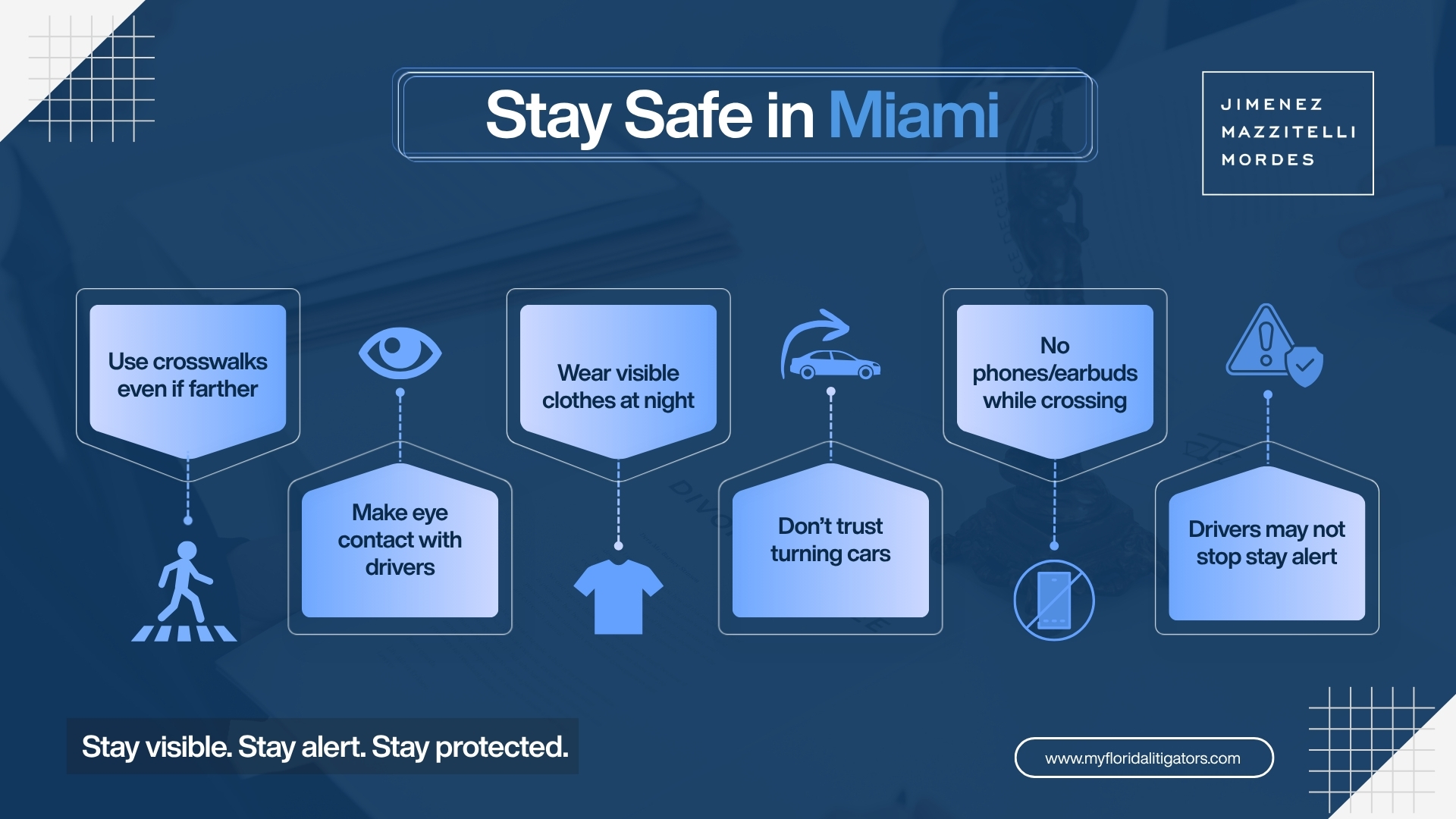
A few practical habits reduce risk meaningfully in Miami.
- Use marked crosswalks even when the nearest one is a longer walk. Drivers look for people at intersections, not mid-block.
- Make eye contact with drivers before stepping off the curb. Assume they have not seen you.
- Wear visible clothing at night. Miami nightlife pushes foot traffic into dim sections of Wynwood, Edgewater, and the Design District after dark.
- Never assume a turning vehicle has seen you, even in a crosswalk with a walk signal.
- Keep phones and earbuds out when crossing major corridors. A driver running a red light is faster than your reaction time.
For tourists unfamiliar with the grid, the best rule of thumb is simple: Miami drivers are not going to stop for you just because the law says they should.
Working Through the Insurance Process
Pedestrian injury cases in Miami-Dade involve at least two insurers, sometimes five or six. Adjusters move fast. They often call within 24 hours, offer a small settlement, and ask for a recorded statement. None of that is for your benefit. The offer is low because the full extent of your injury is not known yet. The recorded statement gets used later to contradict you if your recovery is not linear.
The honest answer is that pedestrian cases are some of the hardest injury cases to handle alone. The fact patterns are usually disputed, the percentages of fault get argued aggressively, and the medical documentation has to be airtight.
This is the work we do every week at JIMENEZ MAZZITELLI MORDES. If you or a family member has been hit while walking anywhere from Homestead up to Aventura, from Doral out to South Beach, reach out before giving any insurance company a statement. The law gives pedestrians rights in Florida, and in Miami, those rights are worth fighting for.
Frequently Asked Questions
Do pedestrians always have the right of way in Florida?
No. Pedestrians have the right of way in marked crosswalks and at intersections. Outside those areas, they usually have to yield to vehicles.What if I were jaywalking when a car hit me?
You can still recover damages in most cases, but your recovery is reduced by your percentage of fault. If you are found more than 50% responsible, you recover nothing.Does my own car insurance help if I were on foot?
Yes. Your Personal Injury Protection coverage follows you as a pedestrian in Florida.How much time do I have to file a pedestrian personal injury claim in Florida?
Two years from the date of the crash under the current state law.What if the driver fled the scene?
Uninsured motorist coverage on your auto policy typically covers hit-and-run pedestrian crashes. Police will also pursue the driver separately.
