
Getting into an accident in Miami can turn your entire day, week, or even year upside down. One minute you’re driving down I-95 or heading through Coral Gables, and the next minute you’re standing on the side of the road, shaken, confused, and wondering what comes next. It’s completely normal to feel overwhelmed. And it’s even more normal to have a flood of questions running through your head, questions about your rights, your medical bills, your insurance, and whether you even need a lawyer. This article breaks down the top questions Miami residents ask after an accident so you can feel a little more in control during what is almost always a stressful and uncertain time.
Miami-Dade County sees roughly 60,000 car crashes every year. That number is staggering. It means that on any given day, about 150 to 170 accidents happen across the county. Some are fender benders in parking lots. Others happen at dangerous intersections or on stretches of highway like the Palmetto Expressway. No matter how minor or serious the crash might be, the questions people have afterward tend to be very similar.
Let’s walk through the most common ones.
What Should I Do Right After the Accident?
This is the first question almost everyone asks, and for good reason. The moments right after a crash can feel chaotic. Your adrenaline is pumping. You might be in pain. You might not even realize you’re injured yet.
Here’s what matters most. First, check yourself and anyone else in the vehicle for injuries. If anyone is hurt, call 911 immediately. Even if nobody seems hurt, it’s still smart to call the police and have them come to the scene. A police report creates an official record of what happened, and that report can become a key piece of evidence later on.
While you’re waiting, move to a safe spot if you can. Take photos of the vehicles, the road, any skid marks, traffic signs, and the overall scene. Exchange information with the other driver, including names, phone numbers, insurance details, and license plate numbers. If there are witnesses, try to get their contact info too.
One thing people often overlook is this: don’t apologize at the scene. It might feel like the polite thing to do, but saying “I’m sorry” can sometimes be used against you later as an admission of fault. Just stick to the facts.
Do I Need to See a Doctor Even if I Feel Fine?
Yes. Absolutely yes. This is one of the biggest mistakes people make after a crash, and it happens all the time. You walk away from the accident feeling okay, maybe a little sore, and you figure you’ll just tough it out. But here’s the thing. Some injuries don’t show symptoms right away. Whiplash, soft tissue damage, and even concussions can take hours or days to fully develop.
There’s also a legal reason to see a doctor quickly. Florida has what’s called the 14-day rule. Under this rule, you need to seek medical treatment within 14 days of your accident to qualify for Personal Injury Protection (PIP) benefits. If you wait longer than that, your insurance company can deny your claim for medical coverage. That’s a hard deadline, and missing it can cost you thousands of dollars.
Beyond the legal angle, having a documented medical record ties your injuries directly to the accident. Without that paper trail, an insurance company can argue that your injuries happened somewhere else or at a different time.
How Does Insurance Work After a Car Accident in Miami?
This is where things can get confusing, especially because Florida’s insurance system is different from most other states, and it’s actually changing soon.
Right now, Florida operates under a no-fault insurance system. That means after a car accident, you file a claim with your own insurance company first, regardless of who caused the crash. Your Personal Injury Protection (PIP) policy covers up to $10,000 in medical expenses and lost wages, but there are limits. PIP covers 80% of medical costs and only 60% of lost wages.
Here’s the catch: PIP doesn’t cover everything. It doesn’t pay for pain and suffering. It doesn’t pay for emotional distress. And it won’t cover the full cost of serious injuries. If your injuries are severe, if they meet what Florida law calls the “serious injury threshold,” then you may be able to step outside the no-fault system and file a claim or lawsuit against the at-fault driver.
Now, there’s a big change on the horizon. Florida is set to repeal its PIP system on July 1, 2026. After that date, the state will shift to a traditional at-fault liability model. Drivers will be required to carry bodily injury liability coverage with minimums of $25,000 per person and $50,000 per accident. This is a major shift. Under the new system, the person who caused the accident will be responsible for paying damages through their insurance. It’s the biggest change to Florida auto insurance in over 50 years, so it’s worth keeping an eye on.
What is the Statute of Limitations for Filing a Claim?
Time is not on your side here. Florida shortened the statute of limitations for personal injury cases in March 2023. It used to be four years. Now, you have just two years from the date of the accident to file a lawsuit.
Two years might sound like plenty of time, but it goes by fast. There’s medical treatment to finish, evidence to gather, negotiations to go through, and potentially a lot of back-and-forth with insurance companies. If you wait too long and miss the deadline, you lose your right to file a lawsuit entirely, no matter how strong your case might be.
For wrongful death claims, the deadline is also two years, but it starts from the date of death rather than the date of the accident.
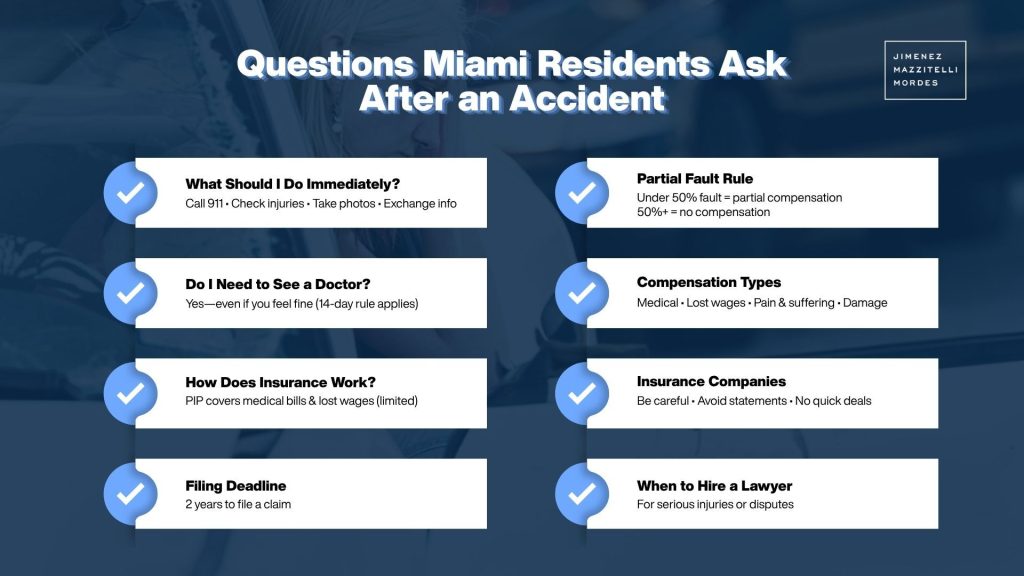
The takeaway? Don’t sit on it. Even if you’re not sure you want to file a claim, at least talk to an attorney early so you understand your options before the clock runs out.
Can I Still Get Compensation if I Was Partially at Fault?
This is a question that comes up a lot, and the answer changed recently. Florida now uses a modified comparative negligence system. What that means in plain English is this: if you were partly responsible for the accident, your compensation gets reduced by your percentage of fault.
So let’s say you were found to be 20% at fault. If your total damages were $100,000, you would receive $80,000 instead.
But here’s the part that trips people up. If you’re found to be 50% or more at fault, you can’t recover anything at all. Zero. That’s a hard cutoff, and it’s a big deal. Under the old system, you could still recover damages even if you were 99% at fault, with your award reduced proportionally. That’s no longer the case.
This rule makes fault determination extremely important. Insurance companies know about this threshold, and they will absolutely try to push your fault percentage as high as possible to reduce or eliminate what they owe you.
What Kind of Compensation Can I Receive?
The types of compensation, or damages, you can pursue after an accident depend on your specific situation. But generally, they fall into a few categories.
Medical expenses are usually the most straightforward. This includes emergency room visits, hospital stays, surgeries, medication, physical therapy, and any future medical care you’ll need because of the accident.
Lost wages cover the income you missed out on while you were recovering. If your injuries affect your ability to work long-term or permanently, you may also be able to claim lost earning capacity.
Pain and suffering are a bit harder to put a dollar amount on because it’s subjective. It covers the physical pain, emotional distress, and reduced quality of life that come with your injuries. Things like not being able to play with your kids, losing sleep from chronic pain, or dealing with anxiety every time you get in a car all fall under this category.
Property damage covers the cost of repairing or replacing your vehicle and any personal belongings that were damaged in the crash.
In cases involving extreme negligence or intentional misconduct, you might also be able to pursue punitive damages. These aren’t meant to compensate you directly. They’re designed to punish the at-fault party and discourage similar behavior in the future.
Should I Talk to the Other Driver’s Insurance Company?
Short answer: Be very careful. The other driver’s insurance adjuster is not your friend. Their job is to protect their company’s bottom line, and that means paying you as little as possible or, ideally for them, nothing at all.
Insurance adjusters are trained to ask questions in ways that can lead you to say things that hurt your case. They might ask you something like, “You’re feeling okay now, right?” and if you say yes because you’re trying to be polite, that statement could be used against you later to argue your injuries aren’t that bad.
If the other driver’s insurance company contacts you, you’re not required to give them a recorded statement. You’re not required to sign any documents. And you’re definitely not required to accept a quick settlement offer. In fact, early settlement offers are almost always lowball numbers that don’t come close to covering the full cost of your injuries.
The safest move is to let an attorney handle communications with the insurance company. Working with a Miami Insurance Litigation Lawyer ensures your rights are protected and helps prevent you from accidentally saying something that could weaken your claim.
When Should I Hire a Personal Injury Attorney?
You don’t need an attorney for every minor fender bender. But if your accident involved any of the following, it’s probably a good idea to at least have a conversation with one: serious injuries that require medical treatment beyond a quick check-up, disputed fault where the other driver or their insurance company is blaming you, an insurance company that’s dragging its feet or offering you a suspiciously low settlement, a hit-and-run where the other driver fled the scene, or an accident involving a commercial vehicle, rideshare driver, or government entity.
A personal injury attorney can help you understand the full value of your claim, handle negotiations, deal with the paperwork, and represent you in court if it comes to that. Most personal injury attorneys in Miami work on a contingency fee basis, which means you don’t pay anything up front. They only get paid if you win your case, and their fee comes out of the settlement or verdict.
If you’re unsure whether your case warrants an attorney, many firms offer free consultations. It doesn’t cost you anything to ask.
What if the Other Driver Doesn’t Have Insurance?
This happens more often than you’d think. Florida has one of the highest rates of uninsured drivers in the country. If the person who hit you doesn’t have insurance or doesn’t have enough insurance to cover your damages, you still have options.
First, your own PIP coverage will kick in for medical expenses and lost wages up to the policy limit. Second, if you carry Uninsured/Underinsured Motorist (UM/UIM) coverage on your own policy, you can file a claim through that. UM/UIM coverage is optional in Florida but highly recommended for exactly this kind of situation.
Without UM/UIM coverage, you could be stuck paying for your own medical bills even though the accident wasn’t your fault. You could still file a lawsuit against the uninsured driver, but collecting money from someone without insurance or assets can be extremely difficult.
How Long Does It Take to Settle a Personal Injury Case?
This is one of those “it depends” answers, and I know that’s not what most people want to hear. But it really does depend on many factors, including how serious your injuries are, how clear the fault is, how cooperative the insurance company is, and whether the case goes to trial or settles out of court.
Simple cases with clear liability and minor injuries might settle in a few months. More complex cases, like those involving multiple parties, serious injuries, or disputed fault, can take a year or more. And if the case goes to trial, add even more time to the timeline.
One thing to keep in mind is that settling too quickly is often worse than waiting. Insurance companies sometimes dangle a fast settlement in front of you because they know you’re stressed about bills. But if you settle before you know the full extent of your injuries, you could end up with far less than you deserve and no way to go back and ask for more.
Your attorney can help you figure out the right timing, balancing the need for compensation now with the goal of getting a fair amount that actually covers your losses.
What if I were in a Pedestrian or Bicycle Accident?
Miami is a tough city for pedestrians and cyclists. In 2024, Miami-Dade County recorded nearly 1,900 pedestrian crashes and over 1,000 bicycle crashes. Dozens of those were fatal. Busy intersections, distracted drivers, and a general lack of protected bike lanes make it risky to get around on foot or on two wheels.
If you’re a pedestrian or cyclist who was hit by a car, you generally have the same right to seek compensation as someone involved in a vehicle-to-vehicle crash. The driver who hit you may be liable for your medical bills, lost income, pain and suffering, and other damages.
One thing that’s specific to Florida: pedestrians and cyclists can actually access PIP benefits through the vehicle that hit them, even if they don’t own a car or have their own auto insurance. If you do own a car and carry PIP coverage, your own policy can also apply.
These cases tend to involve more serious injuries because pedestrians and cyclists don’t have the protection of a vehicle around them. That makes medical documentation and legal representation especially important.
What Evidence Do I Need to Build a Strong Case?
The more evidence you have, the better your chances of getting fair compensation. Start collecting it as early as possible, ideally right at the scene of the accident. Here’s what tends to be most useful.
The police report is usually the foundation of your case. It includes the responding officer’s observations, statements from both drivers, and sometimes a preliminary determination of fault.
Photos and videos from the scene are incredibly helpful. Pictures of vehicle damage, road conditions, traffic signals, injuries, and anything else that tells the story of what happened can make a big difference.
Medical records and bills document the injuries you suffered and the treatment you received. Keep every receipt, every bill, and every doctor’s note.
Witness statements from people who saw the accident can support your version of events. If possible, get their names and phone numbers at the scene.
Your own notes can also be useful. Write down everything you remember about the accident as soon as you can, while details are still fresh. Include the time, weather, road conditions, and anything the other driver said.
Dashcam or surveillance footage, if available, can be powerful evidence. Some businesses near the accident scene may have cameras, and it’s worth asking early before the footage gets recorded over.
What Happens if My Case Goes to Court?
Most personal injury cases in Miami don’t actually go to trial. The vast majority settle through negotiation. But sometimes, the insurance company refuses to offer a fair amount, and going to court becomes the only option.
If your case does go to trial, your attorney will present your evidence, call witnesses, and argue on your behalf in front of a judge or jury. The other side will do the same. The jury will then decide who was at fault and how much compensation you should receive.
Trials can be stressful and time-consuming, but they can also result in higher awards than what the insurance company was willing to settle for. An experienced trial attorney knows how to present a case effectively and can make a real difference in the outcome.
What About Rideshare Accidents?
With Uber and Lyft all over Miami, rideshare accidents have become more common. If you’re a passenger in a rideshare vehicle that gets into an accident, the situation gets a bit more complicated because there are potentially multiple insurance policies involved.
When a rideshare driver is actively carrying a passenger, the rideshare company’s insurance policy usually provides coverage, often up to $1 million. If the driver was logged into the app but hadn’t accepted a ride yet, a different, lower coverage level may apply.
If you were hit by a rideshare driver while driving your own car or walking, you may be able to file a claim against the rideshare company’s insurance in addition to the driver’s personal insurance.
These cases can get tangled up quickly with multiple insurance companies pointing fingers at each other. Having an attorney who understands rideshare accident claims can save you a lot of headaches.
Can I Claim Compensation for Emotional or Psychological Injuries?
Yes, but it’s not always straightforward. Florida law does allow you to seek compensation for emotional and psychological injuries, including things like anxiety, depression, PTSD, and loss of enjoyment of life. These are generally grouped under “non-economic damages.”
The challenge is proving them. Unlike a broken bone that shows up on an X-ray, emotional injuries are harder to document. Medical records from a therapist or psychologist, testimony from family members about how your behavior has changed, and your own detailed account of how the accident has affected your daily life can all help support this part of your claim.
Keep in mind that under the current no-fault system, you typically need to meet the serious injury threshold before you can pursue pain and suffering damages. That threshold requires injuries like permanent scarring, loss of a body function, or a permanent injury.
How Do I Know What My Case Is Worth?
There’s no magic formula for calculating the value of a personal injury case. Every situation is different. But several factors come into play: the severity of your injuries, the total cost of your medical treatment (past and future), how much income you lost and whether your earning capacity has been affected, the level of pain and suffering you’ve experienced, the degree of fault assigned to each party, and the insurance coverage available.
An attorney can give you a realistic estimate of what your case might be worth based on these factors. Be wary of anyone who promises you a specific dollar amount before reviewing the details of your case. That’s usually a red flag.
Why Choosing the Right Attorney Matters in Miami
Miami is a big city with a lot of law firms. Not all of them are the same. When you’re looking for someone to handle your accident case, you want an attorney who actually goes to court, not just one who settles every case quickly. You want someone who knows Miami-Dade County, understands local judges and procedures, and has a track record of getting real results.
At Jimenez Mazzitelli Mordes, we handle personal injury, medical malpractice, insurance litigation, and more across Miami, Hialeah, Coral Gables, Doral, Kendall, Homestead, Fort Lauderdale, and West Palm Beach. Our attorneys have spent years working on both sides, representing insurance companies before switching to fight for injured people. That kind of experience means we know exactly how insurers think, what tactics they use, and how to counter them.
If you’ve been in an accident and you’re not sure where to start, give us a call at 305-548-8750 or visit myfloridalitigators.com for a free consultation. We work on a contingency fee basis, so you don’t pay anything unless we win your case.
Take the First Step
Being in an accident is stressful enough. You shouldn’t have to figure out the legal side on your own. Whether you have one question or twenty, getting answers early makes a real difference. Know your rights, protect your health, and don’t let an insurance company push you into a bad deal.
Miami roads aren’t getting any less busy, and accidents will keep happening. But armed with the right information and the right support, you can get through it and come out on the other side with the compensation you actually deserve.
Frequently Asked Question
How soon should I file a police report after a car accident in Miami?
You should call the police to the scene right away. If the accident involves injuries, deaths, or property damage over $500, Florida law requires that a report be filed. Having an official police report on file protects you if there’s a dispute about what happened.
Is Florida still a no-fault state for car accidents?
Yes, as of now, Florida still operates under a no-fault PIP system. But that’s changing. The PIP requirement is set to be repealed on July 1, 2026. After that, Florida will move to an at-fault bodily injury liability system with new minimum coverage requirements.
What is the 14-day rule in Florida?
The 14-day rule requires you to seek medical treatment within 14 days of your accident to qualify for PIP benefits. If you don’t see a doctor within that window, your PIP insurer can deny your claim for medical coverage.
Can I sue for pain and suffering after a car accident in Florida?
You can, but only if your injuries meet the “serious injury threshold” under current Florida law. That generally means you need to have a permanent injury, serious scarring, or loss of a body function. Minor soft tissue injuries typically don’t qualify.
How much does it cost to hire a personal injury lawyer in Miami?
Most personal injury lawyers in Miami work on a contingency fee basis. That means you pay nothing up front. The attorney’s fee, usually a percentage of the settlement or verdict, is only collected if you win your case. Many firms also offer free initial consultations.
What should I do if the insurance company contacts me after my accident?
Be polite but cautious. You are not required to give a recorded statement or sign anything. It’s generally a good idea to speak with your own attorney before talking to the other driver’s insurance company. Anything you say could be used to minimize your claim.
Do I have a case if I was a passenger in the vehicle?
Yes. As a passenger, you’re seldom considered at fault for the accident. You can file a claim against the at-fault driver’s insurance, and in some cases, against the driver of the vehicle you were riding in if they share responsibility for the crash.
