
Rideshare is woven into daily life in Miami. A quick tap opens a Lyft from Brickell to the airport. A Friday night Uber runs from Wynwood back to South Beach. Tourists hop in and out along Ocean Drive without a second thought. And with that convenience comes a quieter truth most people never think about until it happens to them: Uber and Lyft cars get into wrecks too, and the rules around who pays for what are nothing like a normal fender bender.
If you have been hurt in an Uber or Lyft crash anywhere in Miami-Dade County, this guide walks you through what happens next. It covers Florida’s tiered rideshare insurance system, what to do at the scene, how no-fault PIP applies, and when it makes sense to call a Miami rideshare accident lawyer or Miami personal injury lawyer rather than handle the insurance companies alone.
Why Miami Rideshare Crashes Are a Category of Their Own
A typical car accident usually involves two drivers, two insurance companies, and one straight line from the incident to the claim. A rideshare crash adds three or four more layers. You could have the Uber or Lyft driver’s personal insurance, the company’s commercial policy, a third-party motorist’s coverage, and sometimes a pedestrian’s health insurance or workers’ compensation, all pulling in different directions.
Miami-Dade alone handles tens of thousands of traffic crashes every year, and rideshare density here is stacked heaviest in the places where tourists and locals collide most often: the MIA corridor, the causeways to the Beach, Biscayne Boulevard during a Heat game, and Calle Ocho on weekends. The more vehicles on the road in a small space, the higher the odds. That is just math.
So the first thing to understand is that a Miami rideshare accident claim is not a DIY project. The paperwork is thicker. The deadlines are tighter. And the insurance companies involved have teams whose entire job is to settle these cases for less than they are worth.
Florida’s Three-Tier Rideshare Insurance Rule
Florida treats rideshare coverage in three distinct periods, set under Florida Statute 627.748. Knowing which period applied at the moment of the crash changes everything about how much money is actually on the table.
Period 0 — App off
The driver is just driving their own car, running errands, or picking up their kids. Only the driver’s personal auto policy applies. Uber and Lyft have no skin in the game.
Period 1 — App on, waiting for a ride request
During this window, Uber and Lyft provide limited liability coverage, usually $50,000 per person for bodily injury, $100,000 per accident, and $25,000 for property damage. It is a bridge policy, not a jackpot.
Period 2 and 3 — On the way to pick up a passenger in the car
This is where the big coverage kicks in. Uber and Lyft each carry a $1 million third-party liability policy, plus uninsured and underinsured motorist coverage. If you get rear-ended by a hit-and-run driver while you are in the back seat of an Uber on I-95, that million-dollar policy is why the case is not over before it starts.
The single biggest fight in most rideshare cases is which period the driver was in at the moment of impact. That is decided by app data, timestamps, and pickup records, not by what anyone remembers out loud — which is one of several reasons a Miami rideshare accident attorney pays for themselves quickly.
What to Do After a Rideshare Crash in Miami
The minutes after a crash set the tone for the next eighteen months of paperwork. If you are searching for what to do after a car accident in Miami involving an Uber or Lyft, here is the order that tends to protect people best.
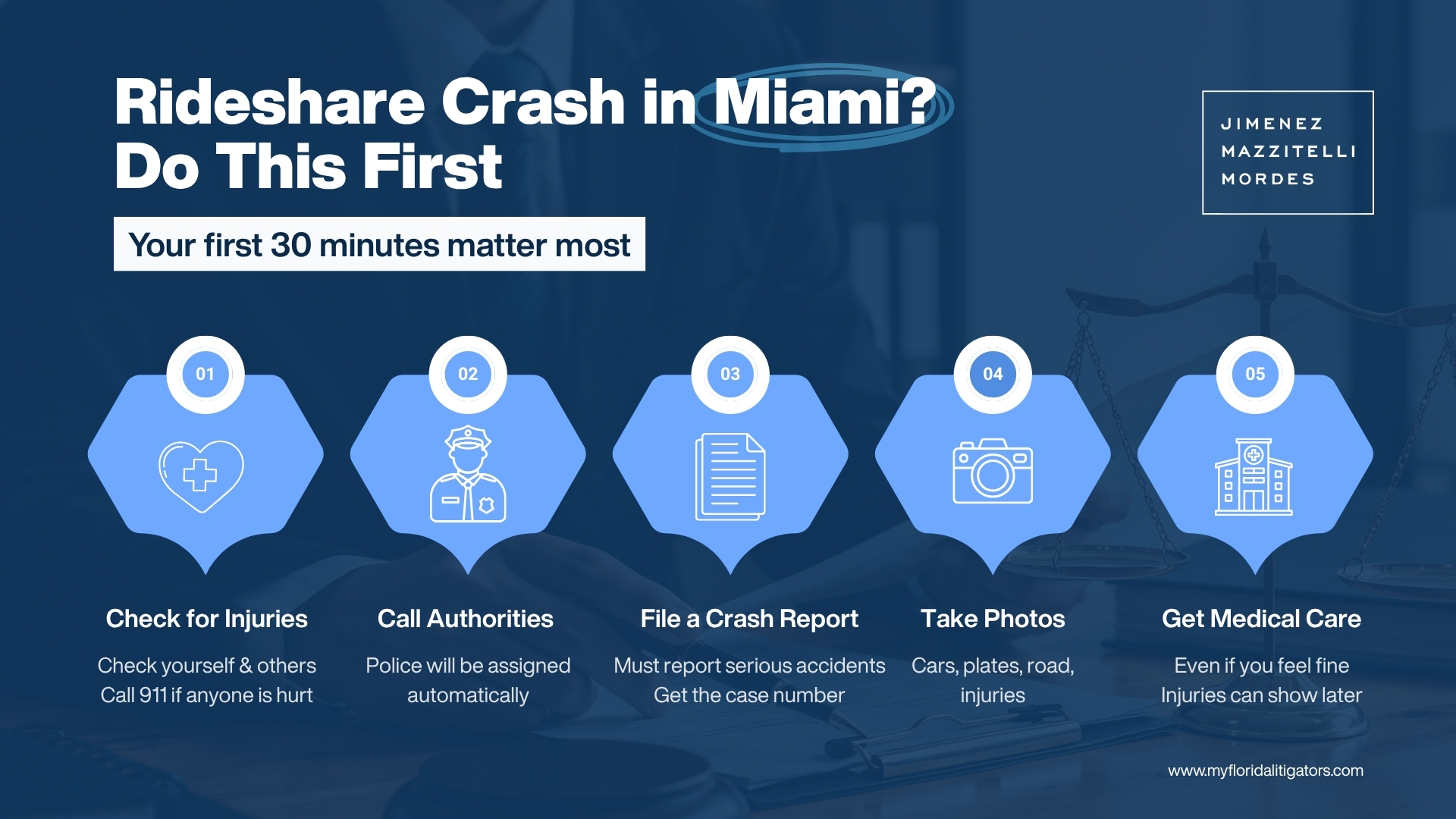
- Check yourself and anyone nearby for injuries. If someone is hurt, call 911 first. In Miami-Dade, that routes you to the correct agency: Miami-Dade Police, City of Miami Police, Miami Beach PD, Coral Gables PD, or whichever jurisdiction you are standing in. Crashes inside municipal limits are handled by the city force; crashes in unincorporated areas go to MDPD.
- Get the crash report filed on scene if at all possible. Under Florida law, any accident involving injury, death, or property damage where a vehicle has to be towed must be reported. Officers will generate a Florida Traffic Crash Report and a case number. Write that number down. You will need it later when you order the long-form report from the Florida Department of Highway Safety and Motor Vehicles.
- Take photos. Everything. The cars, the plates, the street signs, the traffic light you were stopped at, the skid marks, the glass on the asphalt, and your own visible injuries. Get the rideshare driver’s license plate and the trip details on your phone before you close the app. That trip receipt is gold later when the insurance company tries to argue the driver was not on the clock.
- Get checked out medically, even if you feel fine. Adrenaline masks soft-tissue injury for hours. Whiplash, concussions, and disc herniations often do not show symptoms until the next morning, and by then, an insurance adjuster can argue the injury came from somewhere else.
Florida No-Fault PIP and Why Miami Is Different
Florida is a no-fault state for auto insurance. Every registered vehicle is required to carry $10,000 in Personal Injury Protection coverage. PIP pays 80% of your medical bills and 60% of lost wages up to the policy limit, no matter who caused the crash.
Here is the catch that trips up rideshare passengers all the time: if you own a car, your own PIP is usually the first stop, even when you are hurt in someone else’s vehicle. If you do not own a car, the PIP of the vehicle you were riding in steps up. Uber and Lyft drivers carry PIP on their personal auto policy, but many carriers specifically exclude rideshare use, so this is an area where claims get bounced around like a ping-pong ball.
You also have a strict 14-day window to see a medical provider after the crash. Miss that window and you forfeit your PIP benefits entirely. Not reduced. Forfeited. This single rule ruins more Miami personal injury cases than almost any other.
Does Full Coverage Apply in an Uber or Lyft Crash?
One of the most common questions people type after a rideshare crash is whether their full coverage auto policy covers an at-fault accident when an Uber or Lyft was involved. The short answer is that full coverage usually includes collision and comprehensive, which covers damage to your own car regardless of fault. But full coverage does not automatically include bodily injury liability at high limits, and it does not replace the rideshare company’s commercial policy.
If you were the passenger, the rideshare company’s $1 million policy is likely the primary source of recovery during an active trip. If you were the driver of a car that was hit by an Uber or Lyft, your full coverage collision handles your vehicle, but your bodily injury claim goes against the rideshare company’s liability policy. A Miami rideshare accident lawyer can walk you through which policy pays what in your specific situation — it is rarely obvious from the paperwork alone.
Who Pays When a Rideshare Driver Causes the Crash
If the Uber or Lyft driver was at fault and had a passenger in the car, the company’s $1 million policy is usually the primary source of recovery. That covers medical bills, lost income, pain and suffering, and long-term care if the injury is serious.
If the driver was waiting for a ride request in Period 1, the coverage drops sharply to that $50,000 per person limit, which sounds like a lot until you see the bill for a single helicopter trip to Jackson Memorial.
For drivers hit by an at-fault Uber or Lyft driver in another car, or for pedestrians struck in a crosswalk along Coral Way or near the Arsht Center, the same rideshare policies apply as long as the company’s driver was on-app. Pedestrians hit by Uber drivers in the Brickell grid or along South Beach sidewalks are entitled to the same recovery pool as passengers inside the vehicle — a fact most people never realize.
When Another Driver Is at Fault
If the Uber or Lyft was rear-ended by a third driver, that third driver’s liability insurance pays first. In Florida, though, bodily injury liability is not mandatory for every driver, which means roughly one in four motorists on Miami roads carries nothing beyond basic PIP and property damage. When the at-fault driver is underinsured, Uber and Lyft’s uninsured motorist coverage steps in during Periods 2 and 3, up to $1 million. This is a benefit most riders do not know exists, and it is one of the reasons legal options after a Miami car accident involving a rideshare driver are often broader than people assume.
Miami Rideshare Crash Hotspots
A few Miami-Dade corridors show up in crash data again and again when rideshare is involved. The MIA pickup loops near terminals D and E see constant stop-and-go collisions. The causeways, especially MacArthur and Julia Tuttle, generate high-speed impacts during shift changes. The Brickell grid, with its narrow one-way streets and pedestrian-heavy crosswalks, produces low-speed but injury-prone crashes at nearly every corner between 7th and 15th Street. Ocean Drive, Washington Avenue, and Collins along South Beach are notorious for tourist-involved rideshare incidents, especially between Thursday and Sunday nights.
If your crash happened in any of these zones, expect dashcam footage, traffic camera pulls, and business surveillance to matter heavily in the outcome.
Minor Car Accident in Miami Involving a Rideshare: Still Worth a Claim?
People often assume a minor car accident in Miami — a low-speed rear-end at a light, a sideswipe in a parking structure — is not worth pursuing. With a rideshare vehicle involved, that calculus changes. The $1 million policy opens up medical coverage that most people do not have access to through their own auto insurance, and soft-tissue injuries that seem minor at first sometimes turn into months of physical therapy. Filing a claim early preserves your options. Not filing rarely helps anyone except the insurance carrier.
The Miami Rideshare Accident Claim Process Step by Step
- Report the crash and get medical attention inside the 14-day PIP window.
- Preserve the rideshare trip receipt, the crash report number, and all photo evidence.
- Notify the rideshare company through the app’s safety or claims section.
- File a PIP claim with your own insurer.
- Track every medical appointment, every missed workday, and every out-of-pocket expense.
- Before signing anything or giving a recorded statement to any insurance adjuster, consider speaking with a personal injury attorney familiar with Miami-Dade County litigation.
Florida follows a modified comparative negligence rule now. If you are found more than 50% at fault for the crash, you recover nothing. Even a small assignment of fault chips away at the payout. Rideshare cases almost always involve some fight over percentages, and the difference between 49% and 51% is a cliff, not a slope.
Why the Timeline Matters for Miami Car Accident Lawsuits
Florida cut its personal injury statute of limitations in 2023 from four years to two. That clock starts the day of the crash. Two years sounds like a lot until you realize how long settlement negotiations drag on, how many rounds of medical records have to be pulled, and how often insurance companies wait out the clock, hoping claims expire.
Pedestrians struck in crosswalks, cyclists clipped by rideshare doors opening on Biscayne, passengers hit by distracted Uber drivers near Dadeland: every one of these cases has the same deadline. Waiting is the most expensive thing you can do, and the shorter statute of limitations is a major reason a Miami car accident lawsuit involving a rideshare should be evaluated early.
Spanish-Speaking Drivers and Passengers in Miami
Miami is a bilingual city, and a large share of rideshare drivers and passengers are more comfortable handling legal matters in Spanish. Rideshare claims are not easier just because the driver or rider is a native English speaker — the paperwork, the adjuster calls, and the recorded statements all carry the same risk. If you prefer to work with a Spanish-speaking car accident lawyer in Miami, ask up front. A firm serving Miami-Dade properly will have bilingual staff handling intake and case management from day one.
Final Thoughts on Protecting Yourself
Rideshare companies spend enormous resources making sure claims against them settle fast and small. They have internal adjusters, outside counsel, and software that flags any case likely to be worth more than their opening offer. You do not need to fight that fight alone, and you do not need to accept the first number that lands in your inbox.
At JIMENEZ MAZZITELLI MORDES, we have handled the messy end of rideshare cases across Miami-Dade, from passengers hurt on airport runs to pedestrians struck near Brickell Avenue, and we know how the coverage layers actually work in practice. If you have been in a crash involving an Uber or Lyft anywhere in Miami, get medical care first, preserve everything you have, and reach out to a Miami personal injury lawyer before you talk to any insurance adjuster. The phone call is free. The wrong first move is not.
Frequently Asked Question
Does Uber or Lyft cover me if I am hit by one of their drivers as a pedestrian?
Yes, as long as the driver was logged into the app. The coverage amount depends on whether the driver was waiting for a ride, heading to pick one up, or had a passenger on board.What if the rideshare driver had the app off when they hit me?
Only the driver’s personal auto policy applies. Uber and Lyft step away completely in that case.How long do I have to file a personal injury claim in Florida after a rideshare crash?
Two years from the date of the crash for most injury cases under current Florida law.Is the process different from what to do after a regular car accident in Miami?
The scene steps are similar — call 911, file a report, get checked out medically — but a rideshare case adds the extra step of preserving your trip receipt and notifying the rideshare company through the app. That trip record determines which insurance policy applies.Do I have to use my own PIP coverage even if I was just a passenger?
Usually, yes, if you own a registered vehicle in Florida. Your PIP is generally first in line regardless of whose car you were riding in.
