
When you’re driving down a Florida highway or navigating through a busy intersection in Miami, the last thing on your mind is getting into an accident. But car crashes happen—thousands of them across the state every year. And when they do, understanding Florida car accident laws becomes essential. Whether you’re dealing with a minor fender-bender or a serious collision, knowing your rights and responsibilities can make a real difference in how things play out.
The legal landscape surrounding car accidents in Florida is pretty different from what you might expect if you’ve lived in other states. The Sunshine State has unique rules about fault, insurance, and how damages are handled. That’s why it’s so important to understand these laws before you ever need them. This guide walks you through the essentials, so you’re prepared if the unexpected happens on the road.
Florida’s Fault-Based System
Florida operates under what’s called a “fault” system when it comes to car accidents. This means that whoever caused the accident is responsible for paying damages to the other party. Sounds straightforward, right? But there’s actually more nuance here than you might think.
In a fault-based system, the driver who was negligent (careless or reckless) has to cover the costs of injuries and property damage they caused. Their insurance company typically handles these payments, up to the policy limits. However, this doesn’t mean things are always simple or quick. Insurance companies often investigate accidents thoroughly, collect evidence, get statements from witnesses, and sometimes dispute who was actually at fault.
What makes Florida interesting is that you can technically sue another driver directly for damages, even if their insurance company refuses to pay. You’re not locked into dealing with the insurance company—if they deny your claim or don’t offer enough, you have the right to take legal action. This is an important distinction because some states are different.
Understanding Negligence and Liability
At the heart of any car accident case in Florida is the question of negligence. Negligence means someone failed to exercise reasonable care while driving, and that failure caused an accident. Breaking it down, four elements need to be present:
Duty of care is the first one. Every driver has a legal duty to operate their vehicle safely and follow traffic laws. This is pretty universal—you have to watch the road, follow speed limits, obey traffic signals, and refrain from reckless behavior.
Breach of duty happens when a driver fails to meet that standard. This could be texting while driving, running a red light, speeding, failing to yield, or driving while impaired. Basically, it’s when someone violates that duty of care.
Causation means the breach directly caused the accident. If someone was texting but they would have hit you anyway because you merged into their lane suddenly, the causation argument gets murkier.
Damages are the actual losses you suffered: medical bills, property damage to your car, lost wages from missing work, or pain and suffering.
All four elements need to be proven for someone to be held liable in Florida. If you can’t establish all four, you might still recover damages, but the process becomes more complicated.
Comparative Negligence: When Both Drivers Share Blame
Here’s a scenario that comes up often: both drivers were partially at fault. Maybe one person was speeding, and the other wasn’t paying attention. In Florida, the state recognizes comparative negligence, which means both parties can be partially responsible.
Florida follows what’s called “pure comparative negligence.” This means you can recover damages even if you were mostly at fault, as long as you weren’t 100% responsible. So if you were 80% at fault and the other driver was 20% at fault, you could potentially recover 20% of the damages. However, any recovery you get is reduced by your percentage of fault.
This rule can work in your favor if you bear some responsibility but weren’t the primary cause of the accident. It also means the other person’s insurance company might argue you share blame to reduce their payout.
Insurance Requirements in Florida
Florida law requires every driver to carry minimum liability insurance. The state-mandated minimums are:
$10,000 for property damage liability (damage to other people’s property), $10,000 for personal injury protection, also called PIP, $10,000 for bodily injury to one person (or $20,000 per accident)
These are the absolute floor. For a state as populated as Florida with millions of drivers and congested roadways, especially in urban areas, these minimum limits are actually pretty low. Most people should carry higher limits if they can afford it. If you cause an accident and your damages exceed your policy limits, the other person can pursue personal injury claims against you directly.
What’s unique about Florida is the Personal Injury Protection requirement. This is a no-fault benefit that covers your own medical bills and lost wages regardless of who caused the accident, up to the limit you carry. Even if you were at fault, your own PIP covers your immediate medical needs.
The No-Fault Insurance Aspect
Wait, didn’t we just say Florida is a fault-based state? Yes, but Florida actually combines a fault system with some no-fault features, which confuses people. Let me explain how this works.
The no-fault part applies to Personal Injury Protection (PIP). When you get hurt in an accident, your own insurance company pays your medical bills and lost wages through your PIP coverage, regardless of who caused the crash. You don’t need to prove the other driver was at fault to receive these benefits. This is a huge benefit because you get paid right away without waiting for a fault determination.
However, you can only step outside the no-fault system and sue the at-fault driver for additional damages if you meet certain thresholds. These thresholds include serious injuries like significant permanent scarring, loss of bodily function, or injuries requiring continuous care. If you don’t meet these thresholds, you’re stuck with your PIP benefits and can’t sue for additional pain and suffering.
This is a critical point many accident victims miss. Just because someone else caused your accident doesn’t automatically mean you can sue them for pain and suffering. You need to have significant injuries that meet Florida’s threshold requirement.
The Statute of Limitations: Time Limits for Filing
Here’s something you absolutely need to know: there are time limits for filing lawsuits in Florida following a car accident.
For personal injury claims (physical injuries), you have four years from the date of the accident to file a lawsuit. That might sound like plenty of time, but you should act much sooner. Evidence fades, witnesses move away, memories get fuzzy, and the other party’s insurance adjuster needs time to investigate. Waiting too long weakens your case significantly.
For property damage claims (damage to your vehicle), you have five years, though again, you should pursue this promptly to protect your rights.
There’s also something called the “discovery rule,” which can extend the timeline in certain circumstances—like if your injury didn’t immediately appear but showed up later. However, don’t count on this. The statute of limitations is meant to ensure cases are resolved while evidence is fresh and memories are clear.
Missing these deadlines means your case gets dismissed, regardless of how strong it might have been. It’s one of those hard legal rules with no wiggle room.
Damages: What You Can Recover
If you win an accident claim in Florida, what exactly can you recover? There are different categories of damages, and understanding them helps you know what you’re entitled to pursue.
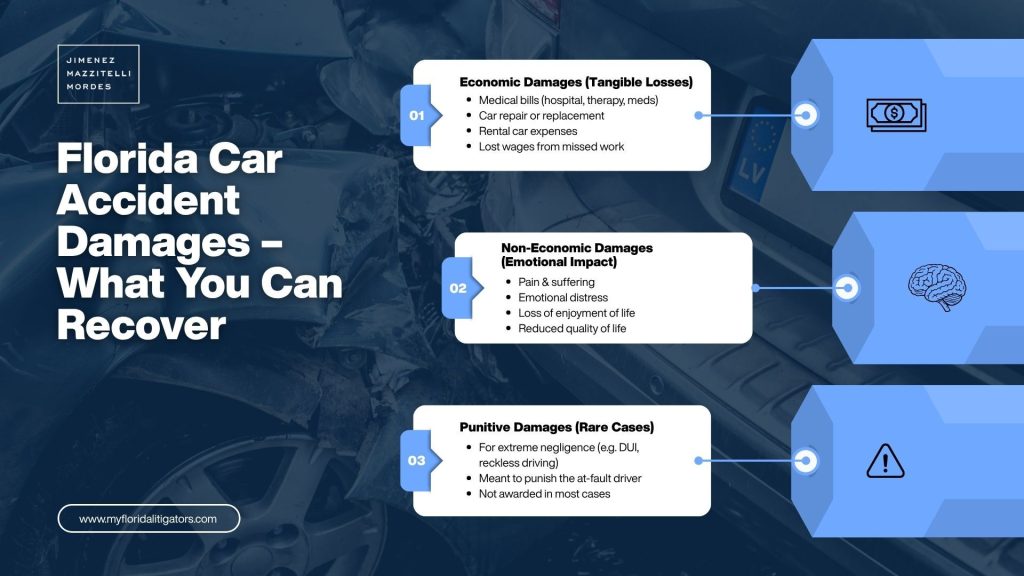
Economic damages are straightforward: they’re the actual out-of-pocket costs you incurred. This includes medical bills, car repair costs, car rental fees while yours is being fixed, lost wages from missing work, and other direct expenses. You need receipts or documentation for these, which is why it’s so important to keep records of everything.
Non-economic damages are trickier because they don’t have a dollar value attached naturally. These include pain and suffering, emotional distress, loss of enjoyment of life, and reduced quality of life. There’s no formula for calculating these—it’s subjective. Insurance adjusters, juries, and judges might all come up with different numbers.
Punitive damages are rare in car accident cases and typically only apply if the at-fault driver engaged in gross negligence or intentional misconduct—like causing an accident while driving drunk or being a habitual reckless driver. These are meant to punish the wrongdoer and deter similar behavior, not just compensate the victim.
Many accident victims don’t realize they can pursue non-economic damages, and that’s where a significant portion of recovery value lies, especially in serious injury cases.
What to Do Immediately After an Accident
Understanding the law is one thing, but knowing what to do in those chaotic moments right after a crash is another.
First, ensure everyone’s safety. If the accident is minor and both cars can move, get to the side of the road to avoid blocking traffic and risking further accidents. If there are injuries or the accident is serious, call 911 immediately. Don’t move people with serious injuries unless they’re in immediate danger.
Call the police. In Florida, you’re required to report accidents that involve injury or property damage above $500. Even if damage seems minor, getting a police report is valuable. The report creates an official record of what happened, and the officer’s observations can be helpful later.
Exchange information with the other driver: names, phone numbers, addresses, driver’s license numbers, license plate numbers, and insurance information. Be polite and stick to facts. Don’t admit fault or apologize in a way that sounds like you’re taking responsibility—”Sorry, are you okay?” is fine; “I’m sorry, this was my fault” is not.
Take photos and videos of the accident scene: the damage to both vehicles, the overall scene, traffic signs, road conditions, and weather, if it was a factor. Photographs are invaluable evidence.
Get contact information from witnesses. Their independent accounts can be crucial, especially if fault is disputed.
Notify your insurance company promptly. This is typically required by your policy. Give them the facts without admitting fault.
Seek medical attention even if you feel fine. Some injuries don’t show up immediately, and having a medical record establishes a link between the accident and your injuries.
When to Involve an Attorney
This is where it gets practical. Not every car accident requires hiring an attorney—sometimes insurance claims settle quickly and fairly. But several scenarios call for legal help.
If you’ve suffered serious injuries, you should absolutely talk to an attorney. Serious injuries typically mean more serious damages, and the insurance company will be looking hard to minimize its payout. You need someone in your corner who understands how to value your claim properly.
If the insurance company denies your claim or offers far less than you believe you’re entitled to, that’s a sign to get legal counsel. Insurance adjusters sometimes lowball offers, hoping you’ll accept out of desperation or lack of knowledge about what your case is worth.
If you’re facing a lawsuit, you need an attorney immediately. This isn’t something to handle alone.
If the other driver was uninsured or underinsured, you might be able to tap into your own uninsured motorist coverage, but navigating this requires legal knowledge.
If liability is seriously disputed—meaning it’s unclear who was at fault—getting an attorney helps protect your rights while the investigation happens.
If there are multiple parties involved (a third-party passenger, another vehicle that caused the original crash, etc.), things get complicated fast, and you need professional help.
The key question: is the potential recovery significant enough to warrant attorney fees? If we’re talking about a few thousand dollars and liability is clear, you might be fine handling it yourself. If we’re talking about tens of thousands or more, or if there’s any complexity, an attorney’s expertise typically pays for itself.
Local Considerations in Florida
Florida’s car accident laws apply statewide, but local conditions matter. Miami and Tampa have higher accident rates due to dense traffic and weather conditions. Rural areas of the state have different patterns. If you’re in a major metropolitan area, accident investigations might be more thorough and insurance companies more experienced in handling claims.
Florida’s weather also affects accidents. Rain, fog, and hurricane season create additional hazards and can factor into negligence arguments. An experienced attorney familiar with your local area understands these regional factors.
Finding the Right Legal Help
If you’ve been in a serious car accident in Florida and need legal representation, you want someone who knows state law inside and out. At JIMENEZ MAZZITELLI MORDES, we’ve helped countless accident victims navigate this process and recover what they’re entitled to. We handle everything from initial investigation through settlement or trial, so you can focus on recovery while we handle the legal side.
Final Thoughts
Florida car accident laws might seem complicated, but the core principles are straightforward: someone has to be at fault, they’re responsible for damages, and you have specific timeframes and thresholds to work with. The better you understand these rules, the better decisions you can make if you’re ever involved in an accident.
The most important thing to remember is to act quickly, gather evidence, protect your rights, and don’t hesitate to get professional help when you need it. A car accident can be overwhelming, but you don’t have to navigate it alone. We’re here to help if you need guidance.
Frequently Asked Question
How long do I have to file a lawsuit for a car accident in Florida?
You have four years from the accident date to file a personal injury lawsuit and five years for property damage claims. However, you should act much sooner to preserve evidence and witness testimony.
Can I sue if I was partially at fault for the accident?
Yes. Florida allows comparative negligence, meaning you can recover damages even if you were partially at fault, as long as you weren’t 100% responsible. Your recovery is reduced by your percentage of fault.
What’s the difference between PIP and liability insurance?
Personal Injury Protection (PIP) covers your own medical bills and lost wages regardless of fault. Liability insurance covers damages you cause to others. Both are required in Florida.
Do I have to talk to the insurance company?
You must notify your own insurance company per your policy requirements. However, you should be cautious about detailed statements to the other person’s insurance company without legal counsel, especially if injuries are serious.
What if the at-fault driver was uninsured?
You can file a claim under your own uninsured motorist coverage (if you have it) to cover your damages. This is another reason to carry higher limits.
